Patients researching vision correction procedures like LASIK or LASEK quickly encounter a dense array of technical terms—wavefront, topography-guided, Contoura Vision, Epi-LASIK, and Opti-LASIK. Sorting through competing clinical offerings to determine the best approach for individual eyes can feel overwhelming.
Much of this confusion stems from rapid technological advancement over recent decades. The benchmark for successful corneal refractive surgery has evolved from simply correcting a refractive prescription on an eye chart to delivering crisp, comfortable visual quality.
The Shift Toward Visual Quality
Historically, vision correction aimed primarily for a 1.0 (20/20) result on the standard eye chart, defining success by matching the patient's spectacle prescription. Today, eye care specialists measure outcomes by visual quality—evaluating how clearly and comfortably patients see without experiencing nighttime glare, halos, starbursts, or reduced contrast sensitivity. The focus has expanded from making objects visible to optimizing overall visual satisfaction.
Understanding this evolution involves examining two distinct aspects of refractive procedures: the surgical method used to alter the cornea, and the diagnostic measurement used to calculate the laser treatment pattern.
By surgical method, LASIK creates a thin corneal flap before using an excimer laser to ablate the underlying stromal tissue. Conversely, LASEK and Epi-LASIK avoid creating a flap altogether, gently removing or shifting only the thin outer corneal epithelium before applying the laser. While LASIK generally offers faster post-operative recovery, surface ablation techniques like LASEK or Epi-LASIK are preferred when preserving maximum corneal tissue is required.
From Prescription Correction to Topography-Guided Customization
The evolution of laser mapping techniques tells a parallel story. Early procedures corrected only basic myopia and astigmatism prescriptions. To address subtle optical imperfections known as higher-order aberrations—which cause nighttime glare and distortion that glasses cannot fix—surgeons developed wavefront technology. Wavefront-optimized methods apply standardized ablation profiles, whereas wavefront-guided techniques incorporate a patient's individual aberration measurements.
More recently, Contoura Vision advanced this concept through topography-guided mapping. Using the cornea's detailed surface topography as a blueprint, Contoura Vision measures and integrates both optical aberrations and surface contours across more than 22,000 unique points, marking a complete shift toward personalized visual customization.
Surgical applications using Contoura Vision are tailored based on corneal thickness and patient lifestyle. Procedures like Contra Epi-LASIK utilize surface ablation without a corneal flap, preserving greater tissue volume and offering superior resistance to physical impact—making them suitable for patients with thin corneas, high myopia, or active lifestyles, albeit requiring a three- to five-day epithelial recovery window. Conversely, Contra Opti-LASIK uses a femtosecond laser to create a corneal flap combined with wavefront-optimized ablation, providing minimal discomfort and rapid visual recovery for patients facing tighter time constraints.
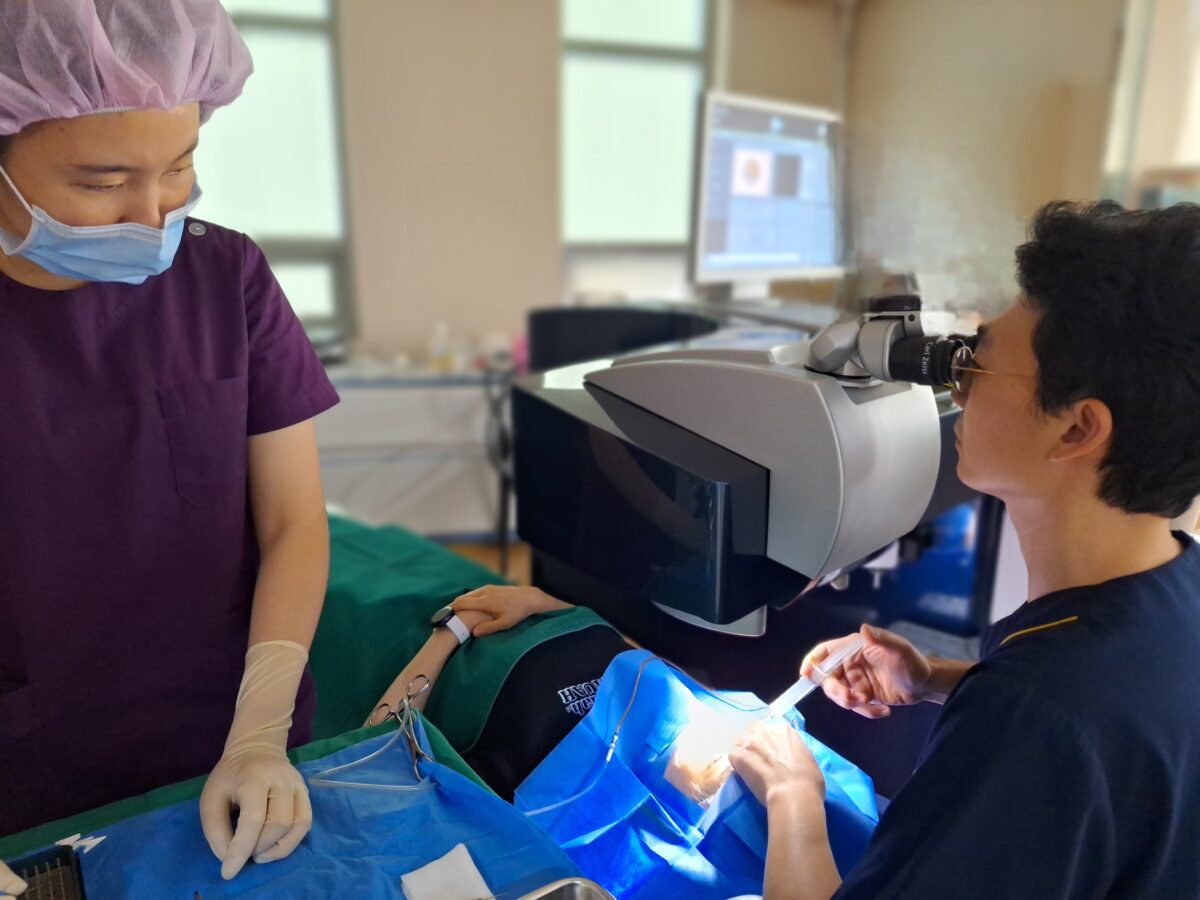
Evaluating Dry Eye and Ocular Surface Health
Selecting the ideal procedure depends heavily on comprehensive pre-operative screening, particularly regarding dry eye disease—a frequent concern among prospective candidates and heavy digital screen users.
"A substantial proportion of dry eye patients suffer not only from deficient tear volume but also from evaporative dry eye, where the meibomian oil glands along the eyelid margins become clogged, causing tears to evaporate rapidly," said Kwon Sang-min, director of Busan Jeonggeun Eye Hospital and an ophthalmologist. "When preoperative testing reveals underlying dry eye, incorporating Intense Pulsed Light (IPL) laser therapy alongside artificial tears can significantly improve outcomes."
IPL therapy delivers specific light wavelengths to the periocular area, melting hardened secretions within the meibomian glands and reducing surrounding microvascular inflammation to support healthy lipid secretion in quick five- to ten-minute sessions.
Ultimately, choosing between LASIK, LASEK, or newer topography-guided options should not depend on marketing terminology alone. Success relies on precise diagnostic mapping of corneal thickness, refractive error, topography, and tear-film stability to tailor a safe, effective surgical plan. "A comprehensive evaluation of corneal thickness, myopia, astigmatism, corneal topography, and meibomian gland health directly dictates surgical results and recovery speed," Kwon added.