In one hand, a sun umbrella; in the other, a handheld fan. If you could carry only one on a sweltering summer day, which should you choose?
If you have to walk under direct sunlight, the sun umbrella should always come first. While a handheld fan creates airflow, it cannot stop the intense heat that sunlight directly transfers to your body.
Block Radiant Heat First
Direct sunlight feels exceptionally punishing because you are absorbing more than just the ambient air temperature. Sunlight delivers radiant heat—thermal energy transmitted directly to your skin and clothing—which a handheld fan cannot block. A fan primarily works by helping sweat evaporate, which provides a cooling sensation, but it does not stop heat from entering the body in the first place.
A sun umbrella, by contrast, physically blocks direct solar radiation. Beyond shading the head and face, it also casts a protective shadow over the shoulders and upper body. In measurements conducted by Japanese researchers under intense sunlight, using a sun umbrella reduced the heat-stress index—a measure combining air temperature, humidity, solar radiation, and wind—by an average of 1.8 degrees Celsius at head height compared to standing in unshaded light.
While hats also offer protection, they shade a significantly smaller area. Furthermore, if a hat lacks proper ventilation, heat can become trapped around the head. For prolonged outdoor walking, a sun umbrella or UV-blocking parasol provides a clear advantage.
A Handheld Fan Is Not an Air Conditioner
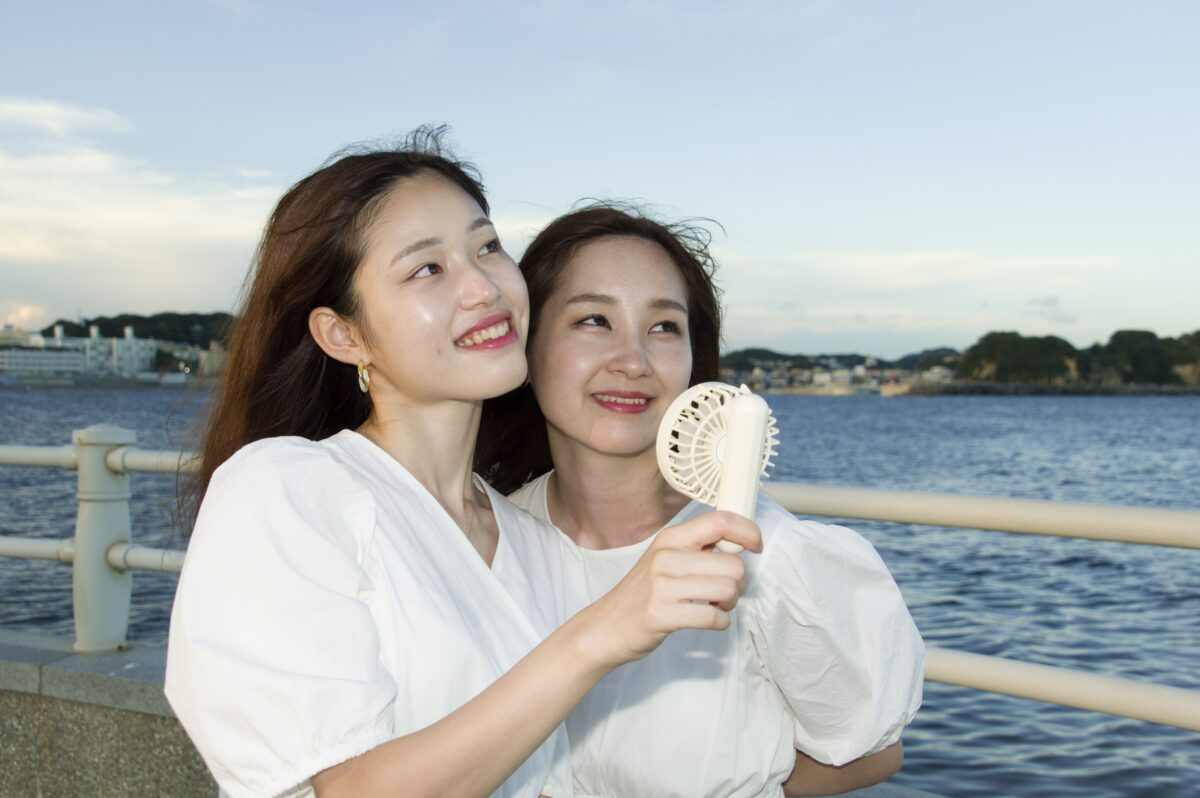
A handheld fan does not lower the temperature of the surrounding air. Instead, it blows air across the skin to accelerate sweat evaporation. As sweat evaporates, it draws heat away from the body, providing relief indoors or in shaded areas.
However, the narrow airflow from a portable fan reaches only the face and neck, making it ineffective as a full-body cooling method. In high humidity, sweat cannot evaporate efficiently, sharply reducing the fan's effectiveness. Worse, on excessively hot days, blowing hot air onto the skin can actually increase body temperature.
The World Health Organization (WHO) warns that when temperatures surpass 40 degrees Celsius (104 degrees Fahrenheit), fan airflow can actually heat the body further. Similarly, the U.S. Centers for Disease Control and Prevention (CDC) notes that fans alone cannot prevent heat-related illness during extreme heat events, recommending air-conditioned environments instead. Older adults, individuals with chronic health conditions, and those who are dehydrated must be particularly cautious.
Shade First, Fan Second
The most effective strategy for outdoor heat defense is a layered approach: block direct sunlight with a sun umbrella first, then use a handheld fan to assist sweat evaporation. Frequent hydration and periodic rest in shaded or air-conditioned spaces further lower the risk of heat-related illness.
According to the Korea Disease Control and Prevention Agency (KDCA), South Korea recorded 4,460 cases of heat-related illness in 2025—a 20.4% increase from 3,704 cases in 2024—including 29 estimated deaths. Notably, roughly 30% of the annual total (1,341 cases) occurred during a single 12-day stretch between July 20 and July 31.
While a sun umbrella is a critical tool, it is not a complete shield against extreme heat. For extended outdoor activities—such as golf, soccer, open-air events, or physical labor—schedules should be shifted to early morning or late afternoon whenever possible. If working or exercising between noon and 5 p.m. is unavoidable, taking structured breaks in shaded or air-conditioned spaces is essential.

"Shade structures and UV-blocking umbrellas are the simplest yet most reliable preventive measures that save lives during summer outdoor activities," said Kim Ho-jung, a professor of emergency medicine at Soonchunhyang University Bucheon Hospital. "Anyone engaging in outdoor activities during extreme heat must strictly follow heat illness prevention guidelines."
If symptoms such as dizziness, headache, nausea, muscle cramps, or excessive sweating occur, immediately cease all activity. Move the person to a cool location, loosen tight clothing, and cool their body down.
Offer water or sports drinks slowly only if the individual is fully conscious. If their consciousness is impaired or if they collapse, do not attempt to force fluids; call emergency services (119) immediately.
When packing for a sunny day, do not rely solely on a portable fan. The proper sequence for preventing heat-related illness is simple: block direct sunlight first, use airflow to aid sweat evaporation second, and maintain steady hydration and rest throughout the day.