A research team led by Kim Wan-wook at the Catholic University of Korea College of Medicine has successfully transferred a novel antibody technology for treating autoimmune diseases, including rheumatoid arthritis and multiple sclerosis, to global biotech firm Celltrion. While the technology is currently in its early stages—with therapeutic efficacy so far demonstrated in animal models—Celltrion plans to actively spearhead follow-up research, development, and eventual commercialization.
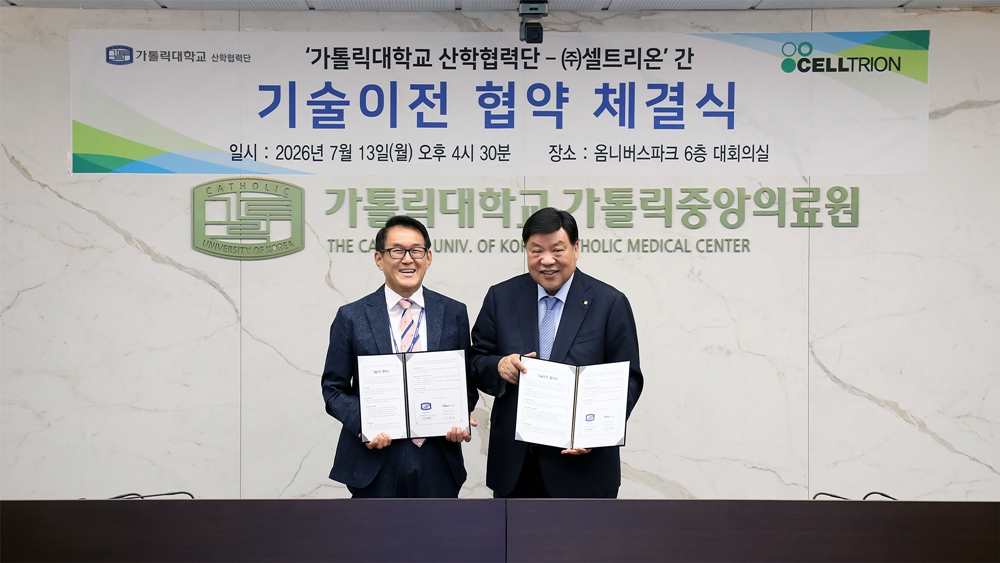
The Catholic University of Korea College of Medicine announced on July 14 that Kim Wan-wook's research team finalized the technology transfer agreement with Celltrion on July 13, licensing a new monoclonal antibody-based treatment technology for autoimmune conditions.
While the exact contract value and specific financial terms remain confidential, university officials stated that the agreement represents the largest single technology transfer to date between a South Korean medical school and a biotechnology company. However, without officially disclosed figures, direct comparisons to past industry agreements are difficult to confirm.
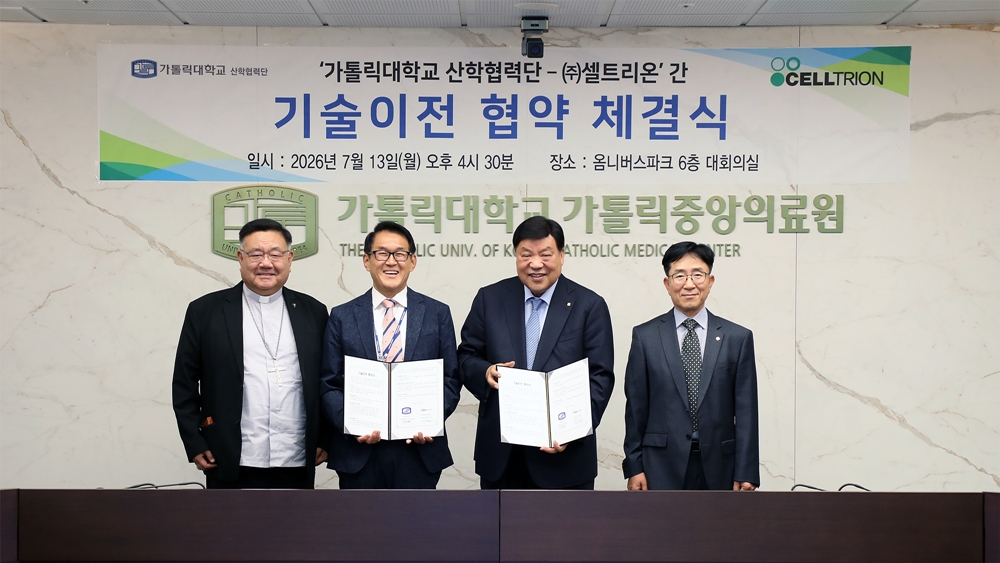
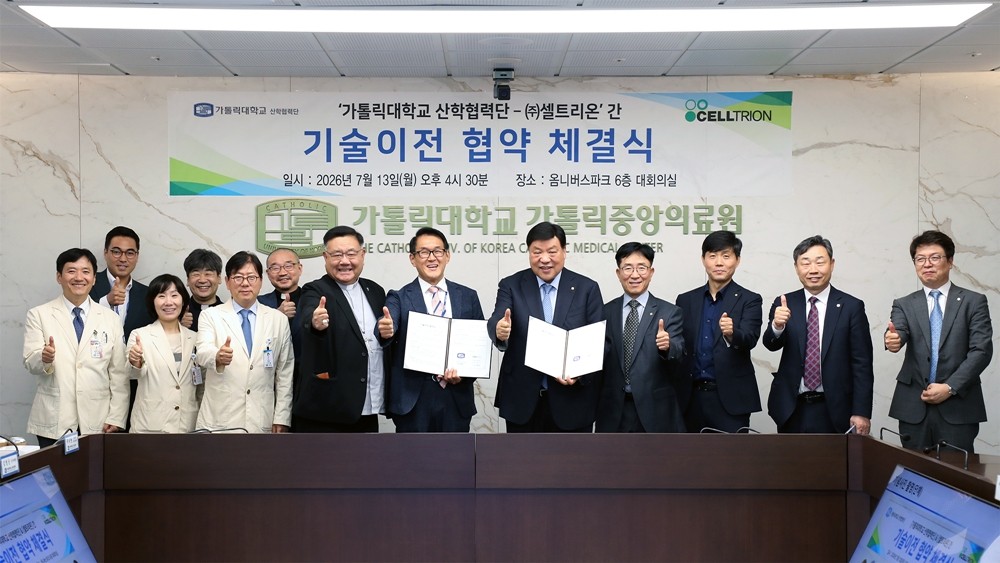
A formal signing ceremony was held on July 13 at the Catholic University Omnibus Park in Seocho-gu, Seoul. The event was attended by key leadership from both organizations, including Lee Kyung-sang, standing director of the Catholic Educational Foundation; Kim Wan-wook, head of the Catholic University of Korea’s Industry-Academic Cooperation Foundation; Lee Ji-yeol, president of Seoul St. Mary’s Hospital; and Seo Jung-jin, chairman of Celltrion.
Dual Control of Immune and Vascular Pathways Improves Symptoms in Animal Models
The transferred technology centers on a monoclonal antibody that targets placenta growth factor (PlGF). According to public registration records with the Korea Drug Development Fund, the asset is classified as an "immune-vascular dual-control antibody" designed to treat rheumatoid arthritis and multiple sclerosis.
Despite its name, placenta growth factor is not unique to pregnancy; it is a protein heavily involved in angiogenesis, the formation of new blood vessels. It acts as a key driver in inflamed tissues, where blood vessels rapidly multiply and inflammatory immune cells become highly activated.
In 2019, Kim Wan-wook's team published a study in the prestigious international journal Nature Immunology, demonstrating that placenta growth factor promotes the generation of Th17 cells—highly inflammatory immune cells—effectively serving as a crucial link between blood vessel formation and autoimmune responses. This foundational research was conducted using mouse models of both rheumatoid arthritis and multiple sclerosis.
Building on those findings, the research team developed a targeted antibody to block PlGF signaling and verified its therapeutic efficacy. When administered to animal models of rheumatoid arthritis and multiple sclerosis, the antibody successfully suppressed abnormal immune responses, limited excessive blood vessel formation, and significantly improved clinical symptoms.
Most biological drugs currently approved for autoimmune diseases work by blocking specific inflammation-inducing cytokines, such as tumor necrosis factor (TNF) or interleukins. In contrast, this new technology offers an entirely different mechanism of action by targeting PlGF, allowing for the simultaneous regulation of both immune responses and blood vessel formation.
While highly promising, the therapy’s efficacy and safety have not yet been evaluated in humans. The Korea Drug Development Fund currently classifies the asset at the "active substance" stage, where a raw compound has demonstrated early-stage efficacy and has been validated. To advance this into a viable commercial drug, researchers must refine the substance to select a final candidate, conduct nonclinical safety and toxicity testing, and eventually proceed to human clinical trials.
Proof-of-Value Strategy and Direct TLO Negotiations Propel the Transfer
This successful technology transfer was driven by "proof-of-value" research, which advanced an initial biological material into a commercially viable asset. Proof-of-value research is a strategic approach in which researchers perform additional, targeted development on existing research outcomes to elevate their technology's commercial potential.
Drawing on decades of academic research in autoimmune diseases, Kim Wan-wook's team thoroughly validated the original material's therapeutic efficacy and mechanism of action. The Catholic University of Korea’s Industry-Academic Cooperation Foundation provided robust support from the earliest stages, assisting with patent strategy, technology valuation, and corporate negotiations. Notably, the university’s dedicated Technology Licensing Office (TLO) negotiated directly with Celltrion to finalize the agreement, bypassing external intermediaries.
"We pursued this agreement because of the tremendous potential of the core technology secured by Kim Wan-wook's research team," said Lee Soo-young, vice president of Celltrion’s New Drug Research Division. "We are fully committed to developing this into a globally competitive new drug through subsequent research and aggressive investment."
Kim Wan-wook added, "We will continue to strengthen the clinical and commercial pipeline that translates basic scientific research into real-world medical applications, ensuring that our discoveries lead to the development of truly innovative new drugs."