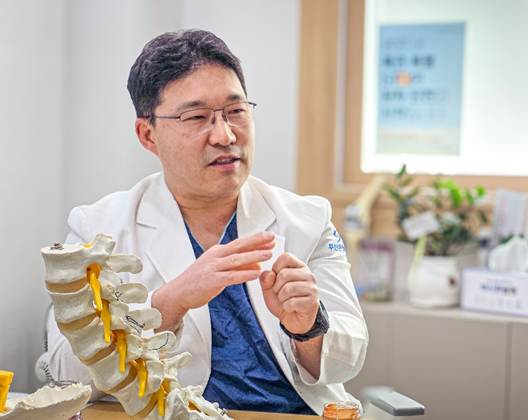
"They say they have to put big screws in my lower back to hold it in place, but I’m so scared I can’t bring myself to get on the operating table."
This was the reality for Lee, a 65-year-old resident of Busan, who suffered for years from legs so numb and tingly they felt as though they might burst. Walking even a short distance forced him to sit down and rest. The diagnosis was spondylolisthesis, a condition where a vertebra slips forward out of alignment. While his increasingly hunched posture was a visible concern, the constant, debilitating back pain caused by the unstable, misaligned vertebrae was far worse. Although physicians advised that spinal fusion—a procedure that fixes and stabilizes the shifting bones with screws—was the only definitive cure, Lee endured the agony with temporary injections and medications, paralyzed by the fear of a massive incision across his lower back.
Ultimately, his pain became chronic, and signs of partial paralysis began to set in. His hesitation was fueled by observing others who, despite undergoing open surgery, struggled to regain lower back strength or were left with a heavy, lingering ache. In the meantime, his condition deteriorated. Putting off critical interventions is a common trend among spine patients. Director Yoon Myung-soo of Busan Keun Hospital warns, "If you miss the optimal window for treatment, nerve cells can suffer permanent damage, leaving patients with persistent numbness or tingling long after the operation is complete."
Preventing Muscle 'Marbling' and Post-Surgical Chronic Pain
Spine operations are inherently complex, with spinal fusion ranking among the most invasive. Traditionally, surgeons must realign the unstable bone structures, expose the compromised disc, insert artificial bone, and secure the alignment with screws—a process requiring a wide, open incision. This approach inevitably cuts, tears, and pulls apart the major back muscles and delicate nerve tissues supporting the lower spine.
Director Yoon Myung-soo compares this structural trauma to the "marbling" found in premium beef to explain why chronic lower back pain often persists after open surgery. "The heavily marbled beef that consumers enjoy features pockets of fat woven between muscle fibers," Yoon Myung-soo notes. "While that may be ideal for flavor, it represents the worst possible physiological condition for a living muscle trying to exert force. The human lower back responds similarly. When subjected to a large incision, the severed back muscles lose their core functional capacity and, during the recovery phase, are replaced by fat and scar tissue." Consequently, even when the underlying vertebrae successfully fuse, patients frequently endure lingering back pain due to unaddressed muscle damage—an anatomical consequence many fail to anticipate.
From Skepticism to Global Standard: Single-Port Endoscopic Lumbar Fusion
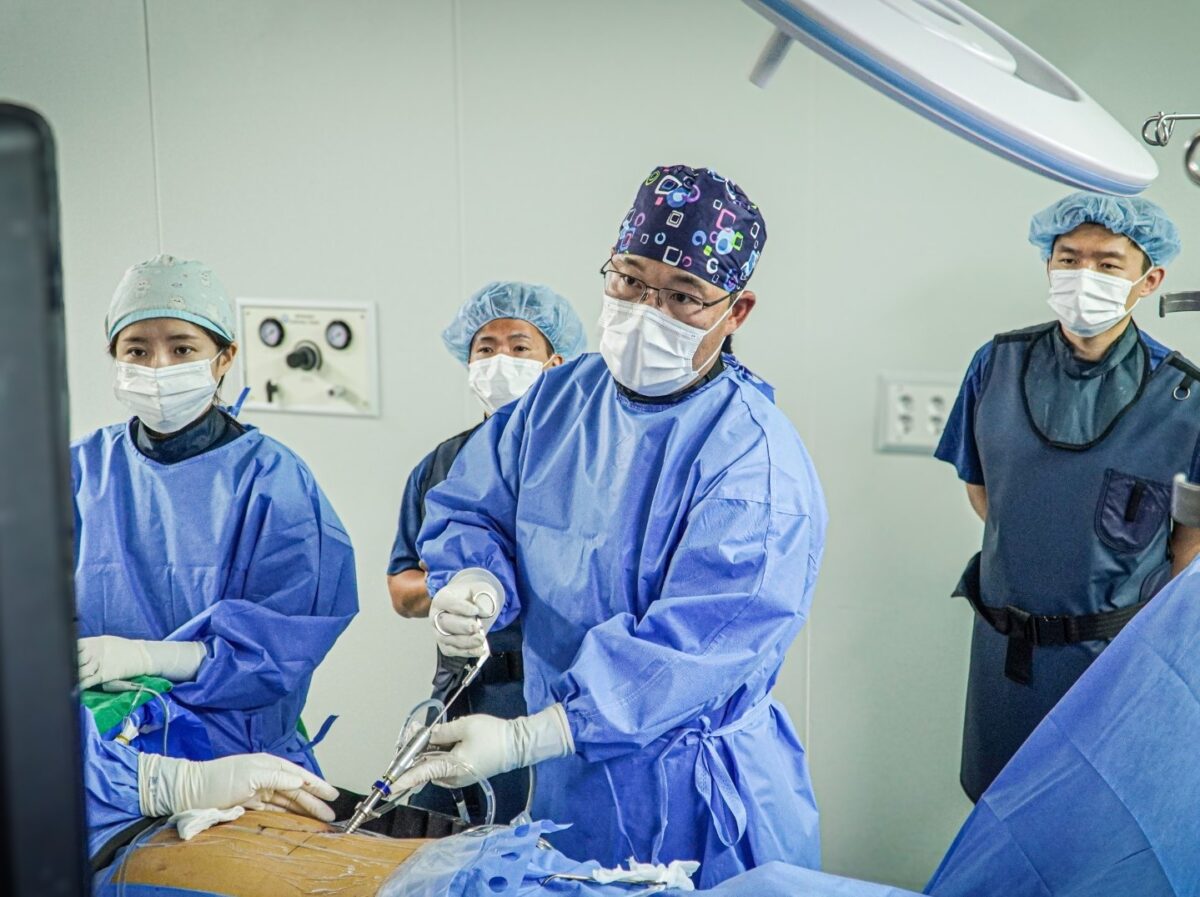
Bypassing the structural limitations of open surgery is an advanced approach known as single-port endoscopic lumbar fusion. This minimally invasive technique addresses the spinal lesion through a single incision measuring just one centimeter wide. Through this tiny entry point, surgeons insert an ultra-high-definition endoscopic camera alongside specialized surgical instruments. Because the instruments navigate delicately along the natural path of the muscle fibers rather than cutting through them, muscle trauma is minimized and blood loss is virtually nonexistent.
As an orthopedic surgeon who has pioneered this procedure in the Busan, Ulsan, and South Gyeongsang regions, Yoon Myung-soo frequently encounters patient doubt. "The most common question patients ask is how screws can possibly be anchored securely through such a tiny opening," Yoon Myung-soo says. "Yet, performing a flawless endoscopic screw fixation through a minute portal—a method known as minimally invasive transforaminal lumbar interbody fusion, or MIS-TLIF—has now become a globally recognized standard."
When Yoon Myung-soo first published a medical paper introducing the single-port endoscopic spinal fusion technique in the European Spine Journal in 2018, skeptics in the medical community argued that while simple disc removals were feasible, executing a full structural fusion with screw fixation through a single port was impossible. Since then, however, the procedure has advanced significantly. Today, endoscopic access is integrated with self-deploying expandable fusion cages, ultra-precision surgical drills, and 4K visualization monitoring systems operating in tandem. This enables surgeons to maintain a highly detailed field of view through a narrow channel, delivering screw fixation strength and structural stability that matches or exceeds conventional open surgery.
Correcting Severe Spinal Deformities and Accelerating Recovery
The clinical utility of single-port endoscopic spinal fusion extends far beyond minimizing cosmetic scars. Yoon Myung-soo has compiled extensive clinical data demonstrating that the endoscopic approach can restore the anterior spinal angle by as much as 34 degrees, even in patients presenting with severe spinal deformities that were previously deemed correctable only via open surgery.
[Single-port endoscopic spinal fusion case volume by Director Yoon Myung-soo of Busan Keun Hospital] |
Total cases performed: 381 |
Reoperation rate for endoscopic spinal fusion: 0.6% |
Pain relief effect: pre-op VAS 8 → post-op VAS 2 |
Clinical outcomes achieved by Director Yoon Myung-soo at Busan Keun Hospital reflect the efficacy of this approach. Across a total volume of 381 performed cases, the reoperation rate for endoscopic spinal fusion stands at a remarkably low 0.6 percent. Furthermore, patients reported dramatic pain relief, with average scores on the Visual Analog Scale (VAS) dropping from a pre-operative 8 down to a post-operative 2.
Because surgeons use the ultra-high-definition monitor to precisely shave away thickened bone and the ligamentum flavum directly adjacent to the spinal nerves, the risk of accidental nerve injury or infection is exceptionally low. This minimally invasive spinal fixation also drastically compresses recovery timelines. While conventional open-surgery patients often remain bedridden for three to four days while relying heavily on narcotic analgesics, endoscopic fusion patients typically experience manageable pain for roughly two days before exhibiting a rapid return to mobility.
This procedure serves as an excellent alternative for elderly individuals, patients with depleted physical stamina due to chronic comorbidities, and those who wish to avoid blood transfusions. Nevertheless, conventional open surgery remains the preferred clinical option if a spinal deformity is excessively severe or if the required intervention spans more than three spinal segments.
Frequently Asked Questions Regarding Endoscopic Fusion
Q: How can screws be safely inserted through a one-centimeter opening? Won't they misalign or loosen over time? A: This is a frequent concern, but it is medically unfounded. While the initial skin opening is only about one centimeter wide, specialized endoscopic instruments and self-expanding artificial bone cages provide exceptional structural fixation strength internally. Furthermore, because the intricate anatomy of the spine is magnified dozens of times on a high-precision screen during the fixation process, surgical accuracy is substantially higher than open procedures performed with the naked eye, eliminating worries regarding post-operative spinal instability.
Q: If my vertebrae are misaligned due to spondylolisthesis, is spinal fusion my only option? Can I get endoscopic decompression instead? A: The appropriate intervention depends entirely on the presence of spinal instability, or physical "play" between the vertebrae. If a patient exhibits severe instability—meaning the bones visibly shift or click when bending forward and straightening—a fusion procedure is required to prevent recurrence. Conversely, if the vertebrae have slipped out of alignment but have naturally stabilized and stiffened without wobbling, the condition can often be successfully resolved through decompression alone, which simply clears and widens the narrowed nerve pathways.
Q: When was single-port endoscopic fusion developed? Is it still considered cutting-edge? A: The foundational technique was first introduced to the domestic medical community in 2018. Over the nearly ten years since its debut, endoscopic visualization has progressed to 4K ultra-high definition, and surgical instrumentation has grown incredibly refined. As of 2026, it is fully recognized by the global spinal community as a primary, validated standard within minimally invasive spine surgery.
Expert Profile
Director Yoon Myung-soo is an orthopedic surgeon specializing in spinal care at Busan Keun Hospital. He earned his medical degree from the Pusan National University College of Medicine and subsequently completed both his master’s and doctoral degrees at its graduate school. A leading authority on spinal endoscopy, particularly single-port interventions, Yoon Myung-soo co-authored an international medical textbook published by Springer and has authored multiple research papers in prominent SCI-indexed international journals. He regularly trains domestic and international physicians on advanced single-port endoscopic spine surgery techniques.