The Dietary Guidelines for Americans (DGA), released in January 2026, contain several serious errors.
The first is that they push animal-based protein at every meal, effectively making protein intake the top dietary priority. In particular, they raised the recommended daily protein intake to 1.2 to 1.6 g/kg, nearly double the previous recommendation of 0.8 g/kg.
But most people already consume more than enough protein, well above the recommended amount. Is more protein always better? It is not. Excess protein intake can cause side effects, including increased diabetes, reduced kidney function, osteoporosis and higher rates of cardiovascular disease [1].
What many people actually lack is not protein but dietary fiber. Ninety-three percent of Americans do not meet the daily recommended amount (38 g for men, 25 g for women) [2]. People in South Korea do better than Americans, but about 57% still do not meet the daily recommended amount (25 g for men, 20 g for women) [3].
What modern people lack is not “protein” but “dietary fiber”
The second error is that the guidelines portray saturated fat from animal foods as a healthy fat. In an inverted pyramid-style graphic, animal foods high in saturated fat — such as steak, cheese, chicken, fish, milk and butter — appear above plant-based proteins, visually emphasizing them.
That prominent placement could suggest there is no real limit on saturated fat intake. Yet the guidelines still cap it at “less than 10% of total calories.” Promoting foods high in saturated fat while strictly limiting saturated fat intake is a contradiction that does not add up.
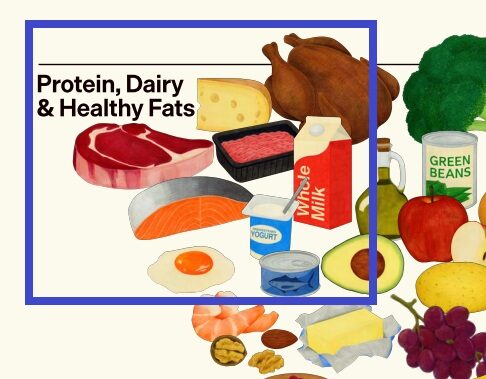
Recommend 3 glasses of milk, but say to cut saturated fat?
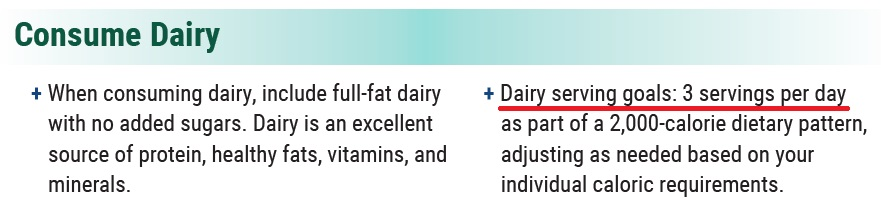
For example, the dietary guidelines call milk a healthy food and recommend drinking three glasses a day. For an adult with an average daily calorie need of 2,000 calories, one 200 ml carton of milk contains 5 g of saturated fat. In other words, drinking three glasses of milk brings saturated fat intake to 15 g, or 135 calories (fat 1 g = 9 calories), already reaching two-thirds (68%) of the daily upper limit (10% of total calories = 200 calories = 22 g).
On top of that, adding even a small amount of animal foods such as meat, fish or eggs over the course of a day — especially to meet the recommended protein intake — would easily push the total past 10%, effectively creating a guideline that is impossible to follow. (*Under the 2025 Dietary Reference Intakes for Koreans, the upper limit for saturated fat intake is 7%, and three glasses of milk already reach that limit [4].)
In 2025, the American Heart Association (American Heart association) set a stricter target for cardiovascular health, recommending saturated fat intake at “less than 6% of total calories” [5].
When about 2,000 calories a day are needed, calories from saturated fat should not exceed 120 calories. That means saturated fat intake should be 13 g or less per day — and three glasses of milk (15 g of saturated fat) already exceed that standard.
What’s truly bad isn’t saturated fat itself ... overconsumption is the bigger problem
In fact, saturated fat is essential for human survival (cell membrane structure, energy storage, maintaining body temperature, etc.). But because the human body can synthesize saturated fat on its own using carbohydrates or protein, it is not an “essential fatty acid” like omega-3 or omega-6 that must be obtained from food. Therefore, excessive intake causes a range of problems.
In particular, diets high in saturated fat raise blood triglyceride levels and “bad” cholesterol (LDL) levels and cause atherosclerosis, increasing the risk of heart disease and stroke. Replacing foods high in “saturated fat” with foods high in “unsaturated fat” reduces the incidence of cardiovascular disease by about 30% — an effect so strong it is comparable to what is achieved with lipid-lowering drugs (statins) [6].
Excess saturated fat intake also increases the risk of developing diabetes by inducing insulin resistance [7]. A 2024 meta-analysis found that groups with high saturated fat intake had significantly increased risks of breast cancer, prostate cancer and colorectal cancer [8].
In a 2025 study by Harvard researchers that followed about 220,000 adults for up to 33 years, the group with the highest intake of the animal-based saturated fat “butter” had a 15% higher risk of death than the group with the lowest intake. By contrast, the group with the highest intake of plant-based unsaturated fats (for example, olive oil) had a 16% lower mortality rate than the group with the lowest intake.
Replacing 10 g of daily butter intake with the same amount of plant-based fat reduced all-cause mortality by about 17% and also cut cancer mortality by about 17%. Replacing saturated fat with unsaturated fat leads to a longer, healthier life [9, 10].
Saturated fat itself is not harmful, but excessive intake is. The “Public health agency recommendations on saturated fat,” released in 2025, synthesizes the latest guidance from authoritative health organizations including the World Health Organization (WHO), the American Heart Association (AHA), the Academy of Nutrition and Dietetics, the American Diabetes Association, the American Cancer Society and the American Medical Association. It recommends that to live healthfully, people should “limit saturated fat intake and replace it with unsaturated fat” [11]. Excess saturated fat intake under the new Dietary Guidelines for Americans harms health.
Song Mu-ho, MD, PhD, orthopedic surgery and lifestyle medicine specialist
References
1. The Dong-A Ilbo https://www.donga.com/news/It/article/all/20260121/133199431/2
2. American society for Nutrition https://nutrition.org/most-americans-are-not-getting-enough-fiber-in-our-diets/
3. S Shin. Association Between Dietary Fiber Intake and Low Muscle Strength Among Korean Adults. Clin Nutr Res 2024;13(1):33-41.
4. Ministry of Health and Welfare https://www.mohw.go.kr/board.es?mid=a10411010200&bid=0019&tag=&act=view&list_no=1488446
5. AHA https://www.heart.org/en/healthy-living/healthy-eating/eat-smart/fats/fats-in-foods
6. FM Sacks, AH Lichtenstein, JHY Wu, et al. American Heart Association. Dietary Fats and Cardiovascular Disease: A Presidential Advisory From the American Heart Association. Circulation 2017;136(3):e1-e23.
7. PK Luukkonen, S Sädevirta, Y Zhou, et al. Saturated fat is more metabolically harmful for the human liver than unsaturated fat or simple sugars. Diabetes care 2018;41(8):1732-1739.
8. J Mei, M Qian, Y Hou, et al. Association of saturated fatty acids with cancer risk: a systematic review and meta-analysis. Lipids Health Dis 2024;23(1):32.
9. Y Zhang, KS Chadaideh, Y Li, et al. Butter and Plant-Based Oils Intake and Mortality. JAMA Intern Med 2025;185(5):549–560.
10. Mayo Clinic https://mcpress.mayoclinic.org/nutrition-fitness/eating-less-butter-may-reduce-your-heart-disease-risk/
11. Center for Biological Diversity https://www.biologicaldiversity.org/programs/population_and_sustainability/pdfs/2025-recs-on-saturated-fat.pdf