“When Gregor Samsa woke one morning from uneasy dreams, he found himself transformed in his bed into a gigantic insect.”
With this iconic opening, Franz Kafka suggests a jarring reality: a sudden split between self and body, a world where the absurd and the terrifying are indistinguishable, and a deep, unconscious scream within the human psyche.
Bugs in Literature: Kafka’s Metamorphosis
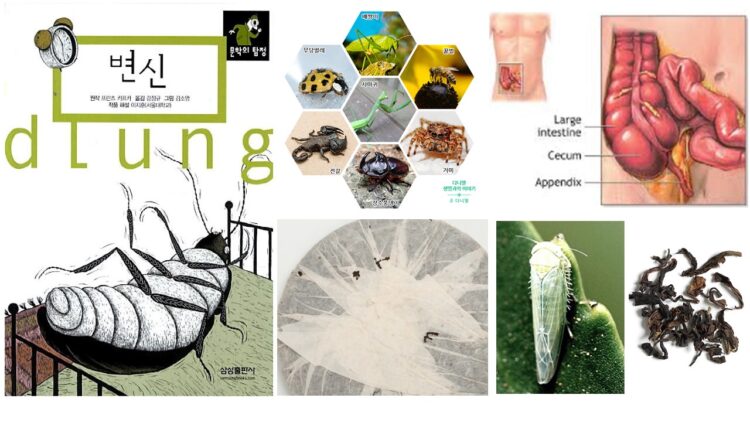
This premise—a man turning into a bug—is one of the most famous scenes in literary history. Kafka intentionally avoided specifying the insect, even asking his publisher not to illustrate it, as he believed the reader’s imagination was paramount.
While scholars debate whether the German text implies a beetle or a cockroach (the latter being the most popular choice for book covers), the creature's identity remains secondary to what it represents: the ultimate isolation of the human condition.
The Emotional Weight of the Word “Bug”
In a biological sense, "bug" is a loose term. In everyday language, it refers to any thin, crawling, or legless creature. However, the word is rarely neutral; it carries a heavy burden of human emotion—usually unpleasantness, fear, or repulsion.
In both Korean and English, "bug" and "worm" are terms of contempt. To call someone "worse than a bug" is the ultimate insult. In English, "a worm in the brain" denotes a tormenting thought, while a "worm-eaten" state refers to something rotten or fallen. Yet, despite their repulsive reputation, these creatures are the essential decomposers of our ecosystem. If you gathered every bug on Earth, their collective mass would outweigh that of all mammals several hundred times over.
The Boundary of “Bugs” and the "Vermiform" Appendix
While people often use the terms interchangeably, not all bugs are insects. "Bugs" generally refers to members of the phylum Arthropoda—animals with segmented bodies and jointed appendages. This includes insects (six legs), arachnids (eight legs), and crustaceans (ten or more legs). Interestingly, we rarely call a crab or a lobster a "bug."
In medicine, the first "bug" students encounter is the appendix. Its formal name, the vermiform appendix, literally means "worm-shaped appendage." Historically, Charles Darwin viewed the appendix as a vestigial remnant of an organ once needed to digest plant fiber—hence why it remains large in herbivores like gorillas but has shrunk in omnivorous humans.
However, 21st-century medicine has reexamined the appendix. In 2007, researchers at Duke University proposed that it acts as a "safe house" or reservoir for beneficial gut bacteria, aiding in immune and microbiome regulation.
Parasites: The Uninvited Guests
Medical students also encounter bugs in parasitology. A "parasite" is not a biological classification but a lifestyle description. In Sino-Korean, the term includes the character for "bug" (蟲). This category includes ectoparasites like fleas, lice, and ticks, as well as "parasitic worms" like roundworms and tapeworms. While the latter are helminths rather than arthropods, they are intuitively recognized as "worms" due to their shape.
The Alchemical Relationship: Tea Plants and the Leafhopper
In the world of tea, bugs are not always villains. The tea leafhopper (Jacobiasca formosana), a tiny insect only 2–3 mm long, is a primary "pest" that sucks sap from tea leaves. However, its attack triggers a fascinating chemical defense mechanism within the tea plant.
When the leafhopper pierces the leaf, the plant perceives the insect's saliva as a chemical attack and produces defensive substances:
Jasmonates: Hormones that induce wound responses.
Terpenoids & Phenylpropanoids: Aromatic compounds responsible for floral, fruity, and honey-like scents.
Flavonoids: Compounds that contribute to astringency and complex aromas after oxidation.
“Bug-Bitten Leaves Are Sweeter”: Chemical Artistry
Through this natural "chemical artistry," tannin levels decrease while aromatic components increase, creating a smoother, more complex flavor. Tea makers now intentionally induce leafhopper damage to produce prestigious teas like Oriental Beauty (Oolong) or specific Yunnan oolongs.
In this context, the relationship is closer to symbiosis than parasitism. There are even "insect-chewed" teas and the controversial "insect-feces" tea (made from the droppings of insects that eat tea leaves), though the latter's existence is a subject of debate among experts.
The Philosophy Taught by the Bookworm
Finally, there is the "bookworm"—booklice that chew through the paper packaging of aged tea. It is a common trope in the tea world that "bugs only inhabit delicious tea." For a long time, I believed this, prioritizing bug-eaten packaging in my purchases.
Eventually, I realized the cognitive error: I had turned a specific experience into a universal rule. What we interpret as "inevitability" is often just a bias hardened by repetition. The tea bug, in its tiny, insignificant way, sneered and taught me a lesson: humans often mistake their own limited interpretations for the laws of nature.
Yoo Young-hyun, Director of Tick Clinic (Audio Column 1+1 Story: https://www.youtube.com/@yhyoo0906)