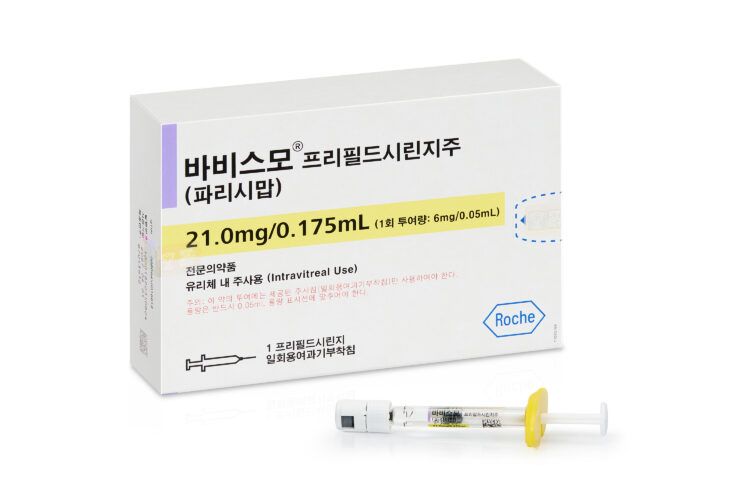
Injectable therapies for chronic eye diseases are entering a new era where clinicians and patients can select formulations based on specific clinical needs. With Roche Korea’s ophthalmic therapy Vabysmo (faricimab) now eligible for National Health Insurance reimbursement in a prefilled syringe (PFS) format, a significant new prescribing option has been added alongside the existing vial formulation. For patients with retinal diseases requiring long-term, repeated treatment, this change is expected to enhance procedural convenience and support continuity of care.
Roche Korea announced that the Ministry of Health and Welfare has approved reimbursement for the Vabysmo PFS starting April 1. Vabysmo is the first bispecific antibody approved for ophthalmic use. Unlike traditional therapies that primarily target vascular endothelial growth factor-A (VEGF-A), Vabysmo simultaneously inhibits angiopoietin-2 (Ang-2), a protein linked to retinal vascular instability and inflammation. Approved by the Ministry of Food and Drug Safety in 2023, it is used to treat neovascular (wet) age-related macular degeneration (nAMD), diabetic macular edema (DME), and macular edema following retinal vein occlusion (RVO).
Seamless Transition Under Existing Reimbursement Criteria
The newly reimbursed PFS formulation follows the same criteria as the existing vial, ensuring that patient access remains unchanged even if a formulation switch occurs during therapy. For nAMD, reimbursement is recognized for patients with subfoveal choroidal neovascularization. For DME, criteria include a glycated hemoglobin (HbA1c) level of 10% or less and a central retinal thickness (CRT) of 300 μm or greater. The total number of covered administrations is capped at 14 per patient, including any prior history with other anti-VEGF therapies.
The shift to a prefilled syringe offers distinct advantages for both clinicians and patients. Because the medication is supplied ready-to-use, it eliminates several preparation steps, shortening procedure time and simplifying the injection setup. This streamlined process also helps lower the risk of contamination or infection, which is a critical consideration for patients requiring frequent intravitreal injections.
Design Focused on Procedural Precision and Patient Safety
The Vabysmo PFS incorporates several design features to improve the injection experience. It utilizes an Extra Thin Wall needle with an inner diameter more than 30% wider than standard needles, allowing for a higher flow rate with less hand force. The system also includes a Luer-lock mechanism to secure the needle firmly and an easy-to-grip finger hold for precise one-handed operation. Additionally, a specialized "baked-on" silicone coating inside the syringe reduces the potential for silicone particle contamination and ensures a smoother delivery of the drug.
The efficacy and safety of Vabysmo have been established through large-scale global trials involving over 3,000 patients. In pivotal studies, Vabysmo demonstrated non-inferior vision gains compared to aflibercept 2 mg, with a similar safety profile. Post hoc analyses further revealed rapid anatomic improvements; in nAMD studies, 85.5% of patients saw a resolution of retinal fluid by week 12. In DME studies, Vabysmo achieved normal central subfield thickness 16 weeks faster than the control group.
Reducing the Treatment Burden Through Extended Intervals
One of the most significant benefits of Vabysmo is the ability to maintain longer dosing intervals. In clinical trials, approximately three out of five patients were able to maintain a 16-week treatment interval by the second year—reducing the burden to just three injections per year. Specifically, up to 81.2% of nAMD patients and 80% of DME patients maintained intervals of 12 weeks or longer.
"In retinal disease treatment where repeated injections are unavoidable, consistent adherence is just as important as drug efficacy," noted an industry official. "The expansion of reimbursement to the PFS formulation is expected to bring meaningful improvements to real-world clinical efficiency and patient outcomes."