“For our baby’s hernia surgery, we decided to go to the most well-known hospital because it involves such a precious part of our child’s body—and it was the right decision. The surgeon even found an opening on the opposite side that we hadn’t discovered beforehand and treated it all at once….”
“I suffered for six years from gynecomastia, where the chest protrudes like a woman’s. I couldn’t even go swimming, let alone wear short-sleeved shirts. I was so embarrassed whenever I wore a crossbody bag or a seat belt, but after surgery I regained my confidence.”
Damsoyu Hospital’s website is filled with voluntary reviews like these from patients. On patient community boards, posts asking, “Is there a place where a newborn can safely get hernia surgery?” or “Where should I get surgery for gynecomastia or accessory breast tissue?” are invariably met with comments recommending “Damsoyu Hospital.”
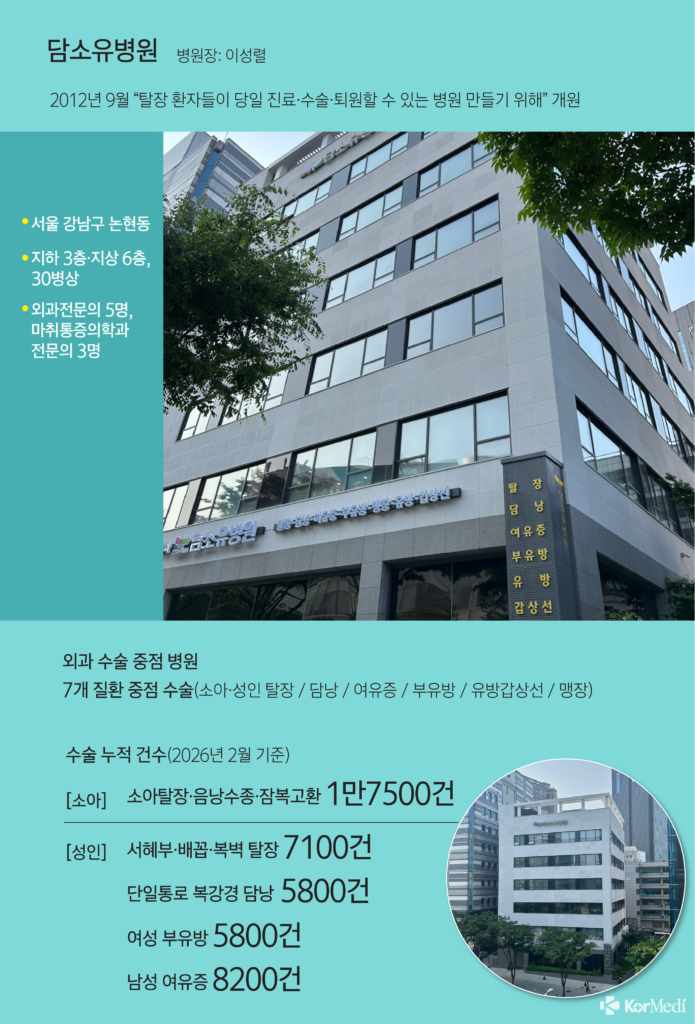
Damsoyu Hospital, as famous among mothers as an idol star, derived its name by combining the first syllables of the Korean words for gallbladder, pediatric, and breast. It was founded in September 2012 by Dr. Seong-ryeol Lee, a surgeon trained at Korea University Medical Center, to address the reality of children struggling because they must visit the hospital multiple times for conditions that could be treated in a single day.
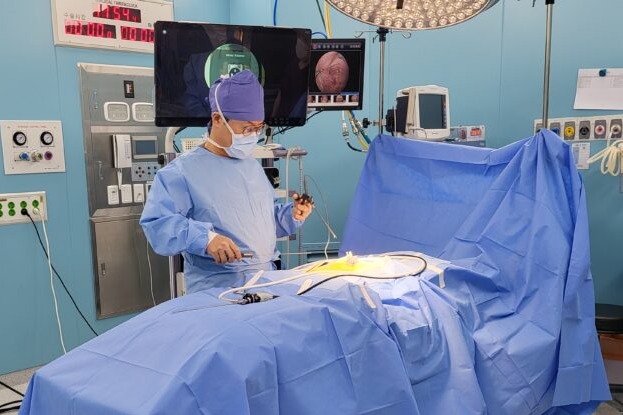
Patients from all over the country come to this hospital for conditions such as hernias, hydroceles, gynecomastia, accessory breast tissue, and gallstones. While its surgical expertise is on par with university hospitals, consultation, surgery, and discharge can all be completed in a single day. “Cancer patients often need to receive chemotherapy or radiation therapy at a university hospital, but there are many surgical conditions—such as hernias and gallbladder disease—where that isn't necessary,” Dr. Lee explains.
When the board-certified surgeon began offering “one-day surgery” in line with the mission of putting patient convenience first, word spread quickly. In just one year, the Korea Record Institute (KRI) recognized the hospital for the “highest number of pediatric laparoscopic hernia surgeries,” and it soon surpassed 1,000 cases for the first time in Korea. Although it is a busy hospital with patients pouring in, from an operational standpoint, it takes a path opposite to conventional wisdom.
The hospital has not obtained specialty hospital certification, meaning it cannot use expressions like “hernia specialty.” While government certification would provide marketing benefits and subsidies, the hospital chose to forgo them. “In Korea, a surgical specialty hospital must have at least 60 beds, but Damsoyu Hospital currently has 30 beds. Based on the building’s size, we could expand to 100 beds, but that would go against our philosophy of being ‘patient-centered.’ We can’t let patients become uncomfortable because the rooms are cramped.”
One-day surgery also does not help immediate revenue. Under the current payment system, the hospital can receive reimbursement when a patient completes preoperative tests during a separate outpatient visit, but it cannot if the tests are done on the day of surgery. From a revenue perspective, the hospital could have patients visit multiple times, but it pursued the more important value of patient convenience.
At Damsoyu, this philosophy is everywhere. It features a “child-tailored care system” where pediatric anesthesiology specialists manage pain, and surgeries are performed using the latest “pediatric-only laparoscopic instruments.” It also operates a “single-occupancy pediatric ward,” where children can recover without worrying about disturbing others.
Damsoyu Hospital’s “patients first” approach is also connected to outstanding research. To date, it has published 43 SCI papers—the highest output in the fields of hernia, accessory breast tissue, and gynecomastia. Dr. Lee, a Fellow of the American College of Surgeons (FACS), has led these efforts, receiving numerous awards including the Minister of Health and Welfare Outstanding Paper Award.
“I never do research for fame,” Dr. Lee says. “I research because to provide better treatment, we need to know the latest therapies. To reduce even one more recurrence or complication, doctors need continuous learning.” He emphasizes that care must be provided based on objective evidence, such as textbooks and the latest research, rather than just a senior's experience.
These principles are applied in real clinical practice. For example, before hernia surgery, patients taking aspirin are usually advised to stop for a week due to bleeding risk. However, based on the latest U.S. research showing that continuing aspirin can reduce cardiovascular complications, Dr. Lee instructs them not to stop abruptly. He also confirmed through research that laparoscopic surgery is safe for patients at high risk of inguinal hernia following prostate cancer surgery—a technique he has applied in over 150 operations.
Dr. Lee’s research begins with meticulous data management. Every day, he carefully organizes surgical data—including symptom onset and operative time—in Excel. This process enables him to deliver confident, evidence-based care. No matter how tired he is after clinic hours, he processes the day's clinical data on the same day.
The hospital also prioritizes transparent communication. Before surgery, staff spend 20–30 minutes explaining the procedure to patients and guardians using PowerPoints and videos. After surgery, they even share the process by showing the recorded surgical video. This service is provided at no additional cost. “All surgeries are recorded,” Dr. Lee says. “These records not only reassure guardians about safety but are also important for accurately analyzing the cause if complications develop later.”
The operating rooms are designed for safety, featuring “ultra-clean sterile rooms” equipped with HEPA filters and a positive-pressure system to block contaminated air. By precisely controlling temperature and humidity, the hospital minimizes the risk of infection. “Even if it costs a lot, it’s important to strengthen the system for patient safety,” he emphasizes.
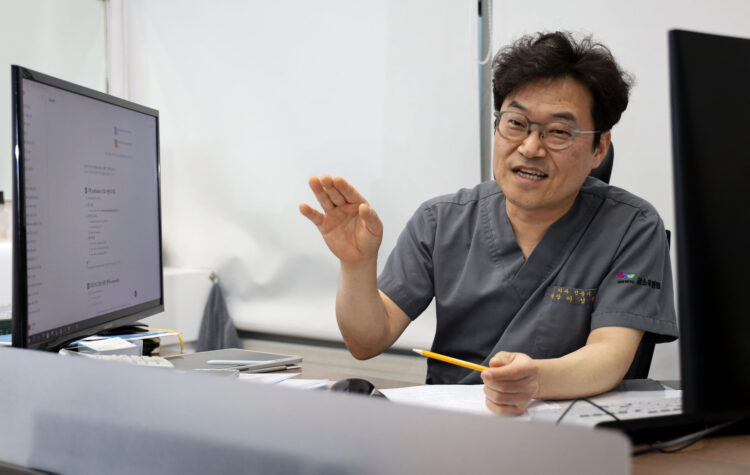
Dr. Lee has grown Damsoyu into a premier surgical institution with five board-certified surgeons and three anesthesiology specialists, performing surgery on about 15 patients a day. To date, he has operated on approximately 18,000 pediatric hernia patients.
Despite his rigorous standards, he is a doctor of deep empathy, often purchasing winter jackets for patients in difficult financial circumstances. “Rather than having grand goals, I just do what I need to do each day,” he says, naming his three core values: safety, continuous independent study by the surgeon, and providing explanations based on solid evidence.