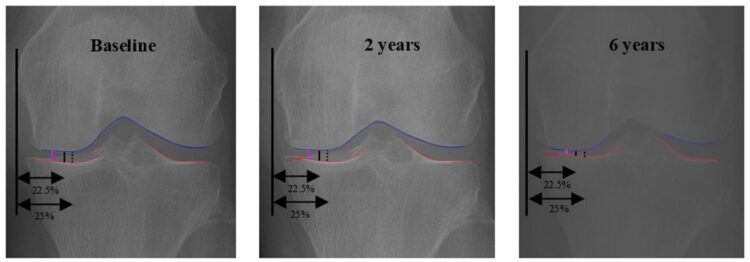
A South Korean research team has developed a breakthrough imaging indicator that utilizes AI deep learning to identify the "most severely worn areas" of the knee joint—a task that has historically challenged traditional X-ray diagnostics.
A joint team led by Professor Noh Doo-hyun of Seoul National University Hospital and Professor Lee Do-won of Dongguk University Ilsan Hospital announced on the 6th the development of "oJSW" (orthogonal minimum joint space width). This AI-based metric accurately measures the specific wear condition of knee cartilage, which can vary significantly from patient to patient. The study’s findings were recently published in KSSTA (Knee Surgery, Sports Traumatology, Arthroscopy), the official journal of the European Society for Sports Medicine, Knee Surgery and Arthroscopy (ESSKA).
Superior Accuracy in Tracking Disease Progression
To validate the new indicator, the researchers analyzed large-scale data from the National Institutes of Health (NIH), examining knee images from 3,855 patients over a period of up to six years. The oJSW indicator recorded a remarkably high diagnostic accuracy (AUC) ranging from 0.86 to 0.97 across all stages of osteoarthritis, from early onset to severe degradation. This performance consistently outperformed conventional diagnostic methods, which typically range from 0.78 to 0.95.
An AUC value closer to 1.0 indicates near-perfect accuracy; at a 0.97 rating, the AI can distinguish between healthy individuals and those with varying severities of the disease with 97% probability. Furthermore, in an analysis of disease progression over a 12-month period (rSRM), the tool scored between 0.91 and 0.97. This suggests that oJSW can capture subtle structural deteriorations over time with far greater sensitivity than existing clinical indicators.
Overcoming the Limitations of Traditional Diagnostics
Traditionally, the severity of knee osteoarthritis is assessed by measuring the Joint Space Width (JSW) between the femur (thigh bone) and tibia (shin bone) on an X-ray. As cartilage wears down, this gap narrows. However, conventional methods measure this gap at fixed, standardized positions. Because the "maximum wear point" varies based on an individual's anatomy and gait, standard X-rays often miss the most severely damaged areas.
In contrast, the newly developed oJSW allows AI to automatically scan the interior of the joint to find and measure the narrowest point vertically. This automated exploration ensures that the measurement reflects the true state of an individual’s cartilage wear.
"oJSW will serve as a vital structural indicator for evaluating the severity of osteoarthritis and tracking the progression of the disease," said Professor Noh Doo-hyun. "In particular, we expect it to be a highly sensitive tool in clinical trials for disease-modifying treatments, ultimately contributing to the development of new drugs that can slow the progression of the condition."