The intake of beta-carotene (found in carrots, spinach, etc.)—a precursor to Vitamin A abundant in fruits and vegetables—and Vitamin E (found in nuts) has been shown to reduce cancer risk through powerful antioxidant effects.
However, when these nutrients are taken in supplement (pill) form, the results can be radically different. The ATBC (Alpha-Tocopherol, Beta-Carotene) study shocked the world by showing an 18% higher incidence of lung cancer among smokers who took beta-carotene, marking one of the most significant findings in medical history [1].
Following this announcement, the scientific community conducted follow-up studies to determine if this was a temporary anomaly or if vitamin supplements were indeed dangerous.
The CARET Study: "Stop the Experiment!"
In 1996, the CARET (Beta-Carotene and Retinol Efficacy Trial) study, sponsored by the American Cancer Society, was published in the New England Journal of Medicine (NEJM).
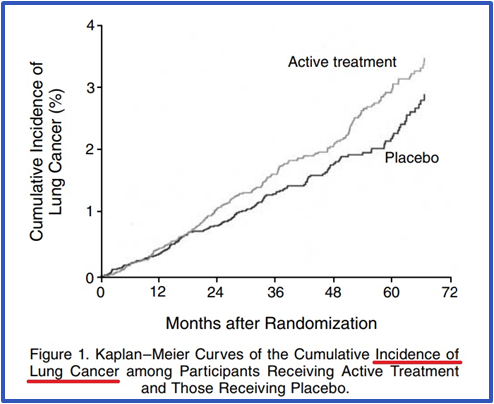
The goal was clear: to determine if a "powerful antioxidant cocktail" mixing beta-carotene with Vitamin A (retinol) could prevent lung cancer. However, after observing approximately 18,000 high-risk individuals (heavy smokers or asbestos workers) for an average of four years, the health of the supplement group was found to be far worse than the control group.
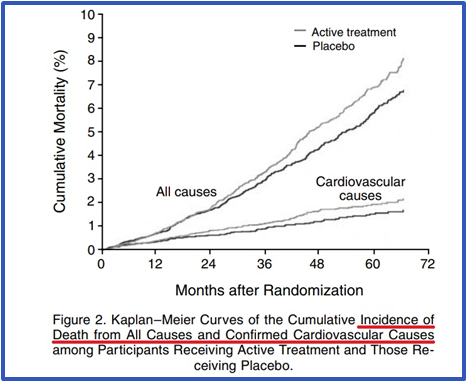
With a shocking 28% increase in lung cancer incidence, a 26% increase in cardiovascular mortality, and a 17% increase in overall mortality, it was deemed ethically dangerous to continue. The study was "forced to stop" 21 months ahead of schedule.
Graph Explanation: > * Fig 1. Those taking beta-carotene and Vitamin A (Active treatment) showed a significantly higher incidence of lung cancer compared to the Placebo group.
Fig 2. Overall mortality and cardiovascular disease mortality were also notably higher in the treatment group [2].
Until then, it was widely believed that oxidative stress from reactive oxygen species caused aging and cancer, and that supplements would improve outcomes.
The Shattering of the "Supplements are Safe" Belief
The failure of these two government-funded clinical trials shattered the belief that supplements are inherently safe. They proved that even beneficial nutrients can cause side effects in artificially concentrated forms. Consequently, health organizations now strongly recommend that "smokers should never take high doses of beta-carotene."
A similar trend was seen in men's health. In 2001, the NIH sponsored the SELECT (Selenium and Vitamin E Cancer Prevention Trial). Targeting 35,000 men over 50, it aimed to see if Vitamin E and selenium could prevent prostate cancer. Planned for 12 years, it was stopped at year eight because Vitamin E actually increased prostate cancer incidence by 17% [3].
Selenium: Once a "Preventative," Now a Risk
In a follow-up to the SELECT trial, selenium supplements were found to be harmless to men with a deficiency, but for those with already high selenium levels, the risk of aggressive prostate cancer increased by 91% [4]. This news was covered by major outlets like The New York Times and The Guardian.
Dr. Alan Kristal of the Fred Hutchinson Cancer Research Center noted that people are often misled by supplement misinformation [5]:
"No large, well-designed studies have proven their benefits in preventing chronic diseases."
"Selenium and Vitamin E supplements pose only risks; men taking them should stop immediately."
"High-dose supplements provide much more than the recommended intake and increase cancer risk."
Similar Failures for Vitamins C, D, and Omega-3
Following the findings on Vitamins A and E, researchers turned to Vitamin C. A 2008 Harvard Medical School study involving 14,000 male doctors found that 500mg of Vitamin C had no effect on cardiovascular disease, while Vitamin E increased the incidence of hemorrhagic stroke by 74% [6]. A 2009 Harvard study of 7,600 women showed similarly that Vitamin C, E, and beta-carotene had no effect on cancer mortality [7].
Vitamin D and Omega-3 were no different. The 2019 VITAL study, led by Harvard and involving 25,000 participants, found that high doses of Vitamin D and Omega-3 failed to reduce the incidence of cancer or heart disease [8].
A New Standard for Modern Health
These results have fundamentally changed our understanding of wellness:
Smoking Contraindications: Warning labels now caution smokers against high-dose beta-carotene.
The Antioxidant Paradox: Excessive antioxidants can become "pro-oxidants" that promote harmful oxidation.
The Vitality of Natural Foods: The attempt to replace fruits and vegetables with a single pill has failed.
The experiment to substitute natural nutrition with factory-synthesized supplements ended miserably. There was no true nutrition to be found in the pills.
Dr. Song Mu-ho Specialist in Orthopedic Surgery and Lifestyle Medicine
References
1. Alpha-Tocopherol Beta Carotene Cancer Prevention Study Group. The effect of vitamin E and beta carotene on the incidence of lung cancer and other cancers in male smokers. NEJM 1994;330(15);1029-1035.
2. GS Omenn, GE Goodman, MD Thornquist, et al. Effects of a combination of beta carotene and vitamin A on lung cancer and cardiovascular disease. NEJM 1996;334(18):1150-1155.
3. EA Klein, IM Jr Thompson, CM Tangen, et al. Vitamin E and the risk of prostate cancer: the Selenium and Vitamin E Cancer Prevention Trial (SELECT). JAMA 2011;306(14):1549-56.
4. AR Kristal, AK Darke, JS Morris, et al. Baseline selenium status and effects of selenium and vitamin e supplementation on prostate cancer risk. J Natl Cancer Inst 2014;106(3):djt456.
5. The Guardian "Some vitamin supplements raise risk of cancer in men, research shows"
6. HD Sesso, JE Buring, WG Christen, et al. Vitamins E and C in the prevention of cardiovascular disease in men: the Physicians' Health Study II randomized controlled trial. JAMA 2008;300(18):2123-33.
7. J Lin, NR Cook, C Albert, et al. Vitamins C and E and beta carotene supplementation and cancer risk: a randomized controlled trial. J Natl Cancer Inst 2009;101(1):14-23.
8. JE Manson, NR Cook, IM Lee, et al. ; VITAL Research Group. Vitamin D Supplements and Prevention of Cancer and Cardiovascular Disease. N Engl J Med 2019;380(1):33-44.