The myth that you need to eat meat to be strong was already disproven in the Colosseum. As depicted in the acclaimed film “Gladiator,” which won five awards at the 2001 Academy Awards, including Best Picture and Best Actor, ancient Roman gladiators achieved exceptional physical conditioning through rigorous training and careful nutritional management.
They were closer to “trained athletes” than simple warriors. Living in communal quarters separated from the general public, they trained more than 16 hours a day at a training school called a ludus under experts in gladiatorial combat, and renowned physicians oversaw the gladiators’ health. Their level was comparable to today’s elite combat-sports athletes or professional sports players [1, 2].
When we think of strength, muscular physiques, grueling training, and endurance, what foods did they mainly eat to maintain their condition? Considering the diets of modern strength athletes, you might expect gladiators to have followed a “high-protein diet,” but research has shown a completely different result.
In archaeology, researchers estimate a person’s lifetime diet by analyzing the ratios of various isotopes in collagen found in human bones recovered from sites. The carbon isotopes C-12 and C-13 provide information about the intake of plant-based foods, and the nitrogen isotopes N-14 and N-15 indicate the amount of animal protein consumed, especially meat and dairy. The higher the strontium-to-calcium ratio (Sr/Ca), the greater the plant-based intake; the lower it is, the more meat-heavy the diet. In addition, a higher sulfur isotope value suggests that the individual likely consumed more fish and seafood than others.
When the University of Vienna analyzed the bones of 22 ancient Roman gladiators and 20 civilians using radioisotopes, the results showed that all gladiators maintained a diet composed of barley, wheat, and beans. In other words, the gladiators were “vegetarians” (paper below) [3].
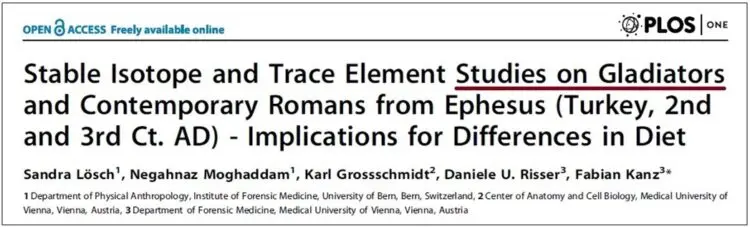
Historical records about ancient Rome also note that gladiators were nicknamed “hordearii (barley men).” Astonishingly, the staple food of these men with tremendous physical strength was not meat but a barley-and-bean-centered “plant-based diet.”
Among soldiers in the Roman legions, legionaries performing engineering work expended an estimated average of about 5,000 kcal per day, and about 6,000 kcal during wartime operations. Today, only manual laborers and athletes typically expend energy at this level. Legionaries were able to endure prolonged wars and endless marches with remarkable stamina.
Seventy-eight percent of soldiers’ daily rations consisted of carbohydrates, mainly wheat or barley. This diet had the advantages of providing slowly absorbed carbohydrates, delivering high energy, and being easy to digest.
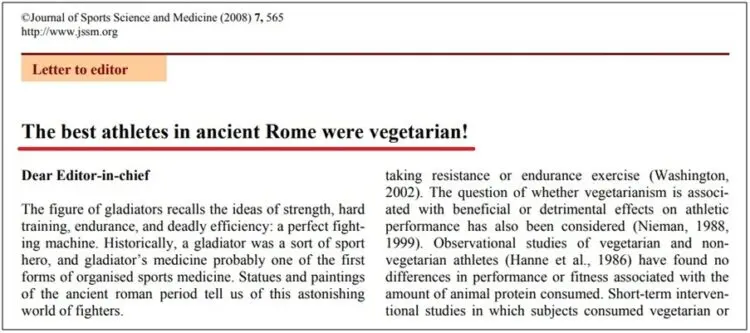
It also helped restore the body’s energy stores. The greatest warriors of the ancient world were essentially “vegetarians” [4]. This surprising story was also reported by BBC News in the United Kingdom [5].
What do people who believe “you have to eat meat to be strong” think when faced with these scientific facts? The idea that “plant-based diet = protein deficiency = lack of muscle = weak strength” is a misconception held by those who believe protein exists only in meat.
Protein is not a type of food but a combination of amino acids, and amino acids can be supplied sufficiently through plant-based foods such as whole grains, legumes, and nuts. Soybeans, in particular, are so protein-rich that they are nicknamed “beef from the field.” Looking at protein content per 100 g of food: beef sirloin 15.6 g, chicken breast 24.1 g, and soybeans 36.2 g—meaning soybeans contain far more protein than beef or chicken breast [6].
Some people say plant protein has a lower absorption rate than animal protein and is therefore “lower quality,” but that is not true. According to the “Protein Digestibility-Corrected Amino Acid Score (PDCAAS),” adopted by the U.S. Food and Drug Administration (FDA) as a method for evaluating protein quality, soy protein received the top score of 1.0—judged to be among the best proteins, along with milk and eggs, which are called “complete proteins.” By contrast, beef scored 0.92 [7].
The heroes of the Colosseum had no problem building muscle and strength not with meat feasts but with beans and barley. The fixed idea that “meat = strength” is nothing more than an unfounded belief (a myth), supported by neither science nor history. It may even be the most successful marketing ever created by the meat industry. The original model of the “strong man” you imagine—the Roman gladiator—was, in fact, a strict vegetarian.
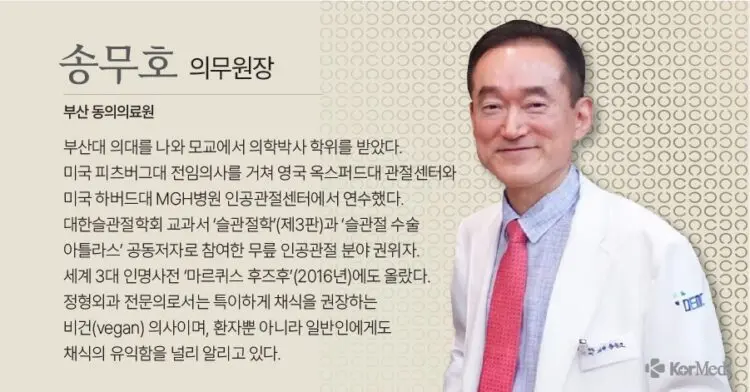
Moo-ho Song, MD, PhD · Board-Certified Orthopedic Surgeon
References
1. ThoughCo. https://www.thoughtco.com/roman-gladiators-overview-120901
2. HL Reid. Was the Roman Gladiator an Athlete? Journal of the Philosophy of Sport 2006;33(1):37–49.
3. S Lösch, N Moghaddam, K Grossschmidt, et al. Stable isotope and trace element studies on gladiators and contemporary Romans from Ephesus (Turkey, 2nd and 3rd Ct. AD)-implications for differences in diet. PLoS One 2014;9(10):e110489.
4. UG Longo, F Spiezia, N Maffulli, V Denaro. The Best Athletes in Ancient Rome were Vegetarian! J Sports Sci Med 2008;7(4):565.
5. BBC News https://www.bbc.com/news/education-29723384
6. Rural Development Administration, National Institute of Crop Science https://koreanfood.rda.go.kr/
7. Science Times https://www.sciencetimes.co.kr/nscvrg/view/menu/251?searchCategory=223&nscvrgSn=145756#:~:text