Editor’s note: In Japan’s orthopedic community, specialists use the term "locomotive syndrome" to describe a decline in mobility caused by weakening bones, joints, muscles, and nerves. The concept is widely used as a health indicator that can signal frailty and the potential need for long-term care before it becomes unavoidable. With guidance from experts, Kormedi.com is presenting a six-part series on physical warning signs that often surface first in everyday routines—such as putting on socks, climbing stairs, and crossing at a crosswalk.

"You need to exercise." It is a recommendation heard constantly in doctors' offices and from family members alike. While the advice is sound, put into practice, it often runs into a wall: knees ache, lower backs tingle, and legs quickly feel heavy after just a few steps.
Many people recognize the importance of physical activity yet find themselves unable to begin. In these moments, a lack of willpower is rarely the problem. The essential first step is identifying precisely what is blocking your stride.
Identifying the Barriers to Mobility
Locomotive syndrome refers to a progressive decline in motor function caused by the compound weakening of bones, joints, the spine, muscles, and nerves. It is far more complex than simple deconditioning; pain, strength loss, osteoporosis, impaired balance, and neurogenic claudication frequently overlap to erode a person's mobility.
Pain is often the primary obstacle. In knee osteoarthritis, every step can cause discomfort, leading individuals to reduce activity—which in turn accelerates muscle atrophy. With lumbar spine conditions, standing or walking for extended periods can trigger leg numbness and pain; forcing oneself to push through the discomfort often aggravates the underlying issue.
Bone health is equally critical. In osteoporosis, a fall carries a high risk of fracture. Spinal or hip fractures drastically curtail physical activity, worsening sarcopenia. Furthermore, weak thigh and hip muscles make rising from a chair or navigating stairs difficult. When accompanied by diminished balance, even a minor stumble can lead to a severe fall.
It is also easy to overlook neurogenic claudication, a classic symptom of spinal stenosis. Individuals may walk normally at first, only for their legs to become numb and heavy after a short distance. While resting temporarily alleviates the sensation, many mistake this warning sign for simple fatigue.
Prof. Yoo Jun-il of the Department of Orthopedic Surgery at Inha University Hospital emphasizes that identifying the root cause is the immediate priority. "The sequence of treatment and exercise changes fundamentally depending on whether the primary issue is joint pain, bone fragility, muscle loss, or spinal nerve compression," Yoo said.
A Continuous Cycle of Assessment and Treatment
Effectively managing locomotive syndrome requires a structured, multi-step approach rather than a single evaluation.
The process begins by assessing baseline walking capacity—measuring the strength required to stand from a chair, two-step stride length, walking speed, fall history, and pain severity. Next, clinicians identify the primary barrier—whether it is joint pain, osteoporotic fragility, sarcopenia, or spinal nerve symptoms—and initiate targeted therapy. Pain is controlled, osteoporosis is treated to prevent fractures, and sarcopenia is addressed through integrated exercise and nutritional strategies.
Once initial barriers are managed, functional movement is restored through gait training, lower-extremity strengthening, balance drills, and fall-prevention education. Re-evaluations should occur every three to six months to review walking speed, chair-rise times, two-step test results, and any fall incidents.
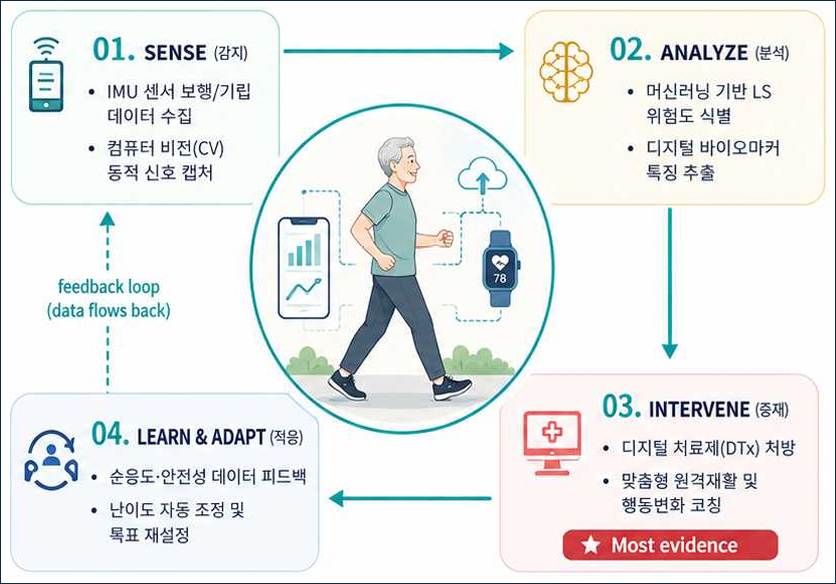
Prof. Park Hyun-tae of Dong-A University's Digital Healthcare Research Lab describes this management framework as a continuous loop: "Sense → Analyze → Intervene → Relearn." In this cyclical structure, wearable devices and digital cameras monitor gait and posture, algorithms analyze risk, clinicians prescribe tailored exercises or digital therapeutics, and patient feedback guides ongoing adjustments.
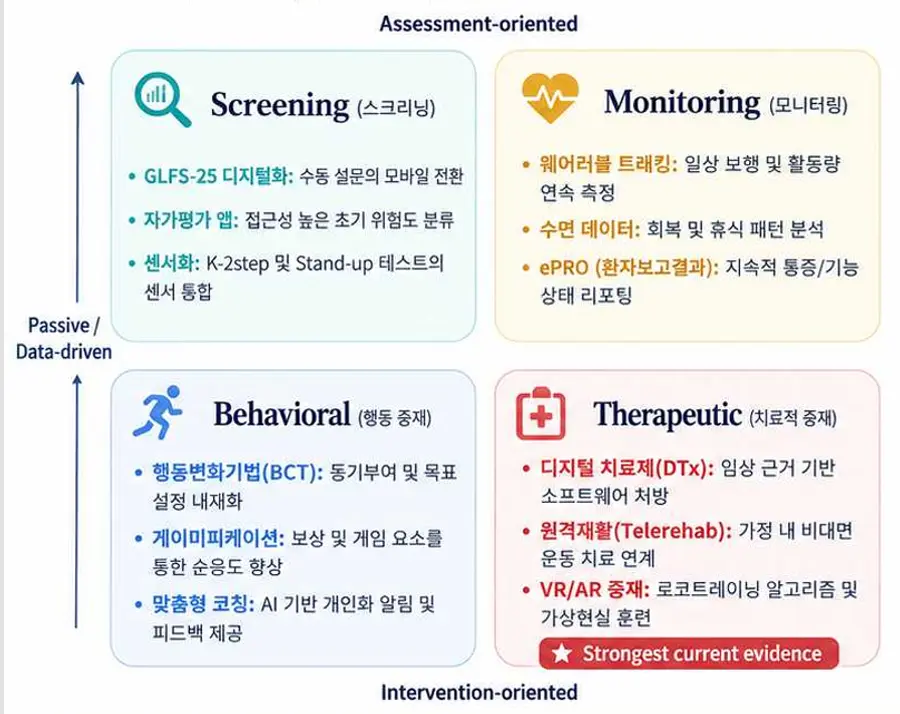
These digital interventions span four primary tracks: screening for risk, monitoring daily activity, behavioral coaching for motivation, and therapeutic interventions such as robot-assisted rehabilitation or evidence-based digital therapeutics. According to Park, virtual reality- and robot-assisted training currently show the strongest clinical evidence for long-term adherence.
However, digital tools serve to support, not replace, medical care. Wearables and smartphones allow clinicians to verify whether treatment plans established in the clinic are being maintained in daily life. Still, limitations persist: study syntheses show that digital engagement drops sharply between one and three weeks, reaching a 25% to 40% dropout rate by week eight—often due to overly complex instructions, fluctuating pain, or isolated training.
Warning Signs That Warrant Medical Attention
If you frequently experience near-falls or find yourself unable to walk for more than 15 minutes without resting due to leg numbness, prompt medical evaluation is necessary. Persistent pain in the lower back, hips, or wrists following a minor impact, or joint pain that curtails daily outings, also signals the need for professional care.
Prof. Kim Mi-ji of the Department of Convergence Medical Science at Kyung Hee University highlights locomotive syndrome as "a critical early warning sign on the path toward frailty and long-term care dependency." Identifying and addressing these deficits early prevents severe outcomes like debilitating fractures or loss of independence.
Exercise remains crucial. However, for those sidelined by pain, the initial prescription should never be to simply "walk more." Pinpointing the exact cause of mobility loss is the essential first step toward helping individuals regain the strength to walk again.