When holding your parents' hands, a noticeably weaker grip should not be brushed off as a harmless part of aging. Struggling more than before to open a plastic bottle cap or wring out a wet towel can be an early sign that their overall muscle strength is declining.
According to a national health study, one in four South Koreans aged 80 and older suffers from sarcopenia—the age-related loss of muscle mass and function. Older adults with reduced handgrip strength face significantly higher rates of difficulty with everyday functions like walking and chewing. Furthermore, among individuals aged 65 to 74, those with weak grip strength showed a sevenfold increase in the prevalence of depressive symptoms.
The Korea Disease Control and Prevention Agency (KDCA) released these findings on Aug. 10 after analyzing sarcopenia and health status data among adults aged 65 and older from the Korea National Health and Nutrition Examination Survey.
High Prevalence in Later Life and Key Diagnostic Thresholds
The KDCA analysis revealed that sarcopenia affects 26.9% of adults aged 80 and older.
The prevalence varied by sex and age group. Among adults aged 65 to 69, sarcopenia was more common in women (5.8%) than in men (2.6%). However, starting in their 70s, the trend reversed, with men recording higher rates of muscle loss than women.
In the study, sarcopenia was defined by more than just low muscle volume alone. Participants were diagnosed with sarcopenia if their maximum grip strength—measured across two trials on either or both hands—fell below 28 kilograms for men or 18 kilograms for women, and their height-adjusted appendicular lean mass measured via dual-energy X-ray absorptiometry (DXA) was below 7.0 kilograms per square meter for men or 5.4 kilograms per square meter for women.
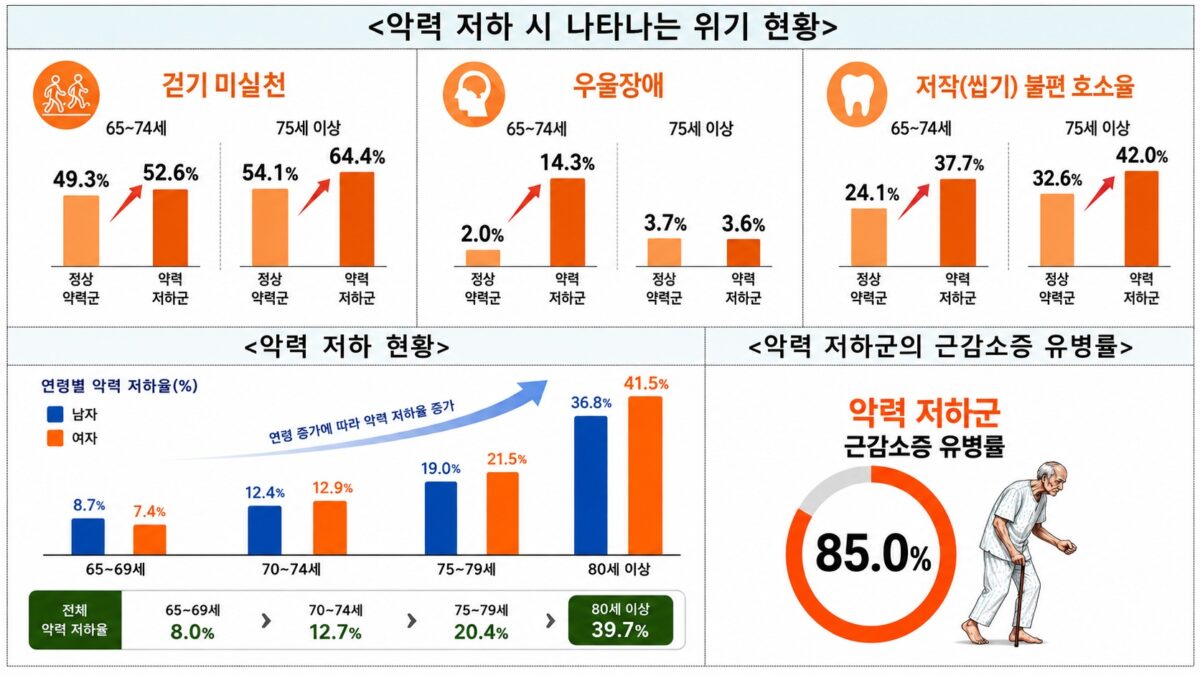
Separate from a full sarcopenia diagnosis, weak grip strength was categorized strictly by handgrip measurements below those same weight thresholds (28 kg for men, 18 kg for women). Among those in the weak-grip category, 85.0% also met the criteria for sarcopenia.
While clinical hand dynamometers provide the most accurate measurements, the KDCA noted that family members can spot warning signs in everyday life. Paying attention to whether a parent struggles to wring out towels, open bottle caps, or offer a firm handshake can provide an informal early signal of changing muscle strength.
Links to Depression, Chewing Difficulties, and Reduced Mobility
The data highlighted a strong correlation between weak grip strength, mental health vulnerabilities, and functional impairment.
Among seniors aged 65 to 74, the prevalence of depressive symptoms reached 14.3% in the weak-grip group—more than seven times the 2.0% rate recorded among those with normal grip strength. In this study, depressive symptoms were evaluated using the Patient Health Questionnaire-9 (PHQ-9), with a score of 10 or higher out of 27 indicating clinical depression. While weak grip strength does not directly cause depression, the two conditions frequently co-occur.
Reduced grip strength also coincided with oral and physical mobility challenges. In the 65-to-74 age bracket, 37.7% of the weak-grip group reported difficulty chewing food due to dental, denture, or gum issues, compared with 24.1% of those with normal grip strength.
For adults aged 75 and older, the divide was even wider. In the weak-grip group, 64.4% failed to meet basic walking activity standards (defined as walking at least 10 minutes continuously, for a total of at least 30 minutes a day, five or more days a week), compared to 54.1% in the normal-grip group. Reported chewing difficulties for this older bracket stood at 42.0% for the weak-grip group versus 32.6% for the normal-grip group.
Early Warning Signs for Frailty and Prevention Steps
Health authorities emphasize monitoring grip strength because it offers an accessible early indicator not only for sarcopenia but also for broader physical frailty.
Frailty represents a state where physiological and cognitive reserves decline, making it harder for the body to recover from physical stressors like infections or surgeries. Core signs include unintentional weight loss, chronic fatigue, reduced activity levels, slower walking speeds, and declining muscle strength.
“Older adults gradually transition from healthiness to severe frailty, making early detection and intervention crucial while the condition is still reversible,” said Park Ki-soo, a professor at Gyeongsang National University College of Medicine. “A weakening grip is an important sign that multiple frailty risk factors, including sarcopenia, may be clustering together, so it should be routinely monitored.”
The KDCA recommends checking a parent's food intake, weight changes, walking speed, overall activity, and mood whenever a decline in hand strength is noticed. Tools like the Korean Frailty Assessment and Reference tool (K-FRAIL) questionnaire can help families evaluate overall risk.
For seniors struggling with chewing, soft, protein-rich foods like steamed eggs or tofu can help maintain nutrition without causing discomfort. To manage pre-frailty, health experts advise combining aerobic exercise with resistance training, quitting smoking, limiting alcohol intake, ensuring adequate protein consumption, and maintaining active social connections.
“Frailty progresses gradually, but early detection and proactive management can go a long way toward preserving independence in older age,” said Lim Seung-kwan, commissioner of the KDCA. “Each time you visit your parents, hold their hand and check their grip. Paying close attention to their meals, activity, and emotional state is a simple yet vital first step in protecting their health.”