When patients are told something looks abnormal in their pancreas, many begin worrying about hospital admission even before receiving test results. Until recently, a pancreatic biopsy required waiting for an available bed and staying in the hospital for two nights and three days. That timeline has now been reduced to a single day.
Asan Medical Center in Seoul announced on August 5 that it has surpassed 1,000 cases since becoming the first hospital in South Korea to introduce a same-day pancreatic biopsy system in March 2024. The hospital reported a diagnostic accuracy exceeding 95% and a complication rate below 1%.
Pancreatic Cancer Often Detected at Advanced Stages
Pancreatic cancer rarely produces noticeable symptoms in its early stages, meaning many cases are detected only after the disease has significantly progressed.
According to the Korea Central Cancer Registry, 9,748 new cases of pancreatic cancer were reported in South Korea in 2023, accounting for 3.4% of all cancer diagnoses and ranking eighth in incidence. The five-year relative survival rate for patients diagnosed between 2019 and 2023 stood at just 17.0%.
At the time of diagnosis, only 14.3% of patients had localized tumors confined to the pancreas. Conversely, 43.3% were diagnosed at the distant metastasis stage, after the cancer had spread to other organs. While the five-year survival rate reached 47.8% when the cancer was localized, it dropped sharply to 2.4% for cases diagnosed at the distant metastasis stage.
Precise Biopsy via Endoscopic Ultrasound
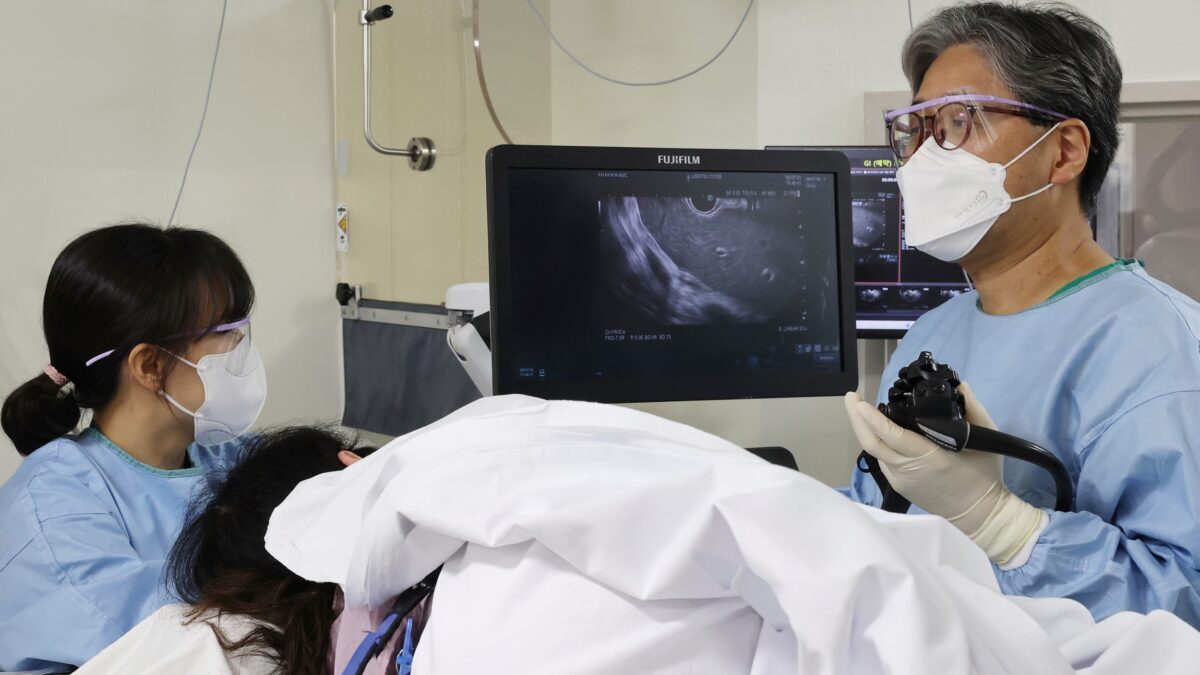
When pancreatic cancer is suspected, physicians typically perform a biopsy using endoscopic ultrasound (EUS). An endoscope is inserted through the mouth into the stomach and duodenum, where an ultrasound probe at the tip evaluates the adjacent pancreas and surrounding blood vessels. Guided by real-time ultrasound imaging, clinicians insert a thin needle into the lesion to collect cell or tissue samples.
Because the pancreas lies deep behind the stomach adjacent to major blood vessels and the bile duct, needle placement requires exceptional precision. Consequently, operator experience plays a critical role in both procedural success and patient safety.
Current international clinical guidelines recommend core needle biopsy techniques that extract intact tissue architecture rather than simple cell aspiration, as core samples yield higher diagnostic accuracy and more comprehensive material. Biopsies are used not only to confirm malignancy, but also to rule out benign inflammatory masses or cysts that mimic cancer on imaging and to profile tumor characteristics for personalized treatment planning.
Same-Day Procedure and Accelerated Treatment Planning
Previously, patients undergoing a pancreatic biopsy were hospitalized for two nights and three days to monitor for potential complications such as bleeding or acute pancreatitis. Coordinating hospital admission schedules and securing a bed often added weeks to the waiting period.
Under Asan Medical Center's same-day system, medical staff evaluate the patient's overall health and lesion location to determine eligibility for an outpatient procedure. Selected patients undergo the biopsy under conscious sedation and return home the same day following recovery. The average time from the initial outpatient consultation to receiving final biopsy results is under one week.
Once results are confirmed, a multidisciplinary team—including gastrointestinal surgeons, medical oncologists, and radiation oncologists—convenes to decide the optimal treatment strategy, whether surgery, chemotherapy, or radiation therapy.
While a biopsy is not always required prior to immediate surgical resection when imaging unequivocally indicates operable cancer, it remains essential when chemotherapy must begin before surgery.
Although shortening the testing period does not raise survival rates on its own, avoiding inpatient admission and receiving results sooner significantly eases the emotional burden on patients during the waiting period.
"We introduced this national-first same-day biopsy system to resolve the inconvenience and distress patients experienced while waiting for hospital beds," said Song Tae-joon, director of the Biliary Tract and Pancreatic Cancer Center at Asan Medical Center. "Through rapid and accurate diagnosis, we will continue providing patients with timely, tailored treatment opportunities."