The Health Insurance Review & Assessment Service (HIRA) has added hemorrhagic stroke to its annual evaluation—which previously focused primarily on ischemic stroke—and released the corresponding treatment outcomes for the first time.
An ischemic stroke occurs when a blood vessel in the brain is blocked by a clot or other obstruction, depriving brain tissue of blood flow. By contrast, a hemorrhagic stroke occurs when a cerebral blood vessel ruptures, causing bleeding within or around the brain.
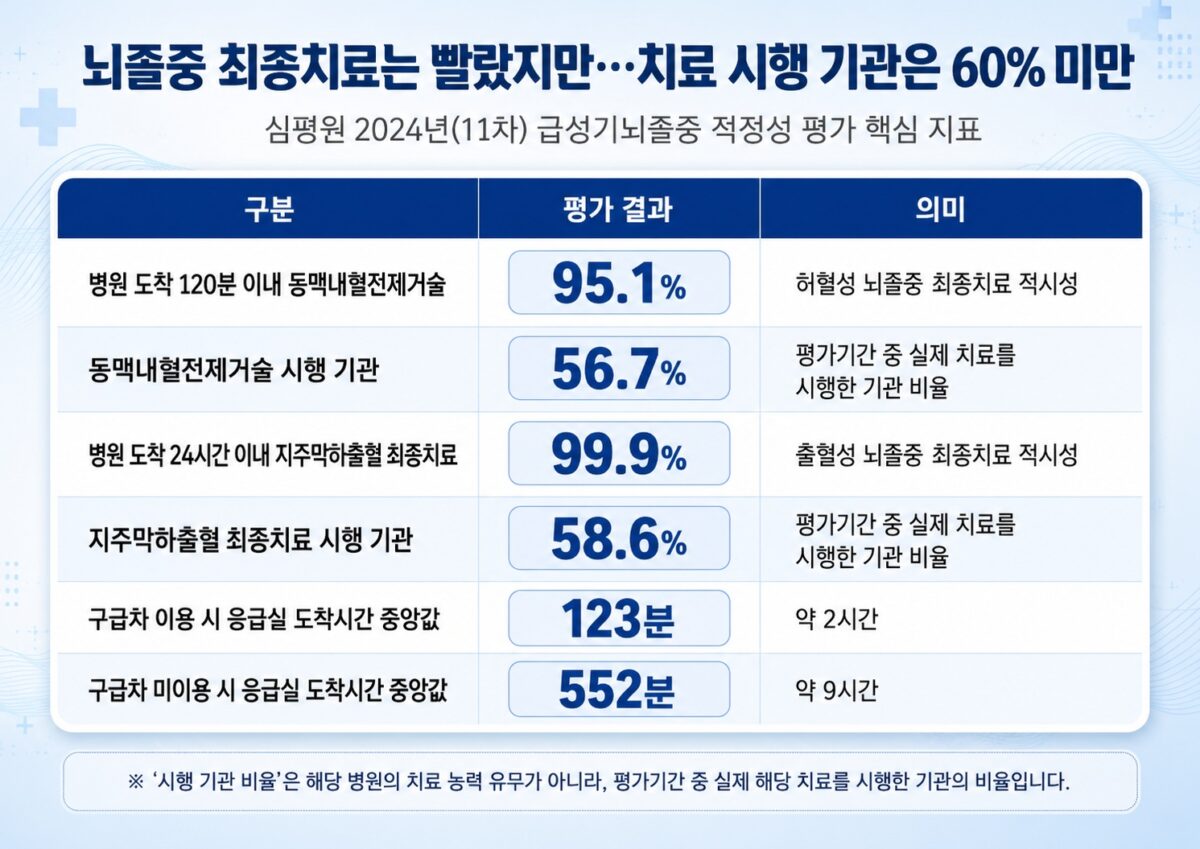
Among patients suffering from subarachnoid hemorrhage—a severe, representative form of hemorrhagic stroke—99.9% received definitive medical treatment within 24 hours of hospital arrival.
Subarachnoid hemorrhage occurs when blood leaks into the space between the brain and its surrounding membranes. It is most commonly caused by the rupture of a cerebral aneurysm—a balloon-like bulge in a weakened blood vessel wall—making rapid medical intervention essential.
However, this high rate of timely care does not mean patients can receive such treatment at any facility. During the evaluation period, medical institutions that actually performed definitive treatment for subarachnoid hemorrhage accounted for only 58.6% of all assessed hospitals.
On July 30, HIRA released the results of its "2024 (11th) Adequacy Evaluation of Acute Stroke Care."
The assessment expanded beyond ischemic stroke to include definitive treatment standards for hemorrhagic stroke.
99.9% receive definitive care for subarachnoid hemorrhage within 24 hours
For both ischemic and hemorrhagic strokes, treatment delays accelerate brain damage and significantly increase the risk of mortality or permanent disability. Consequently, minimizing the time from symptom onset to ER arrival and subsequent definitive care is critical.
The latest evaluation introduced a new indicator measuring how consistently hospitals deliver timely care.
Among ischemic stroke patients, 95.1% underwent endovascular thrombectomy within 120 minutes of reaching the hospital. Endovascular thrombectomy is a procedure in which a catheter is inserted through a blood vessel to directly retrieve a blood clot blocking a cerebral artery.
Among hemorrhagic stroke patients presenting with subarachnoid hemorrhage, 99.9% received definitive care within 24 hours of arrival.
Definitive treatments for subarachnoid hemorrhage primarily include cerebral aneurysm clipping and endovascular embolization. Surgical clipping involves opening the skull to place a tiny metallic clip across the neck of the aneurysm, halting blood flow into it. Endovascular embolization, conversely, is a minimally invasive procedure where a catheter deploys delicate metal coils into the aneurysm to seal it off internally.
These figures demonstrate that among patients who underwent these procedures, nearly all received definitive care within the clinical timeframe set by HIRA.
Timely-treatment rate is high, but under 60% of institutions perform procedures
However, a high rate of timely care does not imply that every hospital evaluated is equipped to perform these advanced procedures.
Across all evaluated medical institutions, only 56.7% performed endovascular thrombectomy. Similarly, institutions that actually carried out definitive treatment for subarachnoid hemorrhage stood at just 58.6%.
This distinction is crucial when interpreting the data. The 99.9% metric measures the proportion of patients who received timely intervention among those who actually underwent treatment. The 58.6% metric reflects the percentage of evaluated hospitals that actually performed definitive care for subarachnoid hemorrhage during the evaluation period.
Therefore, the 99.9% timely-treatment rate should not be interpreted to mean that definitive care for subarachnoid hemorrhage is available at every hospital.
At the same time, this does not automatically mean the remaining hospitals lack treatment capacity entirely; rather, the 58.6% metric tracks whether the procedure was actively performed during the designated assessment period.
Based on these findings, HIRA concluded that significant gaps exist among hospitals regarding their operational capacity to provide definitive care for acute, severe stroke cases.
For patients experiencing stroke symptoms, reaching an emergency room quickly is vital, but being routed immediately to a facility capable of performing definitive procedures is equally critical.
Ambulance users: 123 minutes vs. non-users: 552 minutes
The evaluation also highlighted substantial variations in the time required for patients to reach emergency departments.
The median time from symptom onset to ER arrival was 3 hours and 28 minutes, representing a 16-minute improvement compared to the 10th evaluation cycle.
For patients transported by ambulance, the median time from symptom onset to ER arrival was 123 minutes (about 2 hours). For non-ambulance patients, the median time stretched to 552 minutes (about 9 hours)—a stark difference of 429 minutes, or more than 7 hours.
HIRA noted, however, that ambulance usage alone cannot be conclusively credited for the seven-hour difference, as external factors—such as symptom severity, patient awareness, and caregiver response times—may also influence emergency transport decisions.
Because stroke is a medical emergency where every minute of delay increases tissue damage, individuals should immediately call emergency services if they experience sudden slurred speech, facial drooping, one-sided weakness in the arms or legs, or an unprecedented severe headache.
44.8% of institutions meet standards for a stroke intensive care unit
Hospital infrastructure and specialized staffing dedicated to stroke care improved relative to the previous evaluation.
A stroke intensive care unit is a dedicated ward equipped with specialized medical personnel and monitoring equipment to manage acute stroke patients. Institutions meeting all required standards—including physician and nursing coverage, dedicated facilities, and equipment—accounted for 44.8% of evaluated hospitals, a 12.7 percentage point increase from the 10th evaluation.
Disparities by hospital tier remained wide. While 100% of tertiary general hospitals met all stroke ICU standards, only 33.3% of general hospitals fulfilled the criteria.
In-hospital pneumonia rates stood at 1.9% for hemorrhagic stroke patients and 1.6% for ischemic stroke patients. The 30-day post-hospitalization mortality rate was 11.4% for hemorrhagic stroke compared to 2.9% for ischemic stroke.
HIRA cautioned against directly comparing mortality rates between the two types of stroke, as underlying patient severity and clinical conditions differ substantially.
112 institutions earn Grade 1, distributed across all regions
Out of 268 evaluated institutions, the average composite score was 85.17 points. Tertiary general hospitals averaged 99.25 points, whereas general hospitals averaged 82.22 points.
A total of 112 hospitals (41.8%) earned a Grade 1 rating by scoring 95 points or higher. Among tertiary general hospitals, 45 out of 46 (97.8%) achieved Grade 1, compared to 67 out of 222 general hospitals (30.2%).
Geographically, Grade 1 institutions include 28 in Seoul, 32 in Gyeonggi, 26 in Gyeongsang, 13 in Chungcheong, 8 in Jeolla, 3 in Gangwon, and 2 in Jeju.
HIRA emphasized that receiving a Grade 1 rating reflects a high composite score across multiple clinical indicators, but does not guarantee that a hospital performs every specific type of definitive stroke procedure.
The list of Grade 1 institutions by region is accessible via HIRA's official website, the integrated hospital evaluation portal, and the "Health e-Eum" mobile application.
"Because the time from symptom onset to definitive care is the single most critical factor determining stroke patient survival and long-term prognosis, we will continuously refine our adequacy evaluations," said Hong Seung-kwon, president of HIRA. "Our goal is to shorten treatment delays and strengthen overall medical capacity across institutions nationwide."