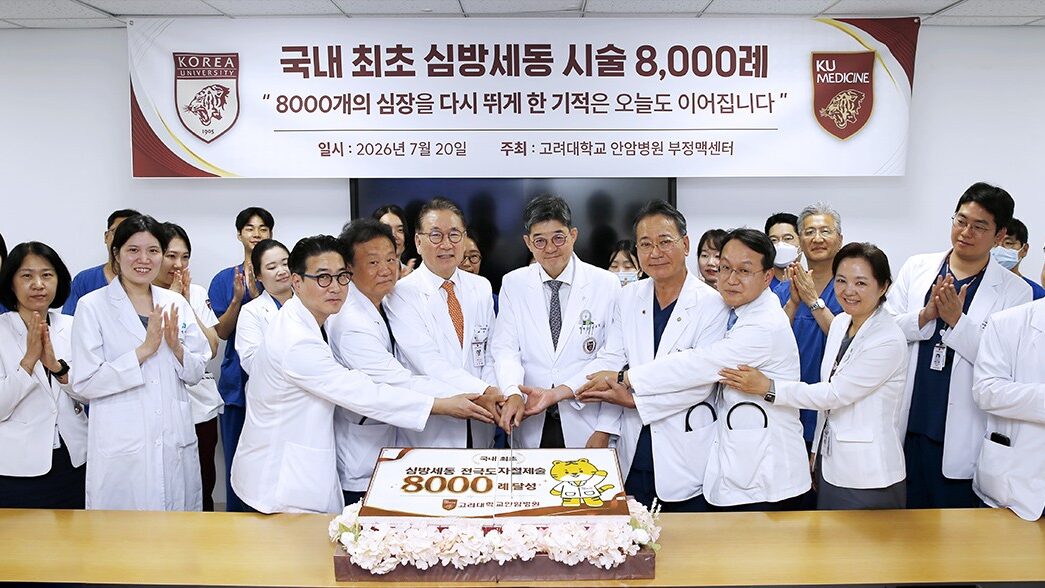
Korea University Anam Hospital has achieved a cumulative total of 8,000 atrial fibrillation procedures—a nationwide first coming 28 years after the institution performed South Korea’s initial catheter ablation for the condition in 1998.
The hospital’s Arrhythmia Center announced on the 24th that it crossed the 8,000-procedure threshold in April, marking an unprecedented record among domestic medical institutions. A commemorative ceremony took place on the 20th.
The cumulative total encompasses both conventional radiofrequency catheter ablation and recently adopted pulsed field ablation (PFA) techniques.
Catheter ablation is a minimally invasive technique where a thin tube is routed to the heart through a blood vessel, typically in the groin, to block the pathway of abnormal electrical signals causing the arrhythmia. High-frequency heat is applied to target tissues to disrupt these irregular signals. Unlike traditional open-heart surgery, the procedure accesses the interior of the heart entirely through the vascular system.
Atrial fibrillation is a form of arrhythmia characterized by rapid, irregular quivering of the heart's upper chambers (atria). When the atria fail to contract properly, pooled blood can form clots; if a clot travels to and obstructs a cerebral vessel, it triggers a stroke. Prolonged atrial fibrillation also degrades cardiac function, significantly elevating the risk of heart failure.
Pulsed Field Ablation: Utilizing Electric Fields Over Thermal Energy
Unlike conventional ablation methods that rely on high-frequency heat, pulsed field ablation applies high-voltage electric fields in microsecond bursts. This selectively targets and disables myocardial cells responsible for the arrhythmia, blocking abnormal signal pathways.
Because it eliminates thermal energy, PFA minimizes the risk of collateral damage to surrounding esophageal tissues and nerves. However, it is not a universal substitute. Clinicians carefully select the procedure by evaluating variables such as the duration of the condition, cardiac anatomy, prior treatments, and recurrence history.

Korea University Anam Hospital also recently surpassed 100 PFA procedures. In recognition of this milestone, the hospital was designated a "Center of Excellence" by Boston Scientific, the U.S. medical device manufacturer that supplies the PFA equipment. Moving forward, the hospital plans to share its procedural expertise and offer clinical training to domestic and international medical personnel.
With national health insurance coverage expanding to cover PFA, the financial burden on patients has decreased. Clinicians can now readily select between conventional catheter ablation and pulsed field ablation based on individual clinical indications.
Mapping Cardiac Electrical Signals via 3D Navigation
Since performing South Korea's first successful atrial fibrillation catheter ablation in 1998, Korea University Anam Hospital established its specialized Arrhythmia Center in 2004. The center has steadily achieved milestones, previously passing 1,000, 3,000, and 5,000 procedures before reaching 8,000 this year.
The Arrhythmia Center utilizes an advanced 3D mapping system that displays the heart's anatomical structure alongside real-time electrical signal propagation in three dimensions. Using these visual insights, clinicians pinpoint the exact origin and pathways of the irregular electrical activity.
Treatment plans are customized through a comprehensive assessment of the type and duration of atrial fibrillation, cardiac structure, and prior clinical outcomes. Clinicians select either radiofrequency catheter ablation or electric field-based PFA, occasionally integrating supplementary modalities such as alcohol infusion therapy depending on patient complexity.
"Reaching 8,000 atrial fibrillation procedures is more than a simple milestone count; it reflects decades of accumulated clinical experience and research dedicated to providing optimal patient care," said Choi Jong-il, Professor of Cardiology at Korea University Anam Hospital.
"Because every atrial fibrillation patient presents unique cardiac anatomy, arrhythmia patterns, and risk factors, precise diagnosis and personalized treatment strategies are paramount," Professor Choi added. "Leveraging our state-of-the-art infrastructure and expert medical staff, we will continue delivering tailored care while elevating the standards of atrial fibrillation management in South Korea through advanced techniques and ongoing clinical research."