Editor’s note: In Japanese orthopedics, specialists define "locomotive syndrome" as a condition where declining function in bones, joints, muscles, and nerves reduces mobility, serving as an early indicator to spot frailty and the need for long-term care. With help from South Korean experts, Kormedi.com is taking a six-part look at early warning signs that appear in daily life—such as putting on socks, climbing stairs, and crossing the street.
If your knees hurt, you cut back on how long you walk. If your back hurts, you put off going out. At first, it feels like the sensible choice: you rest because you are in pain. But a few months later, stairs feel even harder, and even grocery shopping becomes a struggle. You start to wonder, "I rested—so why am I weaker?"
Pain in older age is not just a problem in the body part that hurts. Pain reduces activity, and reduced activity leads to a loss of strength. As strength declines, balance worsens, and when balance falters, the risk of falls rises. That vicious cycle fuels locomotive syndrome—a state in which the functions of bones, joints, the spine, muscles, and nerves decline together, weakening the ability to walk and move. Among older adults with overlapping conditions such as knee osteoarthritis, lumbar spinal stenosis, osteoporosis, and sarcopenia, one problem often triggers or worsens another.
Yoo Jun-il, a professor in the Department of Orthopedic Surgery at Inha University Hospital, explained, "Resting because you are in pain is a natural response at first, but the problem is when that period drags on. Even if activity drops for just two to three weeks, lower-body muscles noticeably weaken." He added that when you walk less because of pain, a vicious cycle begins in which your very ability to walk declines.
Where the Vicious Cycle Starts—and Where to Break It
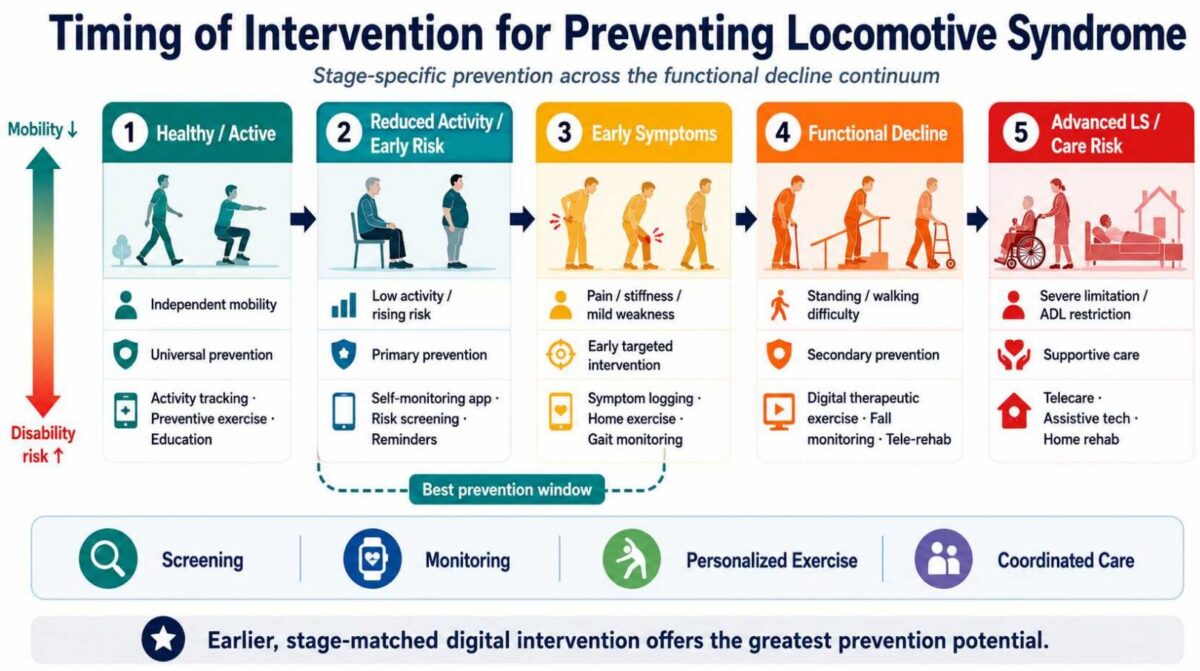
This vicious cycle is supported by research. A concept map of locomotive syndrome presented at the 77th Spring Scientific Meeting of the Korean Geriatrics Society by Park Hyun-tae, a professor at Dong-A University and the Digital Healthcare Research Lab, shows that pain, stiffness, muscle weakness, and reduced balance interlock in an interactive structure where each factor amplifies the others. This leads to difficulty standing up and walking, progressing to daily life restrictions, a lower quality of life, and eventually the need for long-term care.
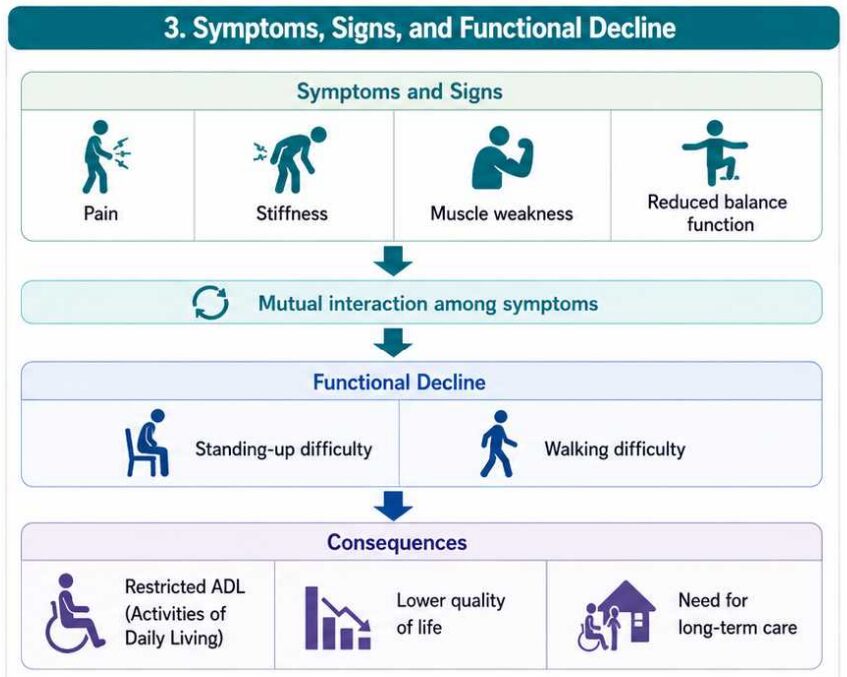
Park Hyun-tae divides this progression into five stages: Stage 1 (healthy and active), Stage 2 (activity decreases, risk rises), Stage 3 (early symptoms like pain and stiffness appear), Stage 4 (ability to stand and walk noticeably declines), and Stage 5 (daily life becomes severely restricted). He pointed to the transition from Stage 2 to Stage 3 as the best window for prevention. The easiest time to break the vicious cycle is before symptoms become obvious—when activity has only just begun to drop.
Asking yourself why resting has made you weaker may be a sign that you have already entered the early phase of this vicious cycle. Rather than letting a period of reduced activity simply pass, that is the crucial time to intervene.
Pain Cuts Steps—Fewer Steps Shrink Muscles
Knee osteoarthritis causes pain with every step, leading people to naturally reduce how far they walk. With lumbar spinal stenosis, walking causes legs to feel numb and heavy, forcing frequent rest stops. As this repeats, daily activity levels drop, causing a loss of thigh and hip muscles—the very muscles essential for standing up from a chair, climbing stairs, and catching yourself when you stumble.
As muscle mass declines, walking becomes unsteady even at the same pain level. Strides shorten, and toes catch on the ground more often. If osteoporosis is also present, the risk increases further. Losing balance and falling can result in wrist, spinal, or hip fractures, which reduce activity again and weaken muscles even more.
Neither Toughing It Out Nor Exercising Blindly Is the Answer
Simply enduring pain and pushing through is not the solution, but starting to walk or do squats without a plan can also be risky. Repeatedly doing stair workouts with severe knee pain can aggravate the joints, while forcing yourself to walk with spinal stenosis can worsen leg numbness.
You must first identify what is interfering with your gait—distinguishing whether pain, strength loss, fracture risk from osteoporosis, or neurogenic claudication is the primary issue before safely restarting exercise. Medications, injections, and physical therapy serve as a bridge to lower pain so you can move again; the ultimate goal of treatment is to walk again, stand up, and regain daily activity.
"If you receive pain treatment and assume you are cured without moving, the effect will not last long," said Professor Yoo Jun-il of Inha University Hospital. "The purpose of injections or medication is to control pain and create the conditions to walk again."
Treatment Needs to Get You Moving Again
Research shows that recovery improves when strength training is added after controlling pain. In a four-week study conducted in South Korea, participants who combined electrical muscle stimulation (EMS) with resistance exercise showed clearer improvements in strength, walking speed, and chair-stand times compared to those who did resistance exercise alone or received no intervention. This demonstrates that the vicious cycle can be broken when treatment goes beyond pain relief to restore physical strength.
Managing locomotive syndrome requires an integrated approach that addresses joints, the spine, muscles, and bones together to control pain, restore strength, regain balance, and prevent falls and fractures. While walking less when in pain may initially seem like a protective choice, prolonged inactivity accelerates weakness. The ultimate goal of pain treatment must be getting patients back on their feet.