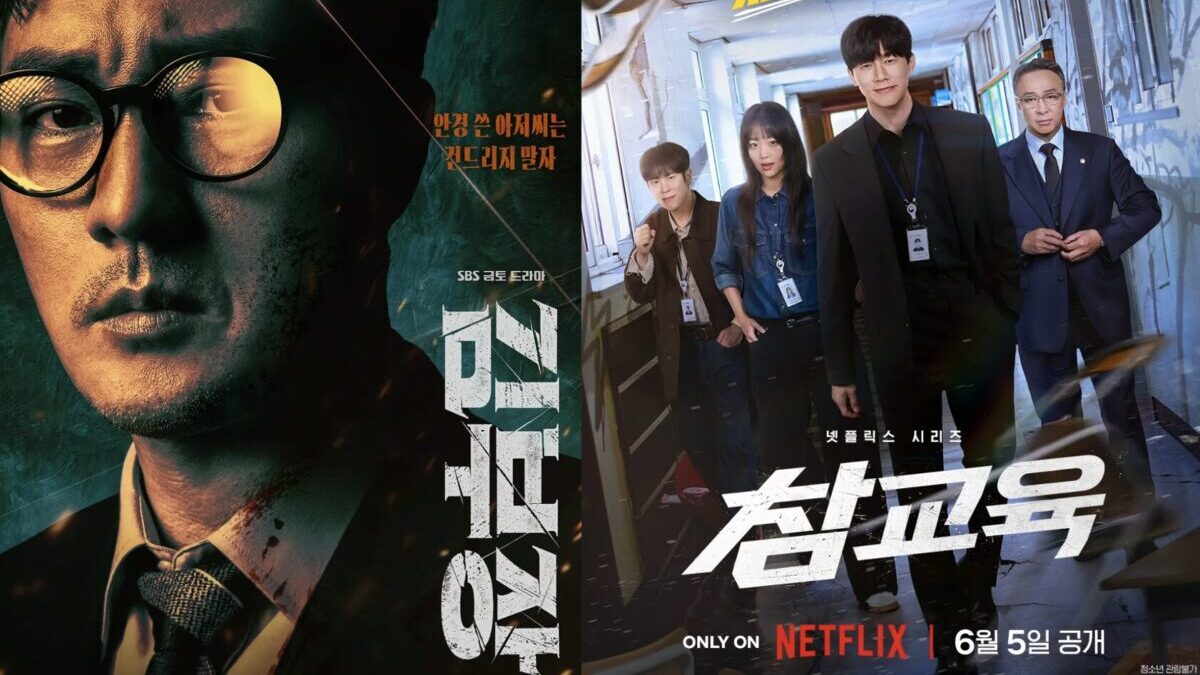
The ratings momentum behind the SBS Friday-Saturday drama Manager Kim has become impossible to ignore.
Starring So Ji-sub, the revenge drama follows a devoted father who embarks on a relentless quest to rescue his daughter after she falls into danger. On July 18, Episode 8 posted a 23.1% viewership rating, setting a new personal record for the series. The figure marks the second-highest rating in the history of SBS' Friday-Saturday drama slot—behind only The Penthouse 2 (29.2%)—surpassing the show's previous high of 22.3% set in Episode 6.
Meanwhile, Netflix's original series True Education has similarly dominated summer viewership. Netflix reported that True Education ranked No. 6 globally among its most-watched titles during the first half of 2026.
What links both hit series is their unhesitating portrayal of violence. In Manager Kim, bloody action sequences appear in nearly every episode as the protagonist pursues vengeance. Graphic depictions of bodily mutilation—including scalping—air unfiltered, evoking imagery more typical of youth-restricted feature films.
True Education follows a similar path. Its two lead characters, played by Kim Mu-yeol and Jin Ki-joo, belong to the "Teachers' Rights Bureau" under the Ministry of Education and employ indiscriminate physical force under the guise of disciplining students. The explicit nature of the show has sparked criticism, leading commentators to question whether solving violence with violence can truly be framed as proper education.
Is public anger driving the appetite for violent content?
Addressing the trend, a psychiatrist identified as Dr. A, who operates a clinic in Seoul's Gangnam District, pointed to recent psychological research examining content consumption habits. According to Dr. A, individuals experiencing negative emotional states are statistically more likely to seek out depressing, violent, or negative media.
Dr. A cited a January 2025 study published in a Nature sister journal, conducted by researchers from Stanford University, the Massachusetts Institute of Technology (MIT), and University College London. The study tracked 1,145 participants who were permitted free internet access for 20 minutes daily over five days, followed by mental health self-assessments.
The findings revealed that participants who consumed higher volumes of negative online content exhibited poorer mental health outcomes. Furthermore, a reverse correlation was observed: participants who reported feeling in a worse mood prior to going online were significantly more inclined to visit negative websites. The study highlighted a psychological feedback loop where consuming negative information heightens feelings of depression, which in turn drives individuals back toward distressing content.
"While verification of the direct causal relationship in this experiment remains ongoing, the concept that a negative psychological state inclines users toward negative and violent content is widely acknowledged by psychologists and psychiatrists," Dr. A noted. "Public taste tends to mirror the prevailing psychological climate. Consequently, the surge in popularity for content centered on graphic violence is difficult to view as a purely positive trend."
Media experts counter: Vigilante justice is a timeless formula
Media scholars, however, offer a different perspective, arguing that the popularity of violent vigilante narratives is far from a new phenomenon.
Yoo Kyung-han, a professor in the Department of Media Communication at Jeonbuk National University, expressed skepticism regarding claims of a sudden shift. "While some argue that works dealing with anger and violence have become uniquely popular recently, I find that hard to agree with," Yoo said. "Frustration with reality and a desire for justice have been best-selling themes throughout human history. Even classic literature like The Tale of Hong Gildong shares the exact same emotional core."
Yoo also highlighted how shifts in the media ecosystem influence viewing habits. "We are no longer in an era where audiences passively consume whatever is broadcast on television. In an age where viewers actively select content through streaming platforms like Netflix, attributing a show's success simply to a surge in public anger oversimplifies a complex dynamic," he explained.
Nevertheless, Yoo emphasized that experts should examine what resonates with audiences in these justice-driven narratives and apply those insights constructively.
"Why are Manager Kim and True Education major hits? Because they rely on emotional formulas that have always worked," Yoo noted. "However, we need to look closely at what viewers empathize with and where they find vicarious satisfaction. True catharsis doesn't come from watching a protagonist beat and destroy everything in sight—it comes when the justice portrayed on screen carries over into real life."