The idea of walking by thought alone—and even regaining sensations in the soles of the feet—is edging closer to reality. A South Korean research team is developing bidirectional Brain-to-Robot technology designed to artificially restore severed neural connections between the brain and the body, with the ultimate goal of helping patients with central nervous system injuries recover both mobility and sensation.
Seoul National University Hospital announced on June 16 that it has joined the Bidirectional Brain-to-Robot Technology R&D Consortium, a flagship project under the pan-ministerial Advanced Medical Device R&D Program. The hospital will oversee the critical clinical trials involving the surgical implantation of the brain-computer interface (BCI) chip, which serves as a core component of the effort.
The project is slated to receive a total of approximately 30 billion won, including 20.25 billion won in state funding, over a seven-year period spanning from 2026 through 2032. Researchers expect this initiative to open entirely new therapeutic possibilities for patients who have struggled to recover using existing therapies alone, including individuals managing spinal cord injuries, traumatic brain injuries, stroke, and Parkinson’s disease.
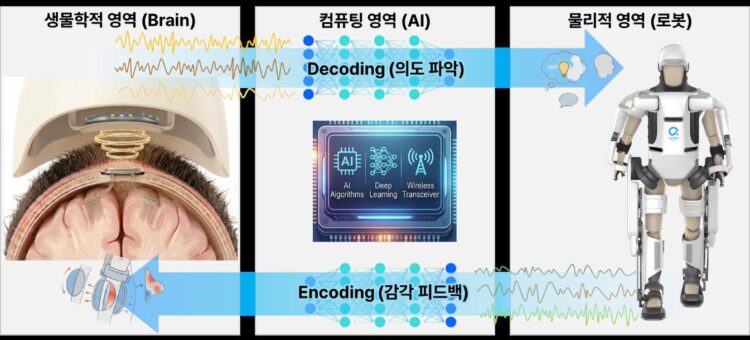
The underlying technology aims to do far more than simply move a robotic limb using brain signals. The objective is a fully bidirectional system created by implanting two distinct types of electrodes into a patient’s brain: a decoding electrode that reads behavioral intent and an encoding electrode that delivers sensory feedback. In this advanced configuration, the brain drives the robot, while tactile and pressure information detected by the robotic sensors is transmitted directly back to the brain.
For example, when a patient thinks, "I want to walk," the corresponding brain signal is transmitted to an exoskeleton robot to actuate the legs. Simultaneously, sensations such as the sole touching the ground, or tactile data from the fingertips, are sent back to the brain to be perceived as real physical sensation. The project aims to complete a fully bidirectional, closed-loop structure that returns this sensory information to the patient's brain within tens of microseconds.
Seoul National University Hospital will manage the project’s human clinical trials for implanting the neural BCI chip. A neurosurgery team led by Professor Baek Sun-ha plans to develop a precision surgical strategy that integrates and analyzes high-resolution MRI, MRA, DTI, and PET imaging to reconstruct each patient’s brain structure and vascular map in 3D. The team will then insert ultra-high-density electrodes into the motor and sensory cortex with an error margin of less than 1 mm.
The consortium unites domestic industry, academia, research institutes, and medical centers. The lead organization, Angel Robotics, will develop the full-body exoskeleton robot; DGIST and Nside will manufacture the cortical-implant electrodes; and KAIST will be responsible for somatosensory sensors and artificial intelligence (AI) signal processing. Clinical trials evaluating the exoskeleton robot will be conducted jointly across Severance Hospital, Gangnam Severance Hospital, Samsung Medical Center, and Pusan National University Hospital.
The research roadmap will proceed in three distinct phases. Phase 1 (2026–2027) will focus on securing high-density electrodes and core robotic technologies. Phase 2 (2028–2029) will integrate hardware and software components and initiate human clinical trials. In the final Phase 3 (2030–2032), the consortium aims to secure regulatory approval from the Ministry of Food and Drug Safety and commercialize a combination medical device that integrates a brain-neural interface, AI, and a powered exoskeleton robot into a single, unified system.
Professor Baek Sun-ha of Seoul National University Hospital’s Department of Neurosurgery said, "This research is a monumental initiative that goes far beyond simply developing a medical device; it breaks through the absolute limits of existing technology." He added, "We will commit our utmost efforts to this clinical research so that patients who have lost motor function due to central nervous system injuries can move again, feel again, and ultimately regain independent lives."