Are humans carnivores or herbivores? Most people answer with confidence: “Neither — we’re omnivores,” without a shred of doubt.
Why? Because that’s how they eat. But that conclusion comes from watching our own diets and the habits of people around us. To assess whether the human body is actually built for omnivory, you have to look closely at anatomy.
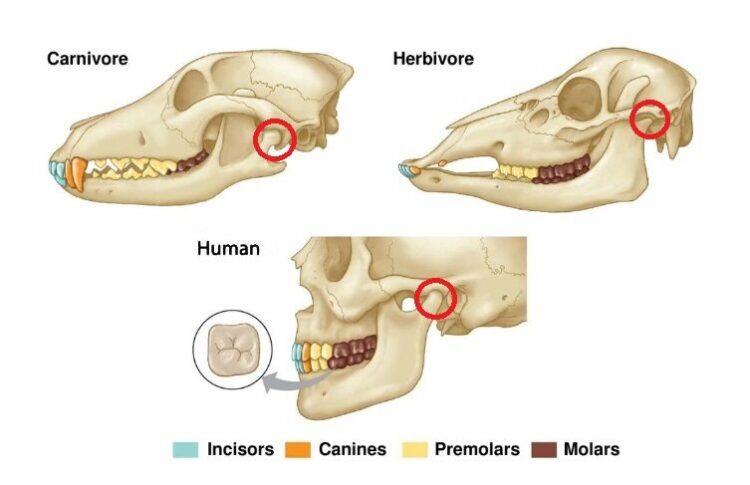
One objective way to judge which foods suit humans is to compare which other animals humans most closely resemble in anatomical and physiological traits [1, 2]. Key anatomical differences among carnivores (Carnivore), omnivores (Omnivore) and herbivores (Herbivore) include the following.
1. Mouth
Carnivores such as lions, tigers and wolves, and omnivores such as bears, raccoons and dogs, can open their mouths wide relative to head size, allowing them to seize prey and bite it to death [3]. A lion can open its mouth up to 28 cm [4]; a dog can open its mouth an average of about 10 cm/ [5]; and a human averages about 5 cm [6].
Herbivores such as rabbits, roe deer, deer, goats and sheep have relatively small mouths. Humans also have small mouths, which makes us closer to herbivores. Herbivores have well-developed facial muscles, thick lips and a muscular tongue that helps mix chewed food thoroughly with saliva. Humans do as well [7].
2. Temporomandibular joint
The temporomandibular joints of carnivores and omnivores are simple hinge-type joints located on nearly the same plane as the teeth, making biting and cutting forces very strong and stable. This helps subdue struggling prey or crush bones. When a carnivore closes its jaw, its teeth slice through prey powerfully like a pair of blades [8].
Herbivores’ temporomandibular joints sit much higher than the plane of the teeth, allowing a larger range of motion while chewing. This type of joint is less stable than the hinge joint of carnivores, but it favors forward-back and side-to-side movement, enabling the complex jaw motions needed to chew fibrous foods such as plants. The mandible (lower jawbone) of herbivores shows clear side-to-side movement while eating; this lateral motion is essential for crushing and grinding food, and the same is true for humans.
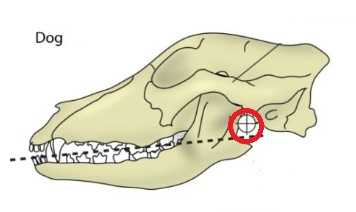
Think about mealtime for cats (carnivores) and dogs (omnivores). They do not chew much and swallow food whole. But if you watch herbivores such as rabbits or deer eat, they chew for a long time before swallowing, much like humans do.
3. Teeth
The incisors of carnivores and omnivores are short and sharp, with a peg-shaped form used to seize and cut prey. Herbivores’ incisors are wide and flat, spade-shaped, and interlock with each other, making them well-suited for peeling fruit, cutting and biting off pieces. Human incisors are similar to those of herbivores [9].
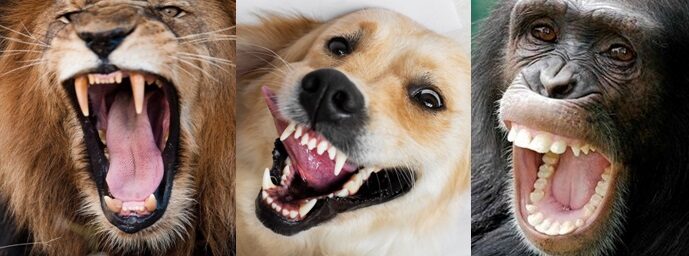
Carnivores’ canines are very long, pointed and sharp like knives, designed to pierce prey and deliver a fatal blow to major arteries or internal organs. Omnivores’ canines are somewhat shorter than those of carnivores, but they remain formidable for gripping and tearing prey. Herbivores’ canines are small and blunt, not threatening, and function like incisors.
Take a look at the photo below. Which animal are our canines closest to?
The premolars (premolar, small molars or front molars) and molars (molar, large molars or back molars) of carnivores and omnivores are triangular and interlock top-to-bottom like scissors, functioning to sharply shear food.
By contrast, the molars of herbivores and humans are square-shaped with flat chewing surfaces. They cannot shear; instead, their chewing surfaces have ridges and depressions that move horizontally to crush and grind food, functioning like a mortar and millstone [10]. The anatomical structure of the human oral cavity is closer to that of herbivores than to carnivores or omnivores.
Song Mu-ho, MD, orthopedic surgery and lifestyle medicine specialist

References
1. RPA https://www.rpaforall.org/animal-abuse-its-why-we-suffer/the-comparative-anatomy-of-eating/
2. MR Mills. The comparative anatomy of eating. ecologos. org. 1996 [Accessed 12 Febraury 2016].
3. J Bourke, S Wroe, K Moreno, et al. Effects of gape and tooth position on bite force and skull stress in the dingo (Canis lupus dingo) using a 3-dimensional finite element approach. PLoS One 2008;3(5):e2200.
4. Britannica https://kids.britannica.com/students/article/lion/275490
5. M Gracis, E Zini. Vertical Mandibular Range of Motion in Anesthetized Dogs and Cats. Front Vet Sci 2016;3:51.
6. Cleveland Clinic https://my.clevelandclinic.org/health/diseases/24086-trismus
7. SW Herring, SE Herring. The Superficial Masseter and Gape in Mammals. The American Naturalist 1974;962(108):561-576.
8 K Schwenk. Feeding: form, function and evolution in tetrapod vertebrates. Academic Press, 2000.
9. S Hillson. Teeth. Cambridge University Press, 2005.
10. PS Ungar. Mammalian dental function and wear: A review. Biosurface and Biotribology 2015;1(1):25-41.