In last week’s 128th column, titled “Telling people to eat more protein while cutting saturated fat?” (Kormedi.com, May 21, 2026), I wrote that the Dietary Guidelines for Americans (DGA), released in January 2026, contain several serious errors.
To briefly recap, I argued that the first error is that the guidelines encourage animal-based protein at every meal and make protein intake the top priority of eating. In particular, they raised the recommended daily protein intake to 1.2 to 1.6 g/kg, nearly double the previous recommendation of 0.8 g/kg.
The Saturated Fat Problem That Follows Protein Recommendations
Most people already consume more than enough protein, exceeding recommended amounts. Excess protein intake can cause side effects including increased diabetes, reduced kidney function, osteoporosis, and higher rates of cardiovascular disease [1].
The second error, I wrote, is that the guidelines present saturated fat from animal foods as healthy fat. However, excessive saturated fat intake raises blood triglycerides and levels of bad cholesterol (LDL), triggers atherosclerosis, and increases the risk of heart disease and stroke [2].
It also causes insulin resistance, raising the risk of developing diabetes [3]. A 2024 meta-analysis found that groups with high saturated fat intake had significantly increased risks of breast cancer, prostate cancer, and colorectal cancer [4].
Reducing Obesity and Diabetes While Recommending More Meat?
Next, I want to point to another error. The preface to the new guidelines says the policy is meant to address a serious problem: more than 70% of U.S. adults are overweight or obese, and about one-third of U.S. adolescents (ages 12 to 17) are already in the prediabetes stage. But if people follow this policy, it could further damage Americans’ already worsening health [5, 6]. It’s ironic.
Cheryl Anderson, a professor at the University of California, said, “It seems like it will be difficult to keep saturated fat intake within 10% of total calories. This could come across as a confusing message to the American public.” If the U.S. Department of Agriculture (USDA) interprets the guidelines to include more meat in school meals, she warned, “diet-related chronic diseases like diabetes and obesity will increase enormously among children,” producing the opposite result of what the government intends [7].
In addition, Frank Hu, a professor of nutrition at the Harvard T.H. Chan School of Public Health, also raised concerns that “the message in the new guidelines recommending animal foods rich in ‘saturated fat,’ such as red meat, butter, milk, and cheese, could lead to increased saturated fat intake, higher LDL cholesterol, and a higher risk of cardiovascular disease” [8].
Who Were the New Dietary Guidelines Really For?
With meat and dairy taking the most prominent place in the new dietary recommendations, other experts also pointed to another issue: “These guidelines appear to favor specific industries.”
In fact, an investigation found that eight of the nine members of the USDA scientific panel that produced the dietary guidelines had, in some form, received funding from the livestock or dairy-processing industries. It’s not hard to guess why the guidelines so strongly emphasized meat and milk [9, 10].
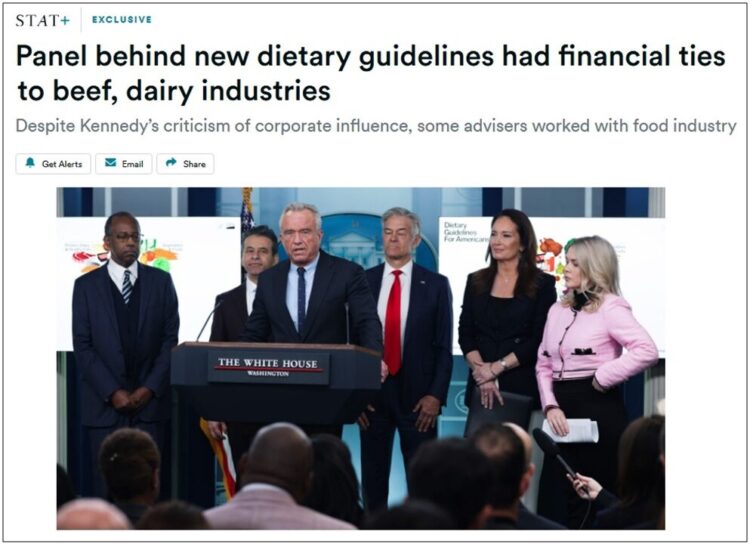
The New York Times also said in an editorial that the guidelines appear to benefit certain industrial sectors. The Center for Science in the Public Interest and the American Society for Nutrition, among other groups, criticized a lack of transparency in the guideline-development process, saying public trust has already been damaged and that their advice therefore cannot be trusted [11].
Walter Willett, a professor of nutrition at Harvard University, also weighed in, saying, “Because the USDA’s guidelines are heavily influenced by the food industry, they fail to adopt scientific truth and could harm Americans’ health” [12].
Why France Went the Other Way
Separately, around the time of the U.S. government’s announcement, the French government in February 2026 recommended reducing meat consumption—exactly the opposite of the United States [13].
One basis for French health authorities’ recommendation to cut meat intake is cancer prevention. In 2015, the International Agency for Research on Cancer (IARC), part of the World Health Organization (WHO), classified processed meats such as ham and sausages as a Group 1 carcinogen, with a high cancer risk like tobacco. It also classified red meats such as beef and pork as a Group 2A carcinogen, with a high likelihood of causing cancer, and previously announced that excessive intake increases colorectal cancer, pancreatic cancer, and prostate cancer [14].
Which country’s policy is more scientific? It is not right to say, “Eat more protein, consume enough dairy, and don’t be afraid of animal fats like beef tallow or butter.” That’s because it does not align with scientific facts [15].
Smart Alternatives for Protein and Fat
The new U.S. dietary guidelines read like an armchair policy that doesn’t understand (or ignores) reality. But there is a smart way to navigate contradictory guidance.
If you sharply increase protein intake as the guidelines recommend, saturated fat intake will inevitably rise as well. That’s because high-protein animal foods (meat, fish, milk, eggs, etc.) are not only high in protein but also high in saturated fat.
A smart way to consume fat is to choose foods other than animal products—namely nuts, seeds, olive oil, and avocados. These plant foods are low in saturated fat, high in unsaturated fat, and contain no cholesterol at all, making them good for cardiovascular health.
For protein, you can also choose foods other than animal products—legumes, nuts, seeds, and whole grains. These plant foods are not only high in protein, but also rich in dietary fiber, which animal foods lack, making them good for gut health as well. They also contain abundant other nutrients such as antioxidants, phytochemicals, vitamins, and minerals, making them effective for preventing various chronic diseases and promoting health.
The most powerful medicine for chronic diseases such as diabetes, high blood pressure, and heart disease is a whole-food, plant-based diet. I hope no one will foolishly harm their own health by following the contradiction-ridden new Dietary Guidelines for Americans.
Song Mu-ho, MD, is a specialist in orthopedic surgery and lifestyle medicine.
References
1. The Dong-A Ilbo https://www.donga.com/news/It/article/all/20260121/133199431/2 2. FM Sacks, AH Lichtenstein, JHY Wu, et al. American Heart Association. Dietary Fats and Cardiovascular Disease: A Presidential Advisory From the American Heart Association. Circulation 2017;136(3):e1-e23.
3. PK Luukkonen, S Sädevirta, Y Zhou, et al. Saturated fat is more metabolically harmful for the human liver than unsaturated fat or simple sugars. Diabetes care 2018;41(8):1732-1739.
4. J Mei, M Qian, Y Hou, et al. Association of saturated fatty acids with cancer risk: a systematic review and meta-analysis. Lipids Health Dis 2024;23(1):32.
5. CDC https://www.cdc.gov/nchs/fastats/obesity-overweight.htm
6. CDC https://gis.cdc.gov/grasp/diabetes/diabetesatlas-spotlight.html
7. The Guardian https://www.theguardian.com/us-news/2026/jan/17/rfk-jr-new-dietary-guidelines-health
8. Harvard T.H. Chan. Nutrition Source https://nutritionsource.hsph.harvard.edu/2026/01/09/dietary-guidelines-for-americans-2025-2030
9. Stat News https://www.statnews.com/2026/01/07/new-dietary-guidelines-review-panel-financial-ties-beef-dairy-industry/
10. Green Queen https://www.greenqueen.com.hk/us-dietary-guidelines-for-americans-2025-rfk-jr-letter/
11. New York Times https://www.nytimes.com/2026/01/09/well/dietary-guidelines-conflicts-of-interest.html
12. Harvard T.H. Chan School of Public Health. https://www.hsph.harvard.edu/nutritionsource/2016/01/07/new-dietary-guidelines-remove-restriction-on-total-fat-and-set-limit-for-added-sugars-but-censor-conclusions/
13. Kormedi.com https://n.news.naver.com/article/296/0000097543?lfrom=kakao
14. V Bouvard, D Loomis, KZ Guyton, et al. Carcinogenicity of consumption of red and processed meat. The Lancet Oncology 2015;16:1599-1600.
15. The cancer letter https://cancerletter.com/podcastc/20260408-dietary-guidelines/