The central focus of osteoporosis care is undergoing a significant shift. No longer does a diagnosis begin and end with a single bone mineral density (BMD) score.
Risk is now being stratified using the Fracture Risk Assessment Tool (FRAX), which integrates clinical risk factors with femoral neck BMD. For high-risk groups, a clearer clinical direction is emerging: providers must now plan not only which medication to initiate but also how to sequence therapies over the long term.
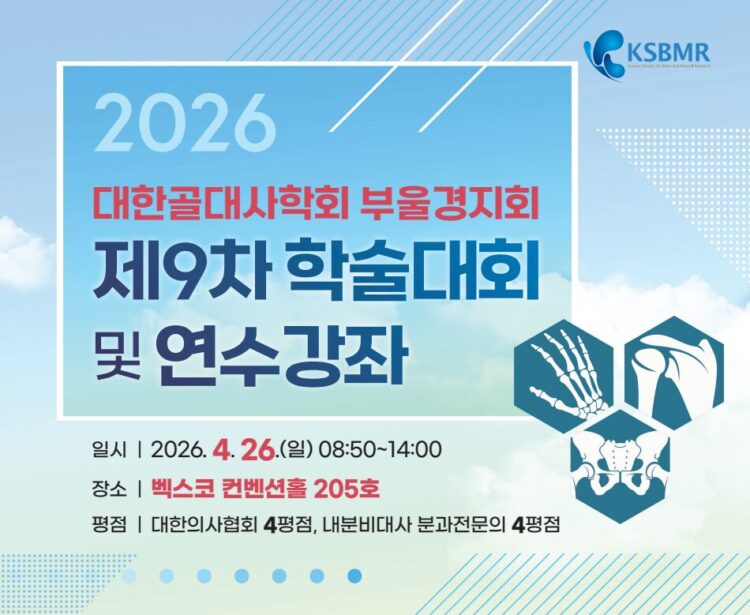
International medical societies are increasingly emphasizing fracture-prevention-oriented strategies and patient-tailored choices for both initial and subsequent treatments. The 9th Academic Conference, hosted by the Busan-Ulsan-Gyeongnam Branch of the Korean Society for Bone and Mineral Research (KSBMR) on April 26, offers a comprehensive review of these evolving trends. The event will take place at BEXCO in Haeundae, Busan (Convention Hall, Room 205).
The conference is organized around three primary pillars:
Bone biology essential for clinicians.
Rare diseases that must not be overlooked.
Real-world challenges in treatment selection.
"We are in an era where we must look broadly beyond simple BMD assessments to include functional improvement and quality of life," said Branch Chair Kim Tae-nyeon on April 16.
Menopausal Hormone Therapy: For Whom and to What Extent?
The third session, "Real Concerns in the Exam Room," directly reflects current shifts in bone metabolism research. Professor Lee Hyun-joo of Pusan National University (Department of Obstetrics and Gynecology) will present on "Menopausal Hormone Therapy and Fracture Prevention: When, for Whom, and in Which Formulation."
The Menopause Society (formerly the North American Menopause Society) reports that hormone therapy effectively reduces bone loss and fractures. Additionally, the 2024 UK National Osteoporosis Guideline Group (NOGG) suggests that hormone replacement therapy may be considered a first-line option for relatively younger postmenopausal women with a low risk of adverse effects but a high risk of fracture.
Following this, Professor Ha Jung-hoon of the Catholic University of Korea will discuss "Start Strong: Effective Use of Anabolic Agents in High-Risk Patients," while Professor Hong Nam-gi of Yonsei University will cover "Think Long: From Initial Selection of Antiresorptive Agents to Sequential Therapy." The program aims to address both the starting point of treatment and long-term sustainability.
The Resurgence of FRAX in Clinical Practice
The first session, "Bone Biology Clinicians Need to Know," is also highly practice-oriented. It will be chaired by KSBMR President Kim Sang-wan and Branch Chair Kim Tae-nyeon.
Professor Kim Beom-jun of the University of Ulsan will present on bone remodeling and modeling, followed by Professor Kwon Min-jung of Inje University on the "Proper Interpretation and Use of BMD Testing and FRAX." Professor Kim Du-hwa of Pusan National University will conclude the session with a discussion on the timing and application of bone turnover markers.
The strength of this session lies in its expansion of the assessment framework. FRAX estimates fracture risk by incorporating clinical variables that BMD alone cannot capture. Furthermore, bone turnover markers have been re-emphasized as critical indicators for assessing treatment adherence and the effectiveness of antiresorptive and anabolic therapies.
Addressing Rare and Overlooked Conditions
The second session, "Rare Diseases That Must Not Be Missed," will be chaired by Professors Choi Je-yong and Kim Bu-gyeong. Professor Choi Yong-jun of Ajou University will present on Paget’s disease and osteopetrosis, while Professor Hong A-ram of Chonnam National University will cover disorders of calcium metabolism.
This portion of the program is designed to move beyond routine care to address rare but significant conditions that are easily missed in general practice. Advance registration for the conference closes at 6:00 PM on April 20.