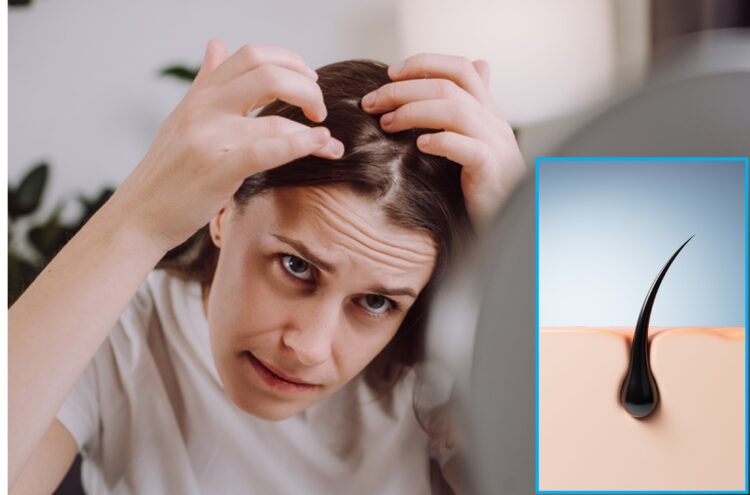
For decades, medical textbooks have taught a singular explanation for hair growth: cells divide rapidly at the hair root, creating a pressure that pushes the hair shaft upward. However, a groundbreaking study has produced findings that could completely overturn this conventional view. Rather than being pushed from below, hair may actually grow as cells inside the hair follicle act like tiny motors to "pull" the shaft toward the surface.
Advanced 3D Imaging Reveals "Cellular Motors"
Researchers from Queen Mary University of London and L’Oréal Research & Innovation reached this conclusion after observing human hair follicles cultured in a laboratory using advanced 3D real-time imaging technology.
The team identified a phenomenon in which cells in the outer root sheath—the tissue layer surrounding the hair—move along a spiral path. This specific cellular movement was found to match the region where the physical force pulling the hair upward is generated.
Ines Sequeira, PhD, a co-lead investigator at Queen Mary University of London, explained: “For a long time, hair was thought to be pushed upward by cell division in the hair bulb, but our findings identified a mechanism in which the surrounding tissue acts like a tiny motor to pull the hair shaft upward.”
Challenging the Role of Cell Division
To test their theory, the researchers conducted experiments that blocked cell division. Under the traditional model, growth should have stopped immediately. Instead, the hair follicles continued to produce hair at nearly the same rate.
In contrast, when the team disrupted actin—a protein essential for cell movement and contraction—hair growth speed plummeted by more than 80%. This suggests that the mechanical movement of cells, rather than just the creation of new ones, is the primary driver of growth.
“Using real-time 3D time-lapse microscopy, we were able to observe the movement patterns and mechanics of cells inside the hair follicle for the first time,” said first author Nicola Tissot, PhD.
New Frontiers for Hair Loss Treatment
The study, published in the international journal Nature Communications, provides vital new clues for hair-loss research. By shifting the focus from cell division to the physical forces and "motors" inside the follicle, scientists may be able to develop more effective hair-regeneration strategies. Understanding these mechanics could play a transformative role in future biological research and the treatment of various hair disorders.