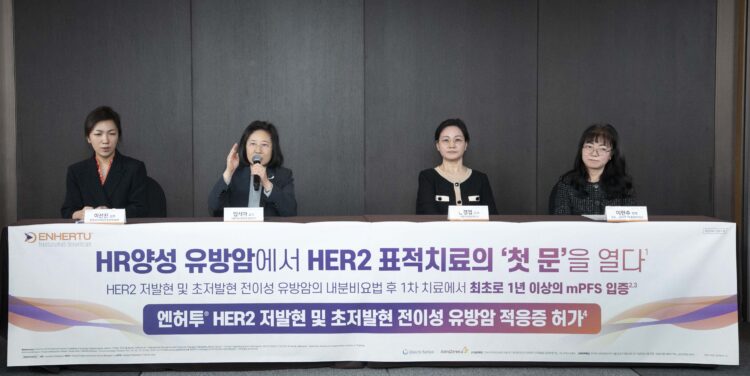
The treatment landscape for metastatic breast cancer is undergoing a significant shift. On February 20, Daiichi Sankyo Korea and AstraZeneca Korea announced that the Ministry of Food and Drug Safety has approved the antibody-drug conjugate (ADC) ‘Enhertu’ (trastuzumab deruxtecan) for patients with HER2-low and ultra-low expression metastatic breast cancer. This expansion is particularly vital for those with hormone receptor (HR)-positive cancer who have exhausted first-line endocrine therapy, as it offers a targeted alternative to traditional, high-toxicity chemotherapy.
Breaking the Chemotherapy Cycle After Endocrine Therapy
Enhertu’s new indication targets unresectable or metastatic breast cancer in patients who have received at least one endocrine therapy. Specifically, the approval covers HER2-low expression (IHC 1+ or IHC 2+/ISH-) and HER2-ultra-low expression (IHC 0 with membrane staining).
By targeting these specific receptors, Enhertu allows clinicians to move away from the traditional "one-size-fits-all" chemotherapy approach. Developed by Daiichi Sankyo and co-commercialized with AstraZeneca, the drug will be co-marketed in Korea, with Daiichi Sankyo Korea managing distribution.
DESTINY-Breast06: Progression-Free Survival Exceeding One Year
At a press conference in Seoul, Professor Lim Seok-ah of Seoul National University Hospital detailed the DESTINY-Breast06 study, which formed the basis for this approval. "In HR-positive metastatic breast cancer—a subtype highly prevalent in Korea—Enhertu proved more effective than existing cytotoxic chemotherapy once endocrine therapy failed," Professor Lim explained.
The study results were compelling. In chemotherapy-naive patients with HR-positive and HER2-low metastatic breast cancer, Enhertu improved the median progression-free survival (mPFS) to 13.2 months, compared to 8.1 months in the chemotherapy group. This represents a 38% reduction in the risk of disease progression or death. Crucially, patients maintained a higher quality of life for a longer duration, providing a much-needed strategic shift for those whose treatment options were previously limited.
While the safety profile remained consistent with previous studies, clinicians noted that 52.8% of the Enhertu group experienced grade 3 or higher adverse reactions. Monitoring for drug-related interstitial lung disease (ILD) remains a priority, as cases were reported across various grades during the trial.
The New Standard: Precise Diagnostics for Ultra-Low Expression
With treatment opportunities expanding, the role of the pathologist has become more critical than ever. Professor Gong Kyung-yeop of Asan Medical Center emphasized that determining the exact degree of HER2 expression is now the "key" to treatment strategy.
"Even patients previously classified as HER2-negative (IHC 0) may now be eligible if they show 'ultra-low' expression," Professor Gong stated. Current international guidelines from ESMO and ASCO-CAP now recommend detailed staining reports to identify these faint expressions. This shift effectively reclassifies a significant portion of the patient population previously deemed "untreatable" by targeted therapies, making accurate re-testing and specialized pathology reporting essential for modern breast cancer care.