A National Health Insurance Service (NHIS) survey found that about 50,000 people exceed the annual reference level for appropriate radiation exposure.
In particular, the public’s average annual radiation dose attributable to CT (computed tomography) exams was 2.1 mSv (millisieverts), which was calculated to be 1.2 times that of airline crew members (annual average 1.72 mSv) and eight times that of radiation workers (0.28 mSv).
On the 22nd, the NHIS released these findings in a report titled “Use of Medical Imaging Examinations and the Status of Excessive Scanning,” and said it will work to raise public awareness to encourage more appropriate use of imaging exams.
A CT exam is a test that uses X-rays to take images of the inside of the body from multiple angles and then reconstructs them with a computer to help diagnose disease. It can show internal structures more clearly than a standard X-ray exam, but the radiation dose is correspondingly higher.
In general, the radiation exposure per CT scan is about 2–15 mSv. Considering that naturally occurring background radiation exposure is around 3 mSv per year, having the exam once a year does not have a meaningful impact on health. International organizations also have not set a separate upper-limit standard for radiation exposure permitted for patients.
However, the NHIS warned that “according to the International Radiation Protection Association and others, patients whose radiation exposure exceeds 100 mSv per year are reported to have a 0.5% increase in cancer risk.” Recently, courts have recognized that airline crew members exposed to radiation due to long flight hours may face an increased risk of illness, contributing to an environment in which the potential risks of radiation exposure are being officially acknowledged.
Meanwhile, CT exams in Korea continue to rise. As of 2023, the number of CT scans per 1,000 people in Korea was 333.5, which is not only higher than the OECD (Organisation for Economic Co-operation and Development) average of 177.9, but also the highest among member countries. The number of people receiving CT scans increased 27.5%, from 5.91 million in 2020 to 7.54 million last year, and the number of scans increased 33.3%, from 11.05 million to 14.74 million.
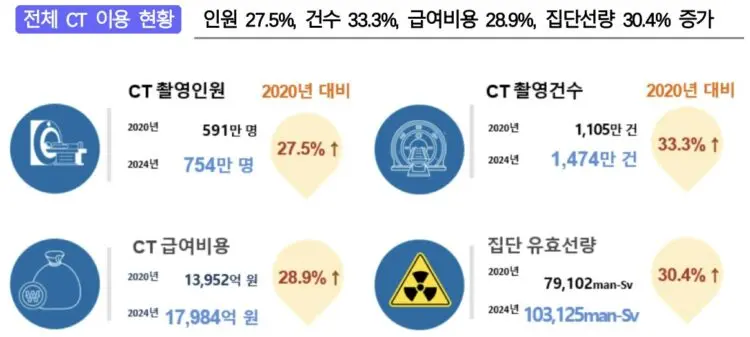
Over the same period, the number of patients exposed to 100 mSv or more of medical radiation per year from CT scans alone also increased by 37.6%, reaching 48,071 last year.
An NHIS official said, “If we assume the medical radiation dose from a single abdominal CT scan is 6.8 mSv, that is about 24 times higher than the average annual radiation dose received by radiation workers,” adding, “Even though Korea is a country with high CT utilization, the risks of patients’ exposure to medical radiation are not being given sufficient consideration.”
In response, NHIS President Jeong Gi-seok said, “We will do our utmost to ensure that patients can use medical imaging exams appropriately while avoiding unnecessary exposure to medical radiation,” and added, “We will further strengthen guidance and public outreach on the risks of medical radiation exposure for the entire population.”
Through the National Health Insurance website and the mobile app (The Health Insurance), anyone can easily check their CT exam and mammography history. Children under age 12, who are more vulnerable to radiation exposure, can also check their general imaging (X-ray exam) history.