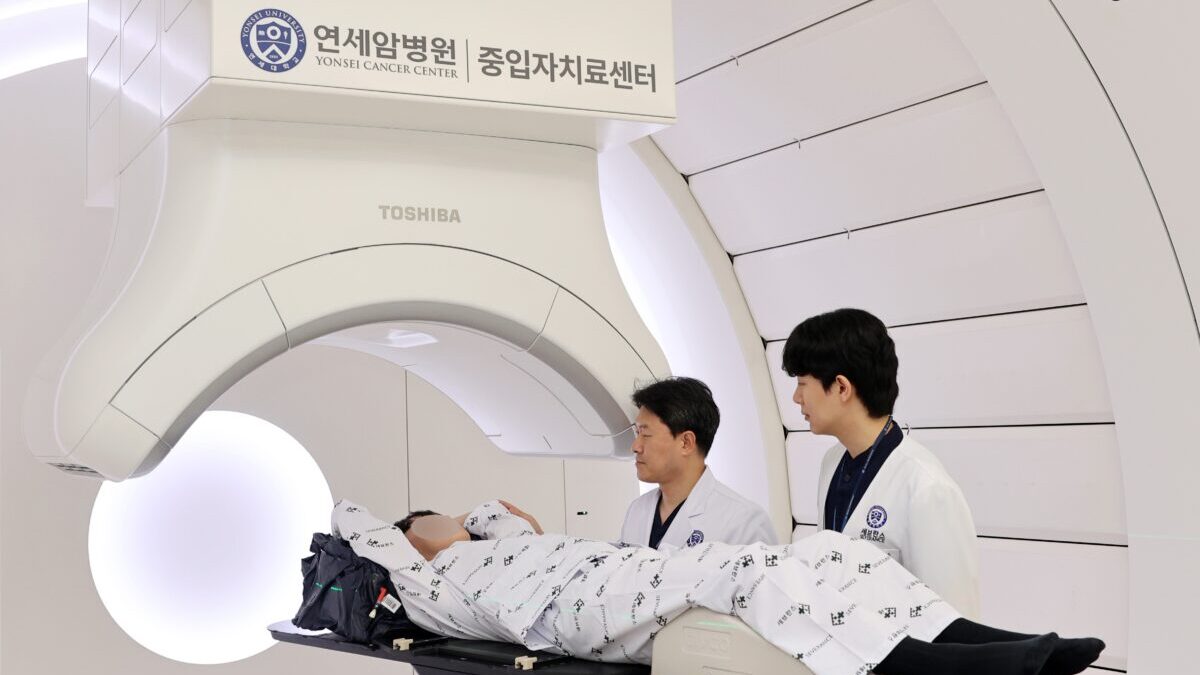
For patients facing cancers that are anatomically difficult to operate on or resistant to conventional radiation—as well as those dealing with local recurrences after prior radiation—access to advanced carbon-ion therapy is expanding in South Korea. Yonsei Cancer Center announced on August 19 that it has broadened eligibility for carbon-ion therapy to include head and neck cancers, sarcomas, and recurrent rectal cancer, while bringing its second rotating gantry system into full operation.
Carbon-ion therapy accelerates heavy carbon ions to target tumors with extreme precision. Because carbon ions deposit the bulk of their energy at a specific depth inside the body—a physical phenomenon known as the "Bragg peak"—and drop off sharply afterward, clinicians can deliver high radiation doses directly to cancer cells while sparing healthy surrounding tissues. The heavy ions also inflict heavier physical damage on cancer-cell DNA compared to standard X-rays, making the treatment effective against tumors that fail to respond to conventional radiotherapy.
Since launching South Korea's first carbon-ion treatment program in 2023 for prostate cancer, Yonsei Cancer Center has gradually expanded indications to pancreatic, liver, and lung cancers. This latest expansion focuses on complex cases where surgery and standard radiation face significant limitations. However, eligibility remains selective based on tumor location, feasibility of resection, prior radiation history, and specific histological type.
Precision Delivery for Complex Head and Neck Cancers
Head and neck cancers encompass malignancies arising between the base of the brain and the collarbone, including the oral cavity, pharynx, larynx, nasal cavity, paranasal sinuses, and salivary glands. Treating tumors in this region is uniquely challenging due to the dense clustering of critical structures—such as the brain, spinal cord, optic nerves, major blood vessels, and organs essential for breathing, speaking, and swallowing. Functional preservation and cosmetic outcomes are as vital as tumor control.
Yonsei Cancer Center will initially target non-squamous cell carcinomas in the nasal cavity, paranasal sinuses, skull base, and salivary glands that are surgically challenging and notoriously resistant to X-rays—such as adenoid cystic carcinoma and mucosal malignant melanoma. The narrow lateral spread of carbon-ion beams allows physicians to concentrate heavy radiation on the tumor while protecting vital adjacent organs like the optic nerves and brainstem.
Japanese multicenter studies demonstrate strong clinical efficacy for this approach, showing a 5-year local control rate of 68% for inoperable adenoid cystic carcinoma, a 2-year local control rate of 83.9% for mucosal malignant melanoma, and a 3-year local control rate of 95% for mucoepidermoid carcinoma. Yonsei Cancer Center plans to administer head and neck treatments in 16 sessions over four weeks.
Targeting Inoperable Sarcomas and Recurrent Pelvic Tumors
Sarcomas—malignant tumors arising in bone, muscle, fat, blood vessels, and nerves—frequently develop in anatomically complex locations like the spine, pelvis, sacrum, and skull base. When these tumors envelope critical nerves or major blood vessels, complete surgical removal is often impossible. While conventional X-ray therapy is an option, many sarcomas require high radiation doses that nearby organs, such as the spinal cord and intestines, cannot safely tolerate. Carbon ions solve this dilemma by delivering high biological doses directly to the tumor site while minimizing collateral exposure. Japanese long-term studies, including those from the National Institutes for Quantum Science and Technology (QST), report favorable outcomes in osteosarcoma and soft-tissue sarcomas of the trunk and extremities.
Recurrent rectal cancer presents an equally severe therapeutic hurdle, particularly when patients have already received pelvic radiation. Recurrences inside the pelvis often invade the sacrum, bladder, ureters, and nerves. Repeat surgery carries high risks of nerve damage and organ dysfunction, while re-irradiation with X-rays is constrained by the cumulative radiation tolerance of the small intestine, large intestine, and bladder. Carbon-ion therapy enables precise dose escalation to the recurrent tumor while sparing surrounding pelvic organs.
A study by the Japanese Carbon Ion Radiotherapy Oncology Study Group (J-CROS) evaluating 224 patients with locally recurrent rectal cancer demonstrated a 3-year local control rate of 93%, an 88% 5-year local control rate, and a 3-year overall survival rate of 73%. Furthermore, a joint study between Yonsei Cancer Center and Japan's QST comparing 35 recurrent rectal cancer patients treated with carbon ions against 31 treated with X-rays found that carbon-ion re-irradiation resulted in significantly lower rates of local treatment failure, mortality, and severe late side effects, though researchers noted that prospective randomized trials are needed to definitively prove superiority over X-rays.
Full-Scale Operations Across Three Cutting-Edge Systems
To accommodate the expanded patient population, Yonsei Cancer Center has brought its entire carbon-ion treatment suite online. Unlike fixed-beam units that deliver radiation from a set angle, rotating gantry units feature a 360-degree rotating structure that allows clinicians to deliver carbon-ion beams from any direction while the patient remains stationary. This flexibility makes it easier to target irregularly shaped tumors while avoiding surrounding critical organs.
With the second rotating gantry now fully operational, Yonsei Cancer Center operates one fixed-beam unit and two superconducting rotating gantries—making it the first center in the world to run two rotating gantries simultaneously. The three fully operational treatment rooms allow the facility to treat approximately 40 patients per day.
"For intractable tumors that are difficult to operate on because major organs are densely packed nearby, or that show resistance to existing treatments, the key is to increase treatment effectiveness while reducing damage to normal tissue," said Keum Woong-seop, Director of the Carbon-Ion Therapy Center at Yonsei Cancer Center. "With the full-scale operation of the second rotating gantry, we have expanded personalized treatment options for our patients."
Lee Sang-gil, President of Yonsei Cancer Center, added, "In carbon-ion therapy, the most crucial factor is not missing the optimal treatment window. We will combine carbon-ion therapy with surgery, chemotherapy, and conventional radiation to tailor care to each patient's condition and achieve the best possible outcomes."