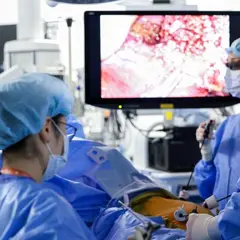
Artificial intelligence (AI) may be able to detect a patient’s disease, but it cannot move stiff arms and legs for them.
So far, medical AI has largely served as a “diagnostic aid,” analyzing medical images such as computed tomography (CT) scans and magnetic resonance imaging (MRI) to predict disease. After diagnosis, actually treating the patient still falls primarily to medical staff.
Lim Jun-yeol, CEO of Medisvy, has focused on that gap. Using a car analogy, he noted that conventional medical AI is closer to a navigation system that tells you the destination. But in rehabilitation therapy, simply showing the route is not enough for patients to reach the finish line. Someone has to guide them there physically.
“In rehabilitation therapy, it’s not enough to just tell someone, ‘Where are you going?’ It’s an area where you especially need a service that takes you all the way to the destination,” Lim said. “We’re building autonomous-driving capabilities into medical devices that directly deliver therapy using a physical object—a robot.”
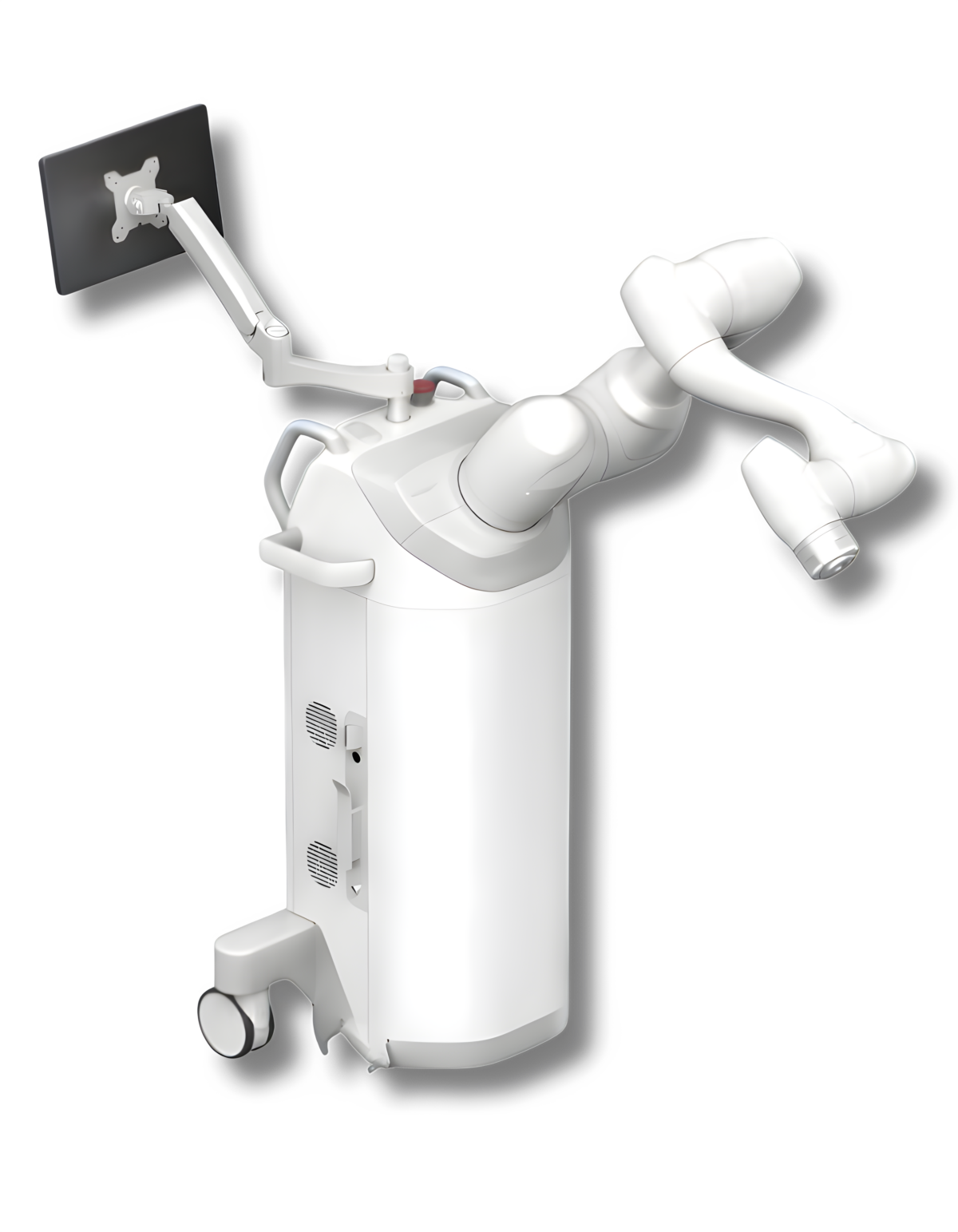
Medisvy built that philosophy into its in-house rehabilitation robot, ROBOARM. For now, it functions as an assistive robot that precisely reproduces treatment paths designed by clinicians. Over the long term, however, the company aims to equip it with AI and develop it into an “autonomous therapy” medical device capable of delivering tailored treatment independently.
“Just Saying ‘Exercise’ Has Its Limits”
Lim is an orthopedic surgeon who treats shoulder conditions at Gangnam Severance Hospital. His daily routine included evaluating patients’ conditions after surgery and explaining necessary exercises to those who did not undergo surgery.
The problem was the gap between explanation and actual execution. No matter how thoroughly clinicians explained how to perform the exercises, patients struggled to execute them accurately. Older patients, in particular, had difficulty understanding the movements or repeating them consistently.
“There were cases where, even if I tried to convey it verbally to the patient, they couldn’t follow along,” Lim said. “As I treated patients, I realized, ‘This has its limits.’”
Of course, clinicians can provide more accurate therapy by directly holding and manipulating a patient’s joint. However, joint mobilization—repeatedly moving a joint to restore range of motion—requires intensive physical labor. The more time clinicians devote to one patient, the harder it becomes to see others.
The situation is even more critical in regions with a shortage of medical staff. Even when patients know they need treatment, following through is difficult if there are no physical therapists or specialized clinicians available. That is why Lim turned to robotics.
A Clinician’s “Third Arm”
Lim compared the reaction of physical therapists who tested ROBOARM in the field to gaining a “third arm.”
“Therapists who tried the equipment in real clinical settings told me, ‘I used to wonder what kind of therapy I could do if I had three hands, and ROBOARM solved that,’” he said. “The fact that the device can operate as if the therapist has three arms is an advantage I didn’t fully anticipate at first, either.”
Conventional joint-mobilization devices typically move a joint repeatedly along a single axis—bending and straightening a knee, or moving a shoulder in a fixed direction. While mechanically simple, these devices face strict limits in the therapeutic movements and range of motion they can deliver.
Lim explained that if the full scope of needed therapy represents 100%, existing devices cover about 60%. They handle basic movements well, but struggle to implement complex paths or reach the final range of motion.
Existing devices also impose posture constraints. To receive shoulder therapy, a patient must sit in a chair fitted with dedicated equipment; leg-therapy devices require moving to a specific space and lying down. For patients with limited mobility, simply getting into position becomes a major barrier.
ROBOARM takes the opposite approach: instead of forcing the patient to adapt to the equipment, the robot comes to the patient. As a result, even patients who are bedridden or have severe mobility challenges can receive therapy where they are, significantly expanding the settings where it can be used.
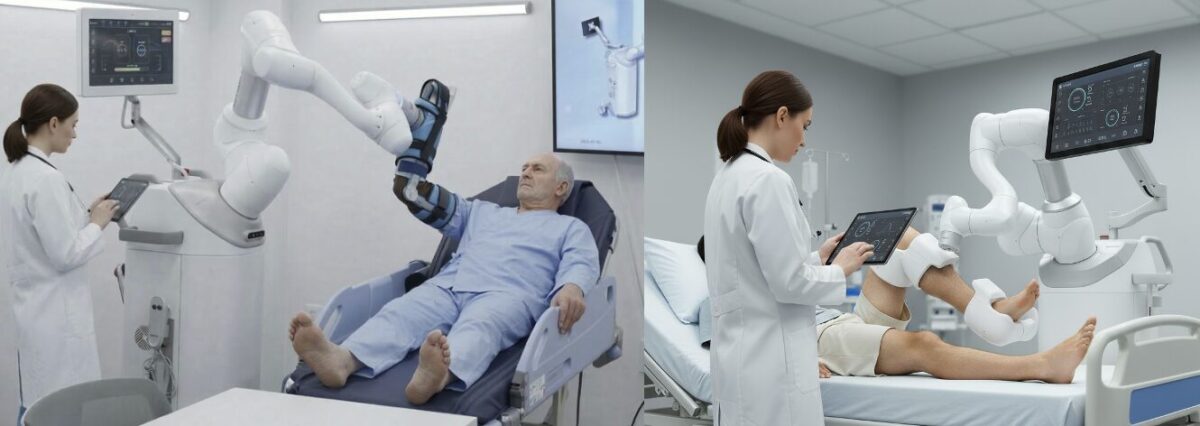
Another strength of ROBOARM is its versatility across multiple joints. It can be used not only for musculoskeletal disorders, but also for neurorehabilitation and intensive care unit (ICU) patients.
“The biggest differences are the breadth of treatment types and range, and the fact that it can be used in far more varied postures and environments than existing devices,” Lim said. “Because the equipment directly approaches the patient, it can also be used in settings where providing sufficient rehabilitation therapy was previously difficult.”
From AI That Detects Disease to “Physical AI” That Treats Patients
While conventional medical AI identifies disease on a screen, the autonomous-driving AI to be installed in ROBOARM will interact directly with a patient’s body off-screen. Lim describes this as “medical physical AI.”
Several steps remain before autonomous therapy becomes a reality. First, Medisvy plans to distribute ROBOARM units to hospitals in a configuration where clinicians program the paths themselves, adding autonomous-driving AI capabilities later through software updates to existing equipment.
Lim compared this process to software updates for self-driving cars. Just as driver-assistance functions advance through software upgrades without replacing the vehicle, ROBOARM units installed in hospitals are designed to seamlessly integrate AI-based autonomous-therapy functions over time.
Nvidia, widely recognized as a pivotal player in the AI era, has taken note of Medisvy’s vision. Medisvy’s autonomous-driving technology development process was selected for Nvidia’s global startup support program.

More recently, the company’s technology gained further validation after being selected for the South Korean government’s 2.4 billion won “AI Applied Product Rapid Commercialization Support Program.” Including that funding, Medisvy has secured approximately 6.0 billion won in total capital.
Once AI is installed, ROBOARM units in other regions or hospitals will be able to replicate a treatment path created by a clinician elsewhere. This makes it possible to store experienced clinicians’ hands-on techniques as digital data and deliver that care in regions facing medical shortages or overseas.
Communication methods will also adapt to operating environments. Medisvy is implementing core functions directly on the device while offering options to connect to hospital networks, dedicated servers, or cloud systems as needed.
“We expect to configure the system to fit various usage environments—hospitals, medically underserved areas, homes, and beyond,” Lim said.
Will Patients Feel Uneasy About a Robot Moving Their Body?
Because the robot directly manipulates a patient’s body, trust matters even more than technical achievement. Patients must feel confident entrusting their rehabilitation to the device.
Lim admitted he expected patients might feel anxious or hesitant about a robot-driven treatment approach. Once therapy began, however, those concerns dissipated quickly.
“Even patients who felt worried at first quickly develop trust as they experience firsthand that the device moves with high precision within its set range,” he said. “In a 30-minute session, we seem to earn the patient’s trust within the first 5 to 10 minutes.”
Lim also stressed that “the technical capabilities of medical devices ultimately need to be proven through peer-reviewed clinical papers so that clinicians worldwide can verify them.”
Preparing Adoption at Five Hospitals to Narrow Care Gaps
Medisvy is currently preparing to introduce ROBOARM at five major institutions: Asan Medical Center in Seoul, Samsung Medical Center, Severance Hospital, Seoul National University Hospital, and Seoul National University Bundang Hospital. The company has also formed a consortium involving specialist clinicians from various fields, including intensive care units, rehabilitation medicine, and orthopedic surgery.
The initial goal is to commercialize the early-stage product—where clinicians set the treatment paths—and build clinical experience and data in hospital settings. Following that, the company plans to integrate AI and remote-treatment features step-by-step while expanding into global markets.
Medisvy is aiming to secure South Korean medical device approval for ROBOARM and initiate sales by the end of this year, while pursuing international expansion in parallel.
Ultimately, Lim aims to narrow healthcare disparities. The goal is to embed skilled clinicians’ treatment experience into the robot so that an equivalent standard of rehabilitation therapy can be provided in medically underserved regions and overseas.
If ROBOARM can deliver treatment techniques without repeatedly sending South Korean clinicians abroad, Lim noted, it could serve as a vehicle not only for exporting medical devices, but also for spreading South Korean clinical expertise globally—delivering Korean clinicians’ “feel in the hands” to the world.
“Until now, patients who live close to top clinicians might receive 70 to 80 points’ worth of treatment, while those who don’t remain at 30 to 40 points,” he said. “I want to help make it possible for all patients to receive 100 points’ worth of treatment, regardless of where they live.”
He added, “I dream of a world where the very best treatment—the level that executives of major companies would seek—can also be accessed in our country’s most medically vulnerable regions. Medisvy’s goal is to use technology to provide care to patients we couldn’t reach before due to physical and practical limitations.”