
Looking at an electronic device such as a smartphone or tablet inside a moving vehicle can quickly trigger motion sickness.
The underlying cause is a sensory conflict that leaves the brain confused. While the inner ear's vestibular system detects the vehicle's shaking, acceleration, and directional shifts, the eyes remain locked on a static screen that appears completely still. As the body registers movement without corresponding visual feedback from the display, the brain receives conflicting signals, resulting in dizziness and nausea.
Apple addresses this sensory disconnect through a built-in feature designed to align visual input with physical motion.
How Animated Screen Dots Counter Motion Sickness
Apple offers a feature across its software ecosystem called "Vehicle Motion Cues," which mirrors a vehicle’s real-time movement directly on the screen.
Available on iPhone, iPad, and Mac devices, the feature can be activated under Settings > Accessibility > Motion. Once enabled, small animated dots appear along the edges of the display.
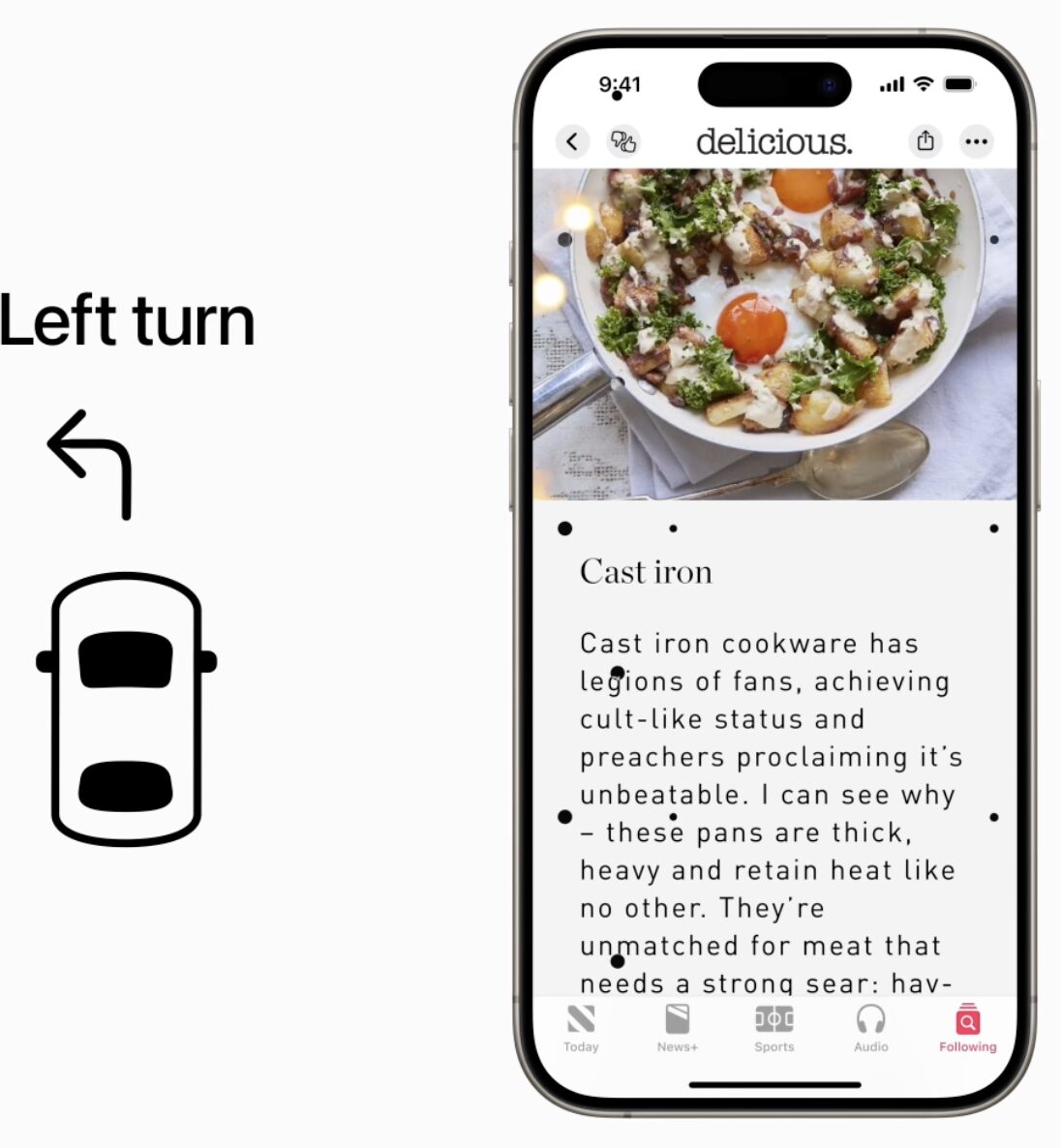
Using the device’s built-in accelerometer and gyroscope, the dots move in sync with the vehicle's motion. When the vehicle turns left, the dots shift to the right; when the driver brakes, they move forward.
This subtle movement allows the brain to perceive spatial motion visually even while the user focuses on a stationary screen. Users can customize the dots' size, color, and quantity, or set the feature to activate automatically whenever vehicle motion is detected.
Android devices, including Samsung Electronics’ Galaxy lineup, do not offer a native equivalent by default. However, users can access similar functionality through third-party applications such as "KineStop" or "Motion Cues."
Delayed Buzz Following Initial Release
Although Apple introduced Vehicle Motion Cues in 2024, the feature remained relatively obscure among mainstream users for some time.
Interest surged after technology news outlet The Verge covered the feature in June, followed by a BBC report on July 29 highlighting it as a practical travel tip, triggering renewed attention among smartphone users worldwide.
"The brain constantly predicts where you are moving in order to control muscles and posture throughout the body," said Tom Stoffregen, an emeritus professor at the University of Minnesota. "That is also why drivers rarely experience motion sickness—they can anticipate motion because they are holding the steering wheel. Vehicle Motion Cues appears to operate on a very similar principle."