Many people who undergo dental implant treatment operate under the assumption that artificial teeth are inherently stronger and more durable than natural ones. When the procedure succeeds, they certainly feel that way at first. However, a significant number of patients find themselves back in the dentist’s chair after biting down on tough or hard foods—such as dried squid, beef jerky, cartilage, or firm cubed radish kimchi—only to discover that their expensive new prosthesis has been severely damaged.
Structurally, implants are surprisingly vulnerable to dense, hard foods. The fundamental difference between natural teeth and implant-supported restorations lies in a microscopic structure called the periodontal ligament. In natural teeth, this ligament sits between the tooth root and the jawbone, functioning as a built-in shock absorber that cushions, absorbs, and disperses the intense forces generated during mastication (chewing).
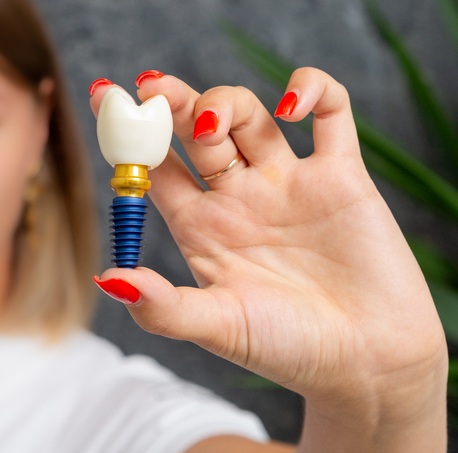
Implant-supported teeth, by contrast, rely entirely on osseointegration—a process where the artificial titanium post fuses directly to the jawbone. Because there is no intervening periodontal ligament to serve as a cushion, the impact and pressure from chewing hard foods are transmitted with zero dampening directly to the prosthetic components and the underlying bone structure.
A long-term clinical study conducted by the Seoul National University School of Dentistry, published in May 2023, underscored just how common these issues are. Tracking 898 implants across 428 patients over a 14-year period, researchers found that approximately 58% of individuals experienced various mechanical side effects. Among these complications, the loosening of internal screws was the most frequent. Investigators also documented numerous structural fractures within the abutment—the connector post that secures the external crown to the internal fixture—as well as fractures within the artificial root itself. Notably, implants positioned in the molar region, where chewing forces are concentrated, carried a substantially higher risk of mechanical failure compared to other areas of the mouth.
The Three Types of Mechanical Failure
When excessive force or chronic overload is applied to an implant, the resulting mechanical damage generally falls into three distinct categories:
Prosthetic Crown Fractures: This occurs when the outermost porcelain or zirconia head portion of the tooth cracks or chips. Typically triggered by sudden, sharp pressure from biting down on rigid items like crab shells, nuts, or hard radishes, these fractures leave behind sharp edges that can lacerate the tongue or cheek, while causing discomfort as food becomes wedged in the broken gaps.
Internal Component Damage: This involves the loosening or snapping of the internal screw connecting the crown and abutment to the root fixture. It is particularly prevalent in individuals who possess a "millstone-style" chewing habit—a horizontal, side-to-side grinding motion often used when tearing through meat tendons or jerky. Because implants are structurally designed to handle vertical pressure far better than lateral, twisting forces, horizontal grinding causes the internal assembly to wobble or fail entirely.
Jawbone and Root Breakdown: The most severe scenario involves microscopic degradation of the surrounding jawbone and damage to the underlying fixture. If a patient chews heavy foods aggressively during the initial post-operative healing phase, or subjects the site to long-term chronic overload, the bone surrounding the metal post can gradually resorb (melt away) due to the unmitigated stress. Deprived of its anchoring foundation, the entire implant becomes unstable, often requiring complete surgical removal and subsequent re-implantation.
Strategies for Long-Term Prevention
Protecting your investment and maintaining oral health requires a deliberate approach to lifestyle and maintenance adjustments. Dental professionals emphasize three essential preventative steps:
First, exercise extreme caution during the first year following surgery. This twelve-month window is the critical period during which osseointegration solidifies; avoiding excessive force ensures the bone-to-metal bond matures properly without disruption. Second, modify how you consume firm foods. Using scissors or a knife to cut tendon-heavy meats, dense jerky, and crunchy vegetables into smaller pieces drastically lowers the mechanical stress on individual restorations, allowing chewing forces to be distributed evenly across the entire molar region. Third, commit to regular professional tracking. Because implants lack sensory nerves, patients cannot feel excessive biting pressure or subtle mechanical shifts on their own. Bi-annual or annual dental visits are necessary so that clinicians can check for minor screw loosening and precisely calibrate the occlusion (bite height) to prevent chronic overloading.
Frequently Asked Questions
Q1. If an implant crown cracks or feels slightly loose, what are the risks of leaving it untreated? Ignoring a damaged or loose implant can cause compounding issues. A cracked crown with sharp edges can cut oral tissues and lead to localized inflammation. More importantly, a loose internal screw allows horizontal twisting forces to act directly on the underlying fixture, which can cause the screw to snap off inside the implant or permanently damage the surrounding jawbone. Immediate clinical evaluation is required.
Q2. Is there a specific post-operative timeframe where dietary caution is most critical? Yes, the first year after implant placement is the most critical. This is when the titanium fixture undergoes osseointegration, fusing permanently with your jawbone. Subjecting the implant to heavy impact from hard foods during this vulnerable phase can halt proper bone bonding, causing the bone surrounding the fixture to recede and ultimately leading to early implant failure.
Q3. Can unconscious behaviors like sleep bruxism (teeth grinding) or clenching damage an implant? Absolutely. While sensory nerves naturally limit your chewing force when awake, unconscious grinding or clenching during sleep can exert up to two to three times your normal bite force. This creates repetitive, highly damaging horizontal stress on the implant assembly. Patients with these habits should be fitted with a custom protective nightguard (splint) by their dentist to shield the components from structural fatigue and bone loss.