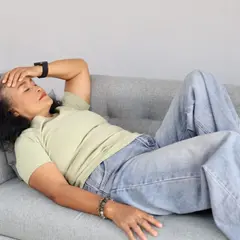
That familiar, stubborn stiffness settles into the lower back, and changing positions brings little relief. Standing up fails to soothe the ache, yet sitting back down feels just as uncomfortable. This is a daily reality for millions. Office workers and students remain anchored to desks for hours, while supermarket cashiers, teachers, and retail employees spend entire shifts balancing on their feet.
The underlying threat to spinal health is not the act of sitting or standing itself, but rather the habit of remaining completely static. The human spine is anatomically engineered for motion. When it is denied movement, physical stress rapidly accumulates within the intervertebral discs and the complex network of surrounding muscles.
The Biomechanics of Disc Pressure
While many assume that prolonged standing is inherently more taxing on the lower back, biomechanical models reveal that sitting actually exerts a significantly heavier toll on the structural integrity of the spine.
If the pressure placed on the lumbar discs while standing upright is categorized as a baseline of 100%, that structural load rises to approximately 140% the moment you sit down—even when maintaining excellent posture. When slouching or leaning the upper body forward toward a screen, the mechanical load intensifies drastically, with clinical studies demonstrating that disc pressure can spike to roughly 185%.
The anatomical reason is straightforward. When standing, body weight is distributed efficiently down through the pelvis, legs, and feet. Sitting removes the lower extremities from this equation, concentrating the entire weight of the upper body directly onto the pelvis and lumbar spine. Compounding this with a rounded back and a forward-shifted head strains the lower back while simultaneously overtaxing the cervical vertebrae.
However, prolonged standing carries its own distinct physiological risks. Although disc pressure remains lower than during sitting, the erector spinae muscles supporting the spine and the stabilizing muscles around the pelvis are forced into a state of continuous, unbroken tension. For individuals dealing with spinal stenosis, standing for extended periods with an excessively arched lower back can compress the spinal canal further, exacerbating lower back pain and triggering numbness in the legs.
Practical Ergonomics for Sitting and Standing
To alleviate tension while seated, proper alignment must begin at the pelvis. Perching on the very edge of a chair forces the pelvis to roll backward, causing the lower back to round detrimentally. Instead, sitting deeply into the chair allows the backrest to naturally support the upper body's weight, significantly reducing lumbar strain.
The knees should maintain an angle of 90 to 100 degrees, with both feet resting flat on the floor. Allowing the feet to dangle builds unwanted tension in the thighs and pelvis; if a chair cannot be lowered sufficiently, utilizing a footrest is highly recommended. For the upper body, simply focusing on lifting the sternum forward will allow the natural lumbar curve to return without forcing the spine into hyper-extension.
Computer monitors should be positioned directly at eye level. Tucking the chin slightly ensures that the ear and shoulder align vertically when viewed from the side. This counteracts the modern habit of staring down at smartphones for extended periods, a posture that exponentially increases the weight load on the neck and shoulders. Because the spine functions as an interconnected kinetic chain, chronic neck tension frequently manifests as compensatory lower back pain.
For those who work on their feet, the golden rule of standing posture is even weight distribution. Feet should be placed shoulder-width apart, with weight centered over the middle of the soles. Leaning predominantly on one leg twists the pelvis, creating muscular imbalances and asymmetric tension over time.
Standing upright should involve a light engagement of the abdomen and glutes—a sensation akin to gently drawing the navel toward the spine—without forcing an exaggerated arch in the lower back. Individuals with pronounced anterior pelvic tilt (a forward-rotating pelvis) put immense pressure on the posterior joints of the lower spine. Keeping the chest open and alignment straight ensures that the ears, shoulders, hips, and ankles form a clean vertical line. Additionally, alternatingly resting one foot on a 10 to 15 cm footrest or a thick book can dynamically alter pelvic tilt, offering immediate relief from localized lumbar fatigue.
Movement as the True Benchmark of Spinal Health
Ultimately, even the most textbook posture becomes detrimental if held for too long. Spinal discs lack a direct blood supply; they depend entirely on the surrounding tissues for the exchange of water, oxygen, and vital nutrients. Movement creates a natural hydrostatic pumping action, compressing and releasing the discs to drive this crucial nutrient exchange. Consequently, long-term spinal wellness depends less on how perfectly you sit, and far more on how frequently you move.
Those anchored to desk environments should establish a firm habit of standing up at least once every 50 minutes. Spending just 5 minutes walking or performing gentle stretches for the lower back, glutes, and hamstrings resets muscular tension. Similarly, prolonged standers should shift their weight dynamically every 30 minutes and incorporate light forward and backward spinal extensions.
“The most basic way to reduce low back pain is to change your posture before turning to surgery or medication,” emphasizes Seo Seong-woo, a neurosurgeon and head of the Spine Center at On Hospital in Busan. “Even changing how you sit, how you stand, and how often you move can significantly reduce the cumulative burden that builds up in the lower back.”
The spine rarely breaks down from a single isolated incident; rather, it is progressively shaped by repeated daily habits. Intentionally adjusting how you sit, stand, and move today is the definitive first step toward preventing chronic, long-term lower back pain.
Posture and Back Care FAQ
Should I use a lumbar support cushion? If your chair lacks adequate built-in lumbar contours, a supportive cushion can be highly beneficial. However, avoid overly thick cushions that aggressively force the lower back forward into hyper-extension, as this creates a new point of joint strain.
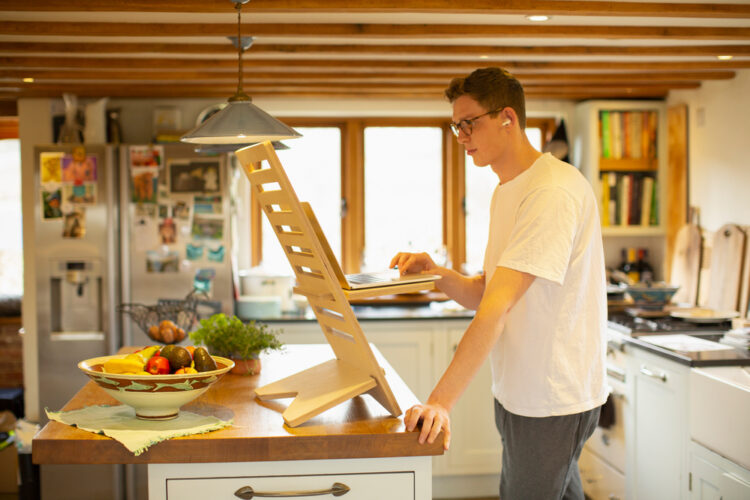
Is a standing desk inherently better for back health? Not necessarily. While a standing desk successfully reduces cumulative sitting time, standing entirely still for prolonged periods accelerates lower extremity and muscular fatigue. The optimal approach is to dynamically alternate between sitting and standing throughout the workday.
Is stretching alone enough to resolve lower back pain? Mild muscular stiffness often resolves well with consistent movement and targeted stretching. However, if your lower back pain is accompanied by leg numbness, radiating pain, localized muscle weakness, or changes in bowel and bladder function, you should immediately bypass self-care and seek professional medical evaluation.
Is a firm, hard chair better for the spine? Chairs with overly plush, sinking cushions are disadvantageous because they inevitably roll the pelvis backward into a slouched position. However, a completely rigid, hard chair can create uncomfortable pressure points over long periods. The ideal seating solution is a chair that provides stable, contoured structural support to the backrest and seat.