Mr. A, a man in his early 60s, has been putting off an implant consultation for three months after losing two molars in quick succession. A warning from a well-meaning friend has kept him from scheduling an appointment, as he finds himself overwhelmed by mounting uncertainties.
“How many implants will I actually need?” “If my gums are weak, do I need an expensive bone graft, too?” “I heard that if an implant fails once, a revision procedure is even harder to pull off.” “With all this high-end equipment clinics use nowadays, won't the treatment cost a fortune?”
Such worries frequently pile up before a patient even steps into a dental office. For individuals in their 50s to 70s, these concerns are remarkably consistent. It can be difficult to discern whether implants are truly the right choice, whether the estimated fees are reasonable, or if a recommended treatment is genuinely necessary. Because patients cannot see inside their own mouths, they must rely entirely on the dentist’s word—a dynamic where trust is not always easily established. Anxiety over potential overtreatment often blends with deep uncertainty about the final clinical outcomes.
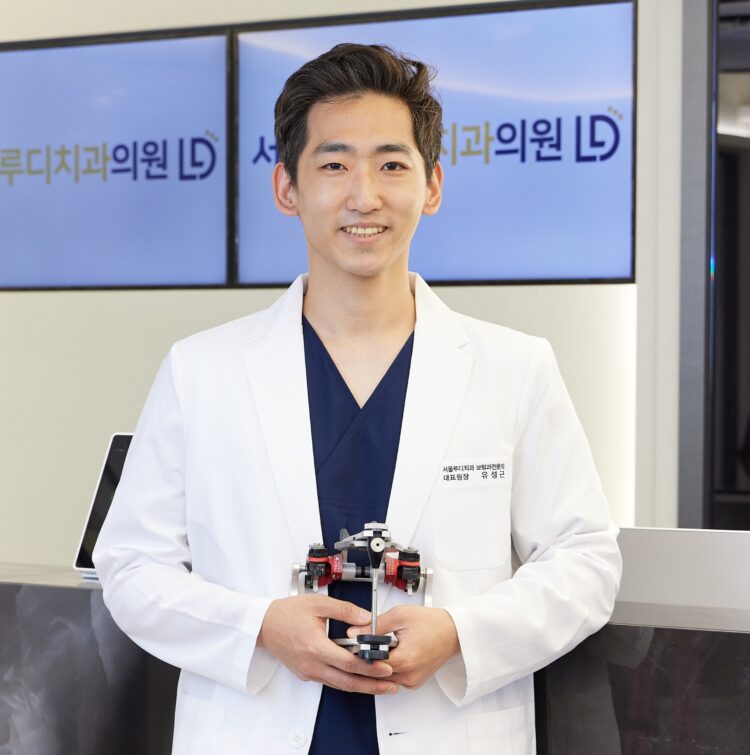
Yu Sung-geun, chief director and prosthodontist at Seoul Rudi Dental Clinic in Gwangmyeong, Gyeonggi Province, characterizes this psychological barrier as a fundamental “fear of uncertainty.” In other words, he explains, patient anxiety rarely stems from the mere fact that treatment is required, but rather from the unknown of whether the proposed procedure is truly the right choice for their specific body..
From Engineering to Prosthodontics: Dentistry as an Applied Science
Yu Sung-geun's professional background diverges sharply from the typical path of a dentist. After graduating early from Busan Science High School, he graduated with honors from the Korea Advanced Institute of Science and Technology (KAIST) with a degree in biological sciences. He later earned his dental degree from Seoul National University, completed an intensive internship and residency at Seoul National University Dental Hospital, and went on to obtain a Ph.D. in prosthodontics from the same institution's graduate school of dentistry.
This rigorous background shapes his engineering-minded approach to dental care. “An error of less than 1 millimeter can determine the lifespan of a prosthesis years down the road, as well as a patient's overall chewing force,” Yu Sung-geun says. He views chewing not merely as a basic physiological act, but as a complex mechanical system where heavy structural loads and force distribution must work in perfect harmony.
If placing implants and prosthetics is akin to civil engineering or construction, then the human mouth—which endures tremendous pressure daily—must be calculated with strict mechanical precision. To ensure procedures are safe and long-lasting, Yu Sung-geun analyzes the teeth and jaw as a single, unified structure. This perspective was further refined during his tenure as head of the dental department at the Armed Forces Capital Hospital and as a member of an implant review committee, where evaluating highly complex clinical cases demonstrated firsthand how dramatically data-driven diagnostics can optimize patient outcomes.
Evaluating Placement Over Quantity: The Role of AI and 3D Diagnostics
In implant consultations, the first question patients usually ask is, “How many implants do I need?” While a practical concern, Yu Sung-geun notes that from a prosthodontic perspective, a different evaluation must take priority.
An implant procedure does not end when a titanium post is surgically placed into the bone. A tooth-shaped prosthesis sits on top, and it must withstand daily chewing forces. Even a minor deviation in positioning affects the shape of the prosthesis, the patient's occlusion (bite), and long-term gum health. “With implants, the key is not the act of placement itself, but positioning them precisely to ensure stable, long-term prosthetic results,” Yu Sung-geun explains.
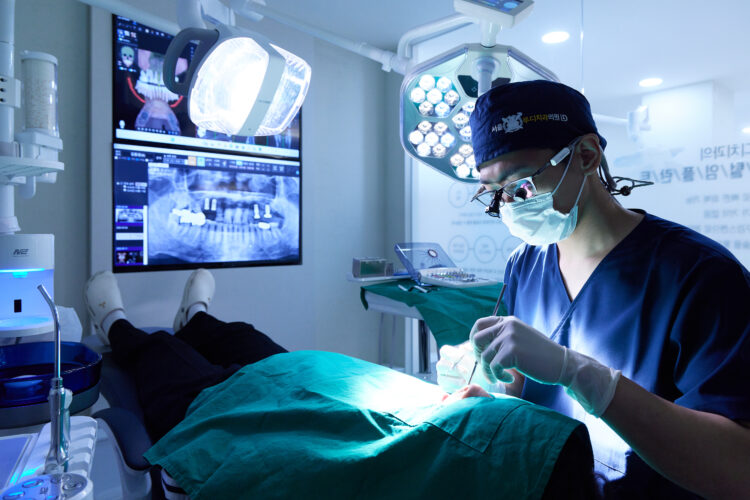
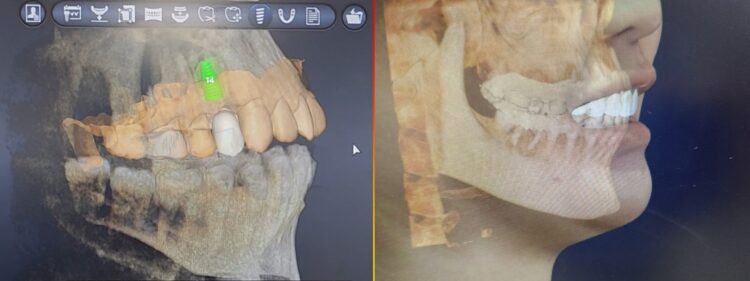
This principle is especially vital for patients in their 50s to 70s. Many in this demographic have already lost multiple teeth or have relied on older restorations, such as dental bridges, for extended periods. Consequently, their jawbone may have already receded, and some patients manage concurrent systemic conditions like diabetes or osteoporosis. Simply filling a missing gap is insufficient; clinicians must meticulously calculate how chewing forces will be distributed across the remaining teeth, assess jawbone density, and ensure long-term maintenance is feasible. To achieve this, digital dentistry utilizes 3D CT scans and intraoral data to map bone structure and plan prosthetic positioning simultaneously before any incision is made.
This technology also shifts the diagnostic paradigm by making the underlying problems visible to the patient. For older patients, one of the most frustrating aspects of dental care is being told they need treatment without being able to see the evidence themselves. Early-stage cavities, interproximal decay (cavities between teeth), hidden jawbone lesions, and precise bone volume are nearly impossible to detect with the naked eye.
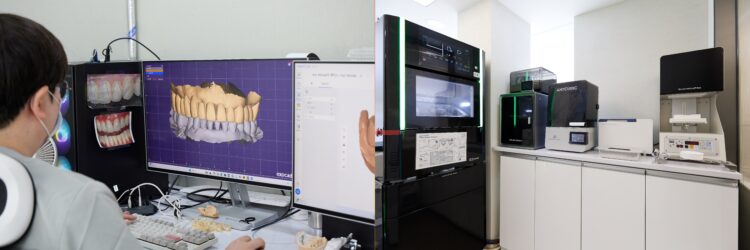
Modern digital imaging provides concrete evidence. Devices like “Qray,” a quantitative light-induced fluorescence (QLF) cavity diagnostic tool, use specific wavelengths of light to quantify and highlight early decay or microscopic tooth cracks that standard X-rays miss. Advanced intraoral scanners like the AI-driven “TRIOS 6,” alongside 3D face-scanning systems, complement this diagnostic toolkit. “When you utilize precision equipment, you can ground your treatment plan in objective measurements and isolate only the areas that genuinely require intervention,” Yu Sung-geun says. “3D CT analysis actually helps prevent unnecessary implant placements by identifying the most biomechanically sound positions.” Far from encouraging overtreatment, high-end diagnostic tools serve as an objective check against it.
Why Digital Tools Cannot Replace Clinical Expertise
As digital dentistry expands rapidly, a common misconception has emerged that an overreliance on advanced machinery might erode a dentist's hands-on technical skills. Yu Sung-geun clarifies that digital and analog methods are not mutually exclusive; rather, substantial clinical experience is required to use digital equipment to its full potential.
“No matter how precise an intraoral scanner is, it cannot deliver ideal results if the clinician lacks the deep understanding required to interpret occlusion, the soft tissue architecture, and the critical margin—the exact boundary where the prepared tooth meets the edge of the prosthesis,” Yu Sung-geun explains. “Even with navigation-guided implants, a computer guide can only execute what the dentist has first accurately designed regarding bone density and prosthetic alignment.”
If a margin is poorly fitted, it can lead to food impaction, chronic gum inflammation, secondary cavities, and prosthesis debonding. No matter how aesthetically perfect a prosthetic crown appears, its structural integrity will fail prematurely if chewing loads are concentrated on one side. These nuanced judgments still rely entirely on a clinician's trained instincts.
Ultimately, Yu Sung-geun views the evolution of digital dentistry as a drive toward zero error—minimizing diagnostic deviations and maximizing clinical predictability. This pursuit of precision explains why progressive clinics are increasingly establishing in-house digital laboratories, where the attending dentist directly oversees the manufacturing process. By leveraging digital milling machines and 3D printers on-site, clinics can now design, fabricate, and deliver highly accurate, custom prosthetics on the exact same day..