Initially, he could still walk. Following a fall, the 67-year-old patient, referred to as Mr. A, experienced mild discomfort around his hip, but the pain was not severe enough to completely disrupt his daily routine. Within a few days, however, his condition shifted drastically, and walking suddenly became agonizingly difficult.

Upon presenting at the hospital, Mr. A was diagnosed with a femoral neck fracture—a structural break located just below the spherical head of the thigh bone. Diagnostic imaging classified the injury as a "Garden type 3" fracture, meaning the bone fragments were already partially displaced. Given the patient's age and the specific displacement pattern, the medical team determined that a total hip arthroplasty (joint replacement) was required rather than a simple internal screw fixation.
However, Mr. A could not be taken straight to the operating room. He had underlying diabetes, and his glycated hemoglobin (HbA1c) level was measured at a high 8.8%, reflecting poor blood sugar regulation over the preceding three months. When blood glucose is elevated, surgical wounds fail to heal properly and the risk of deep infection climbs significantly. Because joint arthroplasty involves placing permanent mechanical implants inside the body, the medical team prioritized stabilizing his blood sugar for a week before clearing him for surgery.
Shifting Focus from the Fracture to the Implant Angle
While the Garden type 3 classification established the need for a total hip replacement, it did not automatically mandate a robotic approach. The decision to utilize robot-assisted surgery stemmed from the next critical phase of planning: determining the exact spatial placement and orientation of the joint implants.
The hip functions as a ball-and-socket joint. Within the pelvic bone lies a socket-like concavity called the acetabulum, into which the rounded head of the femur fits. In a total hip arthroplasty, a prosthetic cup is impacted into the pelvic acetabulum, a metal post known as a femoral stem is inserted down into the thigh bone, and an artificial femoral head is fixed on top of the stem. The primary objective of the surgery is to align these components so that the artificial ball glides seamlessly inside the acetabular cup.
If the acetabular cup is positioned too upright, too flat, or misaligned along its front-to-back axis, structural complications inevitably follow. The mechanical components may collide and impinge, or a leg-length discrepancy may develop. Crucially, the risk of joint dislocation—a major complication where the prosthetic ball slips entirely out of the cup—increases dramatically. In Mr. A's case, the anatomical challenge was heightened because his native femoral anteversion (the degree to which the thigh bone rotates forward) was exceptionally small, requiring the surgeon to calculate a highly customized combined alignment for both the cup and the stem.
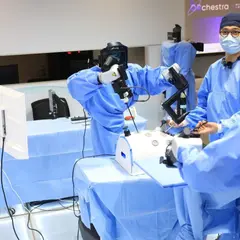
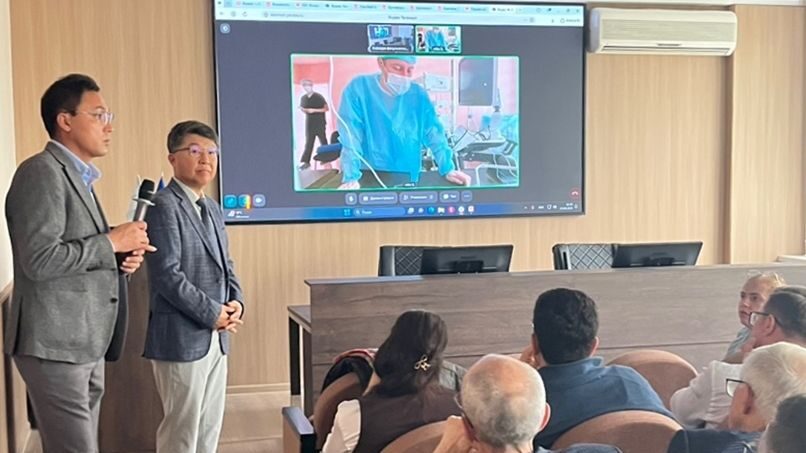
To achieve this level of accuracy, Kang Seung-woo, Director of the Joint Center at Busan Bumin Hospital, utilized Stryker’s Mako joint replacement surgical robot. The advanced system serves as a precision guide, helping execute the surgeon's customized preoperative blueprint with sub-millimeter fidelity during the live operation..
Preoperative 3D Simulation and Advanced Bone Reaming
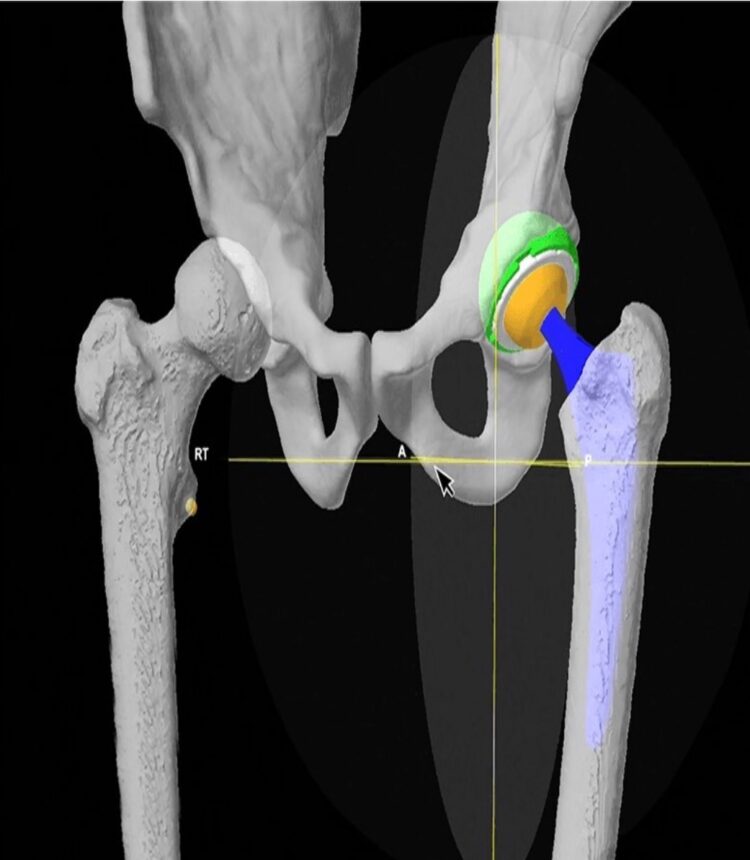
Prior to the first incision, Kang Seung-woo used a three-dimensional (3D) CT simulation to evaluate the patient's specific bone structure, testing for potential implant-to-implant collisions across a full range of daily motions, including sitting in a chair, standing up, or bending over to put on socks.
The resulting calculations established an optimal target alignment: an acetabular cup insertion angle of 40° of inclination and 22° of anteversion. While a 40° inclination and 20° anteversion configuration is standard, the team intentionally increased the cup’s forward rotation by two degrees to adjust for the patient’s low native femoral anteversion, effectively preventing post-operative impingement.
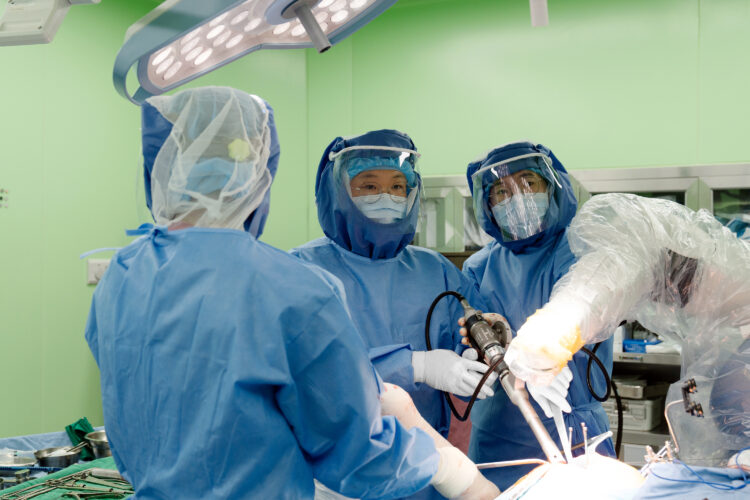
Executing this plan via robotic assistance requires a meticulous "registration" process to map the computer's 3D bone model directly to the patient's physical pelvis on the operating table. Once calibrated, the robotic arm alters how the bone is prepared. Unlike conventional surgery, which relies on manual, incremental reaming with progressively larger tools, the robotic system carves the acetabulum to its final planned size and orientation in a single, highly controlled pass.
Kang Seung-woo noted that verifying the absence of impingement via preoperative simulation is paramount, as repeated friction between components leads to persistent pain, joint instability, accelerated material wear, and an elevated long-term risk of dislocation.
Stable Recovery and Expanding Regional Medical Options
The challenging procedure was completed successfully, with the intraoperative robotic guidance implementing the acetabular cup position exactly as modeled. Postoperatively, Mr. A has demonstrated a stable recovery, reporting minimal pain and no perceptible discrepancy in his leg length. He has already initiated physical rehabilitation, successfully walking with the aid of a mobility device.
While robotic hip arthroplasty is still in its early adoption phase in the regional market—requiring more clinical data to standardize patient selection criteria and monitor long-term outcomes—the trajectory is clear. Following its implementation at Haeundae Bumin Hospital, the introduction of robotic hip surgery at Busan Bumin Hospital expands advanced, specialized care options for residents across the Busan-Ulsan-Gyeongnam region, allowing patients to receive cutting-edge treatment locally.
Frequently Asked Questions
Is robot-assisted surgery mandatory for a Garden type 3 fracture? No. The Garden type 3 classification simply describes the severity of the bone displacement and indicates that a total hip replacement is appropriate. The choice to use a robotic system depends on individual anatomical complexities, bone quality, financial considerations, and the surgeon's clinical discretion.
Does the robot operate independently? No. The robotic system functions strictly as a precision tool that guides the surgeon. The orthopedic surgeon retains full control, making all intraoperative decisions and physically performing the procedure.
What is the primary clinical advantage? The technology allows the surgeon to match the placement and orientation of the acetabular cup to a customized preoperative 3D plan with high fidelity, minimizing human error, lowering dislocation risks, and enhancing joint stability.
Does robotic surgery guarantee a faster recovery? Not necessarily. Recovery timelines remain highly dependent on individual patient factors, including age, baseline muscular strength, pre-existing comorbidities, and adherence to postoperative rehabilitation protocols.
Are there any operational downsides? The calibration and registration process can lengthen initial preoperative setup times. Additionally, ensuring clear line-of-sight for the robotic optical sensors may require a slightly broader surgical exposure of the surrounding soft tissue compared to conventional methods. However, because the robotic bone reaming process is highly efficient, the total operating time remains comparable to traditional surgery.
Expert Input: Kang Seung-woo, Director of the Joint Center (Orthopedic Surgery) at Busan Bumin Hospital. A graduate of the University of Ulsan College of Medicine, he completed his clinical training at Asan Medical Center in Seoul and Ulsan University Hospital, where he subsequently served as a clinical assistant professor. He specializes in robot-assisted joint replacement surgery, complex fractures, and severe trauma reconstruction.