
A "10 minutes a day" workout designed to be performed entirely while lying down has emerged from Japan as a promising tool for older adults and those in rehabilitation. A research team from the Faculty of Engineering at Tokyo University of Agriculture and Technology reports that these coordination exercises, performed in the supine position (lying on the back), can significantly improve physical balance and agility without requiring heavy lifting or high-impact movement.
Coordination is the nervous system’s ability to move muscles smoothly and efficiently. Unlike traditional training, this program does not aim for muscle hypertrophy (size). Instead, it focuses on "neural adaptation"—reconfiguring the communication network between the brain and the body. By viewing the human body as a precise mechanical system, the team designed the routine to help the brain more stably control the heavy masses of the head and rib cage.
The Three-Step Neural Reset
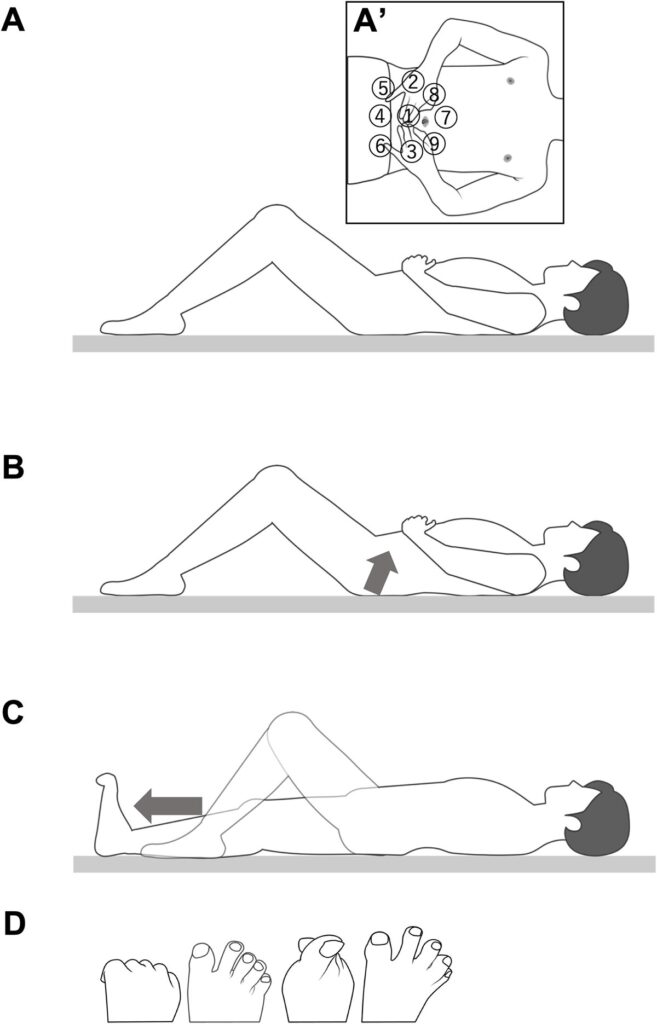
1. Abdominal Activation The workout begins by dividing the area around the navel into a 3×3 grid of nine zones. As the user presses each zone with their fingertips, they must push back against that pressure using their abdominal muscles. This process "switches on" underused muscle fibers, helping the brain clearly recognize and stabilize the trunk.
2. Trunk–Leg Linkage While lying down with knees bent, the individual presses their lower back firmly into the floor and slightly lifts the hips. This specific movement teaches the trunk and legs to coordinate as a single, stable unit. This linkage is vital for preventing the upper body from swaying excessively during walking.
3. Leg Coordination This step improves lower-limb control through "toe rock-paper-scissors" and "heel-push" extensions. Practicing conscious control of the foot muscles while extending the leg with a flexed ankle prepares the body to absorb impact and maintain balance the moment the heel strikes the ground during real-world walking.
Proven Efficiency Without Muscle Growth
The research team conducted kinematic analysis and physical performance tests on participants who followed the 10-minute routine for two weeks. The results, recently published in the international journal PLOS One, were striking: while muscle size remained unchanged, static balance and agility improved significantly. The average number of side steps—a common measure of agility—increased from 45.4 to 48.6. Crucially, participants showed a decrease in unnecessary swaying of the head and torso, maximizing movement efficiency.
How to Perform the 10-Minute Lying Workout
Step 1: Activate the Nine Zones Imagine a 3×3 grid centered on your navel. Press firmly into each square with your fingertips and tighten your abdomen to "push" the fingers back out. Hold for 5 seconds per square. This helps the brain map out the abdominal wall.
Step 2: Set the Pelvis and Lift Lying with bent knees, eliminate any space between your lower back and the floor. While keeping the back pressed down, lift your hips only slightly. This trains the abdomen and thighs to move in sync.
Step 3: Toe Rock-Paper-Scissors & Heel Pushing
Rock: Curl all toes tightly.
Scissors: Lift only the big toe (or bend only the big toe).
Paper: Spread all toes wide like a fan.
The Heel Push: Follow the toe exercises by pulling your ankle toward your body (dorsiflexion) and slowly sliding your heel along the floor to straighten the leg. This "rehearses" the heel-strike phase of walking.
Frequently Asked Questions
Q: How does it work if it doesn't add muscle? A: The goal is neural adaptation. By improving the efficiency of the signaling system between the brain and muscles, the body can enhance motor control and balance very quickly, even without physical changes in muscle mass.
Q: Why must it be done lying down? A: The supine position minimizes gravitational load and is biomechanically the most stable. It allows "antigravity" muscles—which often become overly tense when standing—to relax so the brain can focus on fine-tuning control of the trunk and legs.
Q: Is 10 minutes truly enough? A: Yes. The study showed that just 10 minutes a day for two weeks provided sufficient stimulus to "reset" the communication network, leading to measurable gains in agility and stability.