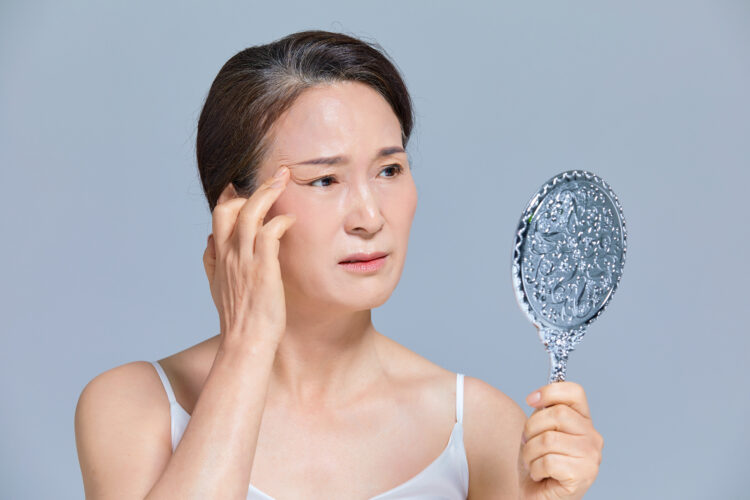
A person in their 50s recently considered double-eyelid surgery as their eyelids seemed to sag lower each day. They recalled a celebrity who, after appearing with more defined eyes, clarified, “I didn’t get double-eyelid surgery—I received medical treatment for ptosis.” This sparked a realization: “My vision has become noticeably dim; could I have ptosis, too?”
Many people mistake ptosis for simple age-related eyelid drooping. Ptosis is a medical condition where the muscle responsible for lifting the eyelid weakens. A key diagnostic feature is the descent of the upper eyelid margin, which physically blocks the field of vision. In contrast, age-related drooping is an external issue caused by stretched skin. While they may look similar, they stem from different causes and require distinct treatments.
Sa Ho-seok, a professor of ophthalmology at Asan Medical Center, explains, “Among older patients suspecting ptosis, many actually have normal muscle function. It often only looks droopy because sagging skin covers the eyelid margin. This is commonly referred to as 'false ptosis' or 'pseudoptosis'.”
Simple self-check for ptosis
Before seeking a clinical diagnosis, you can perform a simple test: place your index and middle fingers at the outer edge of your eyebrow and gently lift the sagging skin toward your temple. If your field of vision still feels restricted or it remains difficult to open your eyes in this position, there is a high likelihood of a muscle function problem.

To further clarify the condition, Professor Sa Ho-seok addresses common questions regarding symptoms and treatment.
Q: Can I leave ptosis untreated? Untreated ptosis can lead to secondary issues. Patients often develop a habit of furrowing their forehead or tilting their head back to see better, leading to deep forehead wrinkles, neck pain, and chronic headaches. Furthermore, while it rarely reduces visual acuity directly, the drooping lid can press on the cornea and worsen astigmatism. Crucially, if a sudden eyelid droop is accompanied by double vision, it may be a warning sign of cerebrovascular disease requiring immediate medical attention.
Q: What are the primary treatment options? Surgery is the standard treatment. The most common procedure is levator muscle repair, though surgeons may also perform frontalis or Müller’s muscle surgery depending on the cause. In countries like the United States and Japan, sympathetic nervous system-stimulating eye drops are also used for mild cases, though these are not yet commercially available in South Korea.
Q: Can younger people develop this condition? Yes. Long-term use of hard contact lenses can weaken the eyelid if one repeatedly pulls on the skin during insertion or removal. Additionally, patients who have undergone glaucoma or retinal surgery may develop ptosis due to the prolonged use of eyelid speculums during the procedure.
Q: Can double-eyelid surgery replace ptosis surgery? No. They serve different purposes. Double-eyelid surgery is cosmetic, while ptosis surgery is functional. While both can sometimes be performed simultaneously during an incisional procedure, double-eyelid surgery alone cannot correct the underlying muscle weakness of ptosis.
Q: Is the surgery covered by health insurance? In South Korea, health insurance covers the procedure if the ptosis is severe enough to cover the pupil and interfere with the central field of vision when looking straight ahead. Mild cases that do not cause functional impairment are generally considered cosmetic and are not covered.