In the English-speaking world, "Gray" is a very common surname. It is typically spelled Grey in British English and Gray in American English. This is the story of two descendants of the British Gray/Grey families who left indelible marks on the worlds of tea and medicine. While Charles Grey, the 2nd Earl, made "Earl Grey" synonymous with black tea, Henry Gray created the definitive symbol of medical education.
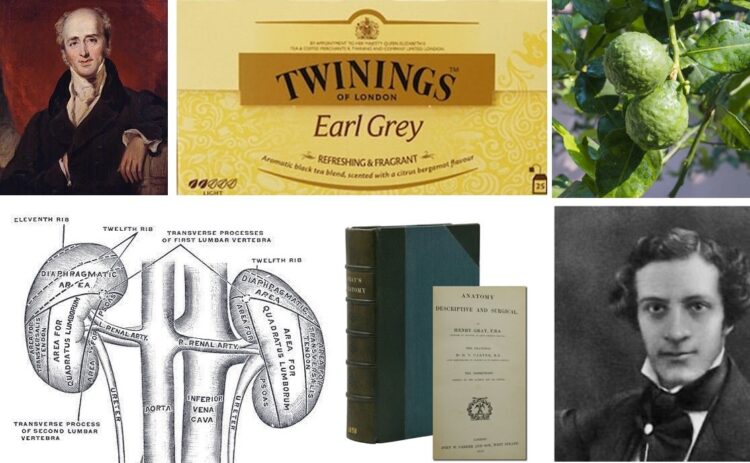
1. Charles Grey, 2nd Earl: The Man Who Defined a Tea Style
Charles Grey, 2nd Earl (1764–1845), whose surname is spelled with an "e," left a legacy that is tasted every day around the world. In the British peerage, "Earl" is a title of nobility, and the tea bearing his name has become a global standard for flavored black tea.
The Origins of the Blend
The story of Earl Grey tea is often reconstructed from various legends. It traces back to Tongmu Village in Fujian Province, China. There, a unique tea was created when a farmer tried to salvage tea leaves by drying them over pine fires, resulting in a distinct smoky aroma. This tea, known as Zhengshan Souchong, reached Europe as Wuyi tea.
As demand grew, production expanded beyond the rocky Wuyi region, and the tea exported from other parts of Fujian became known in Europe as Lapsang Souchong. Charles Grey was a particular fan of this tea. To mimic its unique smoky profile, a tea merchant added Bergamot (a fragrant citrus fruit) oil to the leaves.
From a Single Tea to a Global Style
The Earl’s preference for this fragrant blend became famous, and it eventually took on his name. Originally a blend of Chinese leaves, the production shifted to Indian and Sri Lankan black teas in the late 19th century.
Today, Earl Grey is no longer just a specific product; it is a "style" of tea. Much like "Mocha" evolved from a coffee bean variety into a term for chocolate-flavored coffee, Earl Grey now represents any black tea infused with Bergamot. Despite countless modern variations—such as Lavender Earl Grey—the name persists because it carries a narrative of nobility and elegance, making it one of history’s most successful "brand" stories.
2. Henry Gray: The Architect of Modern Medical Education
Henry Gray (1827–1861), a descendant of the family branch that uses the "a" spelling, was a brilliant British surgeon and anatomist. At just 25, he became a Fellow of the Royal College of Surgeons.
A Revolution in Textbooks
In the mid-19th century, anatomy texts were often overly dense or impractical. Gray collaborated with his friend and illustrator, Henry Vandyke Carter, to create a book where the text and illustrations worked in perfect harmony. In 1858, they published Anatomy: Descriptive and Surgical. The spine of the brown cloth-bound volume was famously embossed in gold with the title: Gray's Anatomy.
The book featured 363 precise woodcut illustrations by Carter, with structures labeled directly on the drawings. Gray focused on practical knowledge that clinicians actually needed, a structure that revolutionized medical publishing. Tragically, Gray died of smallpox at the age of 34 while caring for his nephew, shortly after the first edition was released.
A Symbol of Medicine
Though subsequent editions were revised by other scholars, the name Gray's Anatomy stuck. In the mid-20th century, some suggested renaming it the "British Textbook of Anatomy," but the proposal was rejected. The name had already become a global brand. To this day, "studying Gray" is a common phrase for studying anatomy.
The title is so iconic that the popular American medical drama Grey's Anatomy used a play on the name (changing the "a" to an "e" to match the protagonist, Meredith Grey). In January 2026, the 43rd edition of Gray's Anatomy is set to be published, marking nearly 170 years as the definitive text on the human body.
The Power of a Name
Both the Earl and the Surgeon founded "power brands" that have outlived them by over a century. One inscribed the name Grey into the culture of tea, while the other etched Gray into the foundation of medical science. Though their fields are vastly different, both names represent a tradition of excellence that continues to evolve today.
Yoo Young-hyun, Director of Tea Clinic (Audio Column 1+1 Story https://www.youtube.com/@yhyoo0906)