Today, I walk down the street and see a sign for a nursing home located in a commercial building. Patients likely have few opportunities to get fresh air, such as outdoor walks. If the windows are opened, it seems like car exhaust will come in. Nowadays, the windows are tightly closed for heating. How suffocating must it be for the patients? A small number of caregivers move between frail patients to assist with their needs. Do they have to stop breathing to leave this place? During the COVID-19 pandemic, about half of all deaths occurred in nursing facilities. To go to a place with good hygiene and facilities, one needs money. A single room is the safest, but there is no money to enter one.
"I want to die at home..." In reality, it's only 14-16%
Many elderly people choose their home as their place of death. They dislike the term 'nursing' and reluctantly refer to it as 'there.' Among elderly individuals receiving care, 67.5% hoped to die at home, according to a survey of long-term care recipients (as of 2023). However, the actual percentage of home deaths was only 14.7%. Deaths in medical institutions reached 72.9%. According to data from the National Data Agency (formerly the National Statistical Office), the ratio of deaths at home compared to total deaths is only 15.5-16.5%. The percentage of deaths in medical institutions is as high as 74.8-76.6%.
"Ending my life in my beloved home is also a right"
According to a report released by the National Assembly Legislative Research Service in November last year titled 'Measures to Activate Home Death Rights,' only 8.3% of 5,086 hospice patients who preferred home care actually died at home. This percentage has been decreasing each year: 14.0% in 2021, 13.2% in 2022, and 10.6% in 2023. The Legislative Research Service emphasized the need to promote 'home death' instead of medical institution-centered deaths to realize a dignified death. They pointed out that deaths in medical institutions not only impose a heavy financial burden for medical and caregiving costs but also cause emotional distress for patients, bed shortages, and significant financial issues.
One factor hindering the promotion of home deaths is the culture of avoiding discussions about death. Even if a patient expresses their 'desired place of death,' it may not be easily shared with family. Additionally, there is an absolute lack of infrastructure for end-of-life care. Currently, a home hospice system is in place, but it is limited to terminal patients nearing death. There is also a shortage of service providers, leading to significant regional disparities. The inconveniences and disadvantages from death confirmation at home to funeral procedures are substantial. This makes it difficult to choose to die outside of a hospital. If one dies at home, obtaining a death certificate is challenging. An autopsy and police investigation for cause of death await. The psychological burden, shock, and inconvenience experienced by the bereaved during this process are considerable.
The burden on families preparing for home death... Who will take care of them?
The Legislative Research Service stated that to promote home death, it is necessary to relax the requirements for designating home hospice specialized institutions and strengthen government budget expansion and support. They suggested reviewing ways to increase the fees for end-of-life services in home healthcare and visiting nursing. It is also important to alleviate the burden on families preparing for home death. Even if the patient wishes for home death, the family may face various difficulties. There may be no one to care for the patient in the last 1-2 weeks. For working individuals, there is a need for institutional measures to compensate for time and income loss during end-of-life care, and for self-employed individuals, similar measures are necessary.
Do I have the 'right' to end my life in my beloved home?
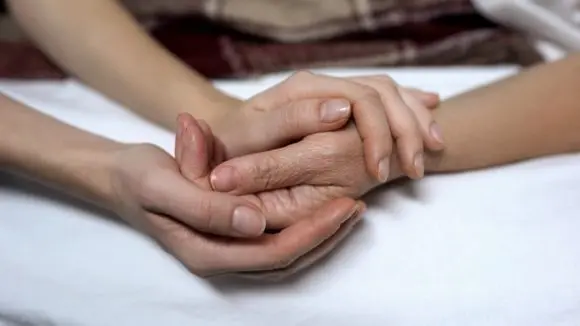
Middle-aged couples may not be unfamiliar with 'death' due to their parents' illnesses and deaths. They also feel the difficulties of caregiving. Just when they manage to catch their breath, they may wonder, 'What kind of death will I face?' Do I have the 'right' to end my life in my beloved home? If I decide on home death, will my family support me? If so, who will take care of me as I enter the end-of-life stage? Caregivers, wife, husband, children, relatives... No matter how much I think about it, I can't find an answer. I worry that my insistence on home death will cause difficulties for my family. It will be hard for me, weakened, to insist on home death. If my family takes me to the hospital, that will be it...
A time when we cannot freely choose the place to end our lives... "I want to die peacefully in my sleep"
I might also die in a nursing home located in a commercial building. Perhaps due to my fondness for alcohol and cigarettes since my youth, I have been battling high blood pressure, diabetes, and now a stroke (cerebral infarction) for a long time. One side of my body is paralyzed, and my vision is poor. My family has struggled to care for me, but can I insist on home death? Do I even have such a 'right'? I feel that it would be difficult to trouble my family until the end. Still, the desire to die in my beloved home is strong compared to an unfamiliar nursing facility...
As seen in these cases, home death awaits a complicated process. Support from the government, the National Assembly, and local governments is essential. It is a sad time when we cannot freely choose the place to end our lives. The desire to die peacefully in my sleep without a long battle resonates particularly deeply at this time.