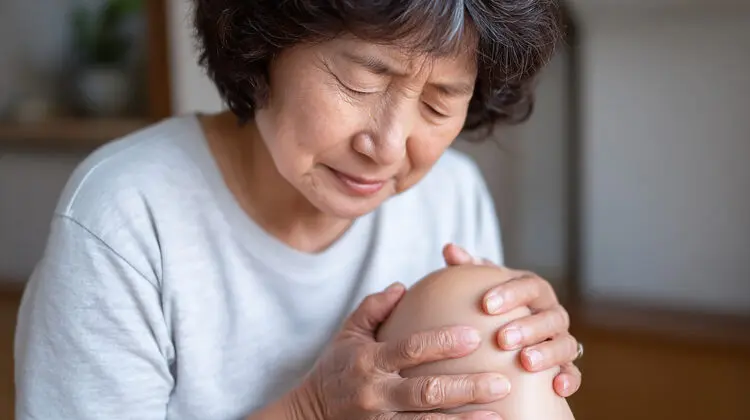
"Ouch, my knee is aching. Is it going to rain...?"
Grandparents always said that. They would predict the weather with their knees. Whether the weather knows the knees first or the knees know the weather first is unclear...
Especially when the temperature drops like now, the complaints increase. "It's colder, so my knees hurt more." But if I remember, they said the same in summer. During the rainy season, they would habitually say, "It's humid, so my joints ache."
So, trying to sound knowledgeable, they would say, "In winter, it's 'degenerative' osteoarthritis, and in summer, it's 'inflammatory' arthritis."
However, this statement is only half true. The season is more of a 'switch' that makes existing problems feel worse rather than a 'cause' that makes joints hurt. Even with the same knee, the pain can vary greatly depending on the day's temperature, activity level, muscle condition, sleep, and stress. Therefore, it is dangerous to simply "fit a diagnosis" to the season.
Winter: The Reason Knees Hurt More as the Weather Gets Colder
You need to find the clues well. By observing how the pain manifests, you can somewhat determine whether it leans towards degenerative or inflammatory.
Degenerative osteoarthritis usually presents in this way. At first, there is a stiff feeling when moving → after a little movement, it feels loosened → but if you walk for a long time or climb stairs, it hurts again → especially uncomfortable when going down stairs, squatting, or kneeling.
The pattern of 'pain when used, better when rested' is clear. This pattern is especially common after the 60s.
Then, when the weather is cold, the body shrinks. The knees are no exception. Muscles and ligaments can become stiff, reducing blood flow around the joints. Also, decreased activity can weaken thigh strength, making the knees feel more burdened even with the same weight and steps. In winter, these weaknesses become more apparent.
Of course, there are exceptions. Even degenerative conditions can cause pain when fluid accumulates in the joints (joint effusion) or if inflammation is present. Moreover, if there are issues with the meniscus or tendon inflammation, the pain patterns can mix. Thus, simply looking at the season only explains half of the causes.
"When it's humid, it's inflammatory" can be a hint in such cases
It's difficult to immediately conclude 'inflammatory' arthritis just because it hurts in summer or during the rainy season. Swelling can increase discomfort, and muscle stiffness in air-conditioned environments can cause more pain. Changes in lifestyle patterns can also exaggerate pain.
There are specific signals that make doctors suspect 'inflammatory' conditions more. First, morning stiffness lasts longer than just a short tightness. There is swelling, warmth when touched, and a feeling of heat. It aches even when still, regardless of movement. It's not just the knees that hurt. Other joints like fingers, wrists, and toes can also feel uncomfortable.
Therefore, the key to inflammatory arthritis is not the 'season.' The presence of clear signs of inflammation is what matters first. If such signals are clear, the likelihood of it being 'the weather's fault' is higher.
The danger of 'seasonal superstitions' is... "The two have completely different treatment directions"
If my knee pain is due to degenerative issues, the core of treatment is load management and strength training. Adjusting weight, walking habits, thigh strength, and gait patterns is most effective.
On the other hand, if it's due to inflammatory issues, the story changes. Enduring the pain won't solve it. The timing of treatment to control inflammation is crucial. If you just brush it off as "it's just because I'm getting older," joint damage can progress more rapidly.
So the conclusion is this: the season is just a hint, and the diagnosis is made by 'symptom patterns.' Therefore, making assumptions without a doctor only delays the appropriate treatment timing.
Habits to Reduce Knee Pain in Winter
In winter, warming up is more important than exercising for the knees. Moving lightly for about 5-10 minutes before going outside can make a significant difference. Especially on painful days, you should avoid straining yourself by going up and down stairs or steep slopes, or squatting.
On the other hand, thigh muscles should always be sufficiently developed. The thighs are the insurance that saves the knees. In other words, the answer is, "Keep the knees warm and the thighs strong." Also, on painful days, it's better to say, "Let's move less aggressively today" rather than "Let's rest today."
However, in situations where the knees are swollen, hot, and the pain is rapidly worsening, saying, "Let's work it out with exercise" can be harmful. In such cases, medical attention is a priority.
Which side is my knee on?
You can count which side has more checks below. However, this check is not for 'diagnosis' but rather for 'direction setting.'
A. Closer to 'Degenerative' Osteoarthritis □ Morning stiffness generally eases within 30 minutes □ Pain becomes more pronounced when walking for a long time or climbing stairs □ Going down stairs is particularly difficult □ Pain often arises when squatting or kneeling □ The knee feels stiff and creaky, but feels a bit better when the body loosens up.
B. Closer to 'Inflammatory' Arthritis □ The feeling of joint stiffness in the morning lasts longer than 1 hour □ There is swelling and a hot feeling (heat sensation) in the knee □ It aches even when still, regardless of movement □ Other joints like fingers, wrists, and toes also feel uncomfortable □ Recently, the pain has rapidly intensified.
C. Should see a doctor immediately □ The knee is locked and cannot be straightened, or it bends when walking □ There is significant swelling and clear heat sensation, and the pain is rapidly worsening □ Wakes up at night due to pain.