Last week, seeing multiple media outlets publish a stream of articles about Ms. Choi Jun-hee’s plastic surgery made me uneasy. Each time I clicked on one, the first thought that came to mind was anxious worry—what if something had gone wrong again?
This feeling is a bit different from simply following a celebrity’s news. For my generation, Ms. Choi Jun-hee can sometimes feel like a niece who lost her parents at a young age. Because so many people held deep affection for the late actress Choi Jin-sil, quite a few have watched with gratitude simply because Jun-hee has grown up bright and well.
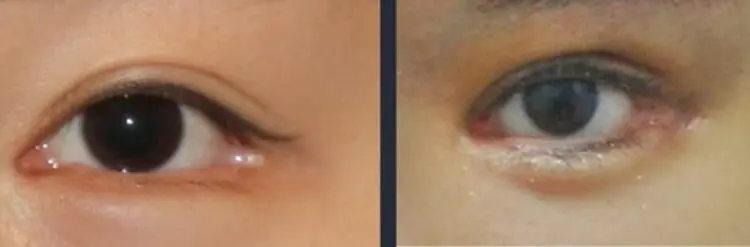
And there was a reason I felt anxious about her plastic surgery news. When I heard that Ms. Choi Jun-hee had undergone a lateral canthoplasty (lower) in July, I felt regret as a plastic surgeon. Lateral canthoplasty (lower), which lowers the outer eye corner, runs counter to normal anatomy and function and is not an aesthetically appropriate procedure. For that reason, in previous columns in this ‘Principles of Plastic Surgery’ series, I have addressed it multiple times as a “procedure I do not recommend”. Many people choose lateral canthoplasty (lower) to lower the outer corner because they feel their “outer eye corners look upturned.”
However, it is normal for the outer eye corner to be slightly upturned. In most cases, the cause of eyes that look upturned is not the outer corner itself. It is the inner corner slanting downward, which makes it appear as though the outer corner is raised.

So, this forced procedure of lowering the outer eye corner was born from a misunderstanding rooted in the Korean expression “the outer eye corners are upturned”.
An upturned outer eye corner plays an important role in supporting the eyelid so it stays closely apposed to the eyeball. If you lower the outer corner with a lateral canthoplasty (lower) simply because it looks upturned, you leave the inner corner—the true cause—unchanged, while collapsing only the normal structure of the outer corner. As a result, support at the lateral canthus weakens, and I have seen countless cases in which the eyelid no longer properly apposes the eyeball, leading to excessive tearing or dry eyes and functional discomfort such as a foreign-body sensation and eye fatigue.
So ever since July, whenever I saw articles about Ms. Choi Jun-hee’s plastic surgery—especially when they mentioned her eyes—I think my worry came first: what if a problem had arisen from the previous surgery, or what if she had undergone yet another problematic procedure?
But in last week’s flood of articles, the truly important story is nowhere to be found. It is hard to find content that explains her current condition; instead, only provocative headlines and phrasing are repeated.

Articles that simply string together words like plastic surgery, illness, and weight change without context—just to drive clicks—do not so much inform as they consume the plastic-surgery issue itself.
In the meantime, as I looked at Ms. Choi Jun-hee’s social media (SNS) and recent photos, I began to feel relieved. It appeared that this time she had undergone a procedure to restore the results of the previous lateral canthoplasty (lower) closer to their original state.

Choosing to reverse a procedure you have already had is not as easy as it may seem. That is because our brains dislike discomfort. Based on my long experience meeting people who come in for revision consultations after an unsatisfactory surgery, far more people feel, “My judgment was right, but the surgery went wrong,” than those who think, “My previous judgment was wrong.”
That is why the choice to reverse the prior surgery feels all the more fortunate.
I also think my anxious assumption—vaguely worrying, “What if she had another problematic surgery?”—may have been a bit hasty.
Now, I think I can watch her choices with a little more peace of mind.