For more than 20 years, she incinerated belly fat. She saw it as treasure.
Why liposuction specialist Dr. Kim Jung-eun wrote a book on adipose-derived stem cells
Kim Jung-eun, chief executive director of 365mc, has watched the same scene play out for years. After a liposuction procedure ends, the human-derived fat removed from the body typically goes straight to an incinerator.
After more than 20 years of that routine, she began asking a different question: Does this fat really have to be thrown away?
She came to a different conclusion. Fat, she said, is a future resource for regenerative medicine, rich in stem cells and collagen. She recently laid out that argument in a book.
The government and the National Assembly have also acted. On June 18, the National Assembly passed an amendment to the Waste Management Act at a plenary session that removes human-derived fat from the list of materials barred from recycling.
A door opened after six years
The claim has a scientific basis. Adipose tissue contains stem cells along with various growth factors and cytokines. It is also rich in extracellular matrix (ECM). ECM is a structural framework made up of collagen and various proteins. By creating an environment where cells can settle and grow, it is considered a foundational component for tissue regeneration.
Until now, among medical waste, only the placenta was exceptionally allowed to be recycled for pharmaceutical manufacturing purposes. With the latest amendment, a legal basis has been established for human-derived fat to be used—under uses and methods prescribed by presidential decree—for research and development and the production of pharmaceuticals and medical devices.
That does not mean fat can immediately be recycled freely in clinical settings. The relevant rules will take effect only after one year from promulgation. Relevant ministries must establish systems to manage safety and ethics across the collection, storage, processing, and use stages.
Discussions about using human-derived fat as a medical resource are not new. In 2020, the government presented allowing the recycling of human waste fat as a policy task in its “Measures to Improve Key Biohealth Regulations.” Related bills were also introduced in the 21st National Assembly, but they failed to clear the hurdle amid concerns over ethics, infection risks, and the possibility of illegal distribution. The passage of this amendment is significant because a debate that has resurfaced for nearly 20 years has now moved into an institutional framework.
A growing market, but expectations may be premature
Industry is also tracking the shift. ECM has recently been discussed as a potential material for skin boosters aimed at improving skin elasticity and creating a tissue-regeneration environment, as well as for wound dressings and medical-device materials.
Shinhan Investment Corp. projected that South Korea’s ECM skin-booster market will grow from 9.9 billion won in 2025 to 172.9 billion won in 2027. However, this is not the market size for adipose-derived ECM alone, but an overall forecast for ECM skin boosters. It should be understood to mean that adding adipose-derived ECM could expand the market further.
Related companies are also said to be reviewing the potential to commercialize adipose-derived ECM products. The pace of commercialization will be clearer only after the law takes effect and management standards and a raw-material supply system are put in place.
Holding on to one thing—fat—for 23 years
Since opening in Nowon, Seoul, in 2003, 365mc has focused on a single field: obesity and liposuction. As a result, it established itself as South Korea’s first hospital-level medical institution specializing in obesity. That accumulated experience became the foundation for the new book.
According to 365mc, it developed the fat-extraction injection LAMS in 2014, and in 2017 unveiled an artificial intelligence-based liposuction system with Microsoft. It previously announced that as of its 20th anniversary in 2023, it had recorded 6 million cumulative patient visits and annual revenue exceeding 100 billion won.
The hospital also said that last year the 365mc Adipose Stem Cell Center was designated by the Ministry of Health and Welfare as an advanced regenerative medicine implementing institution. The designation means it met the facility, staffing, and equipment standards required to conduct regenerative-medicine clinical work and research. It does not mean any specific cosmetic or anti-aging effects have been proven.
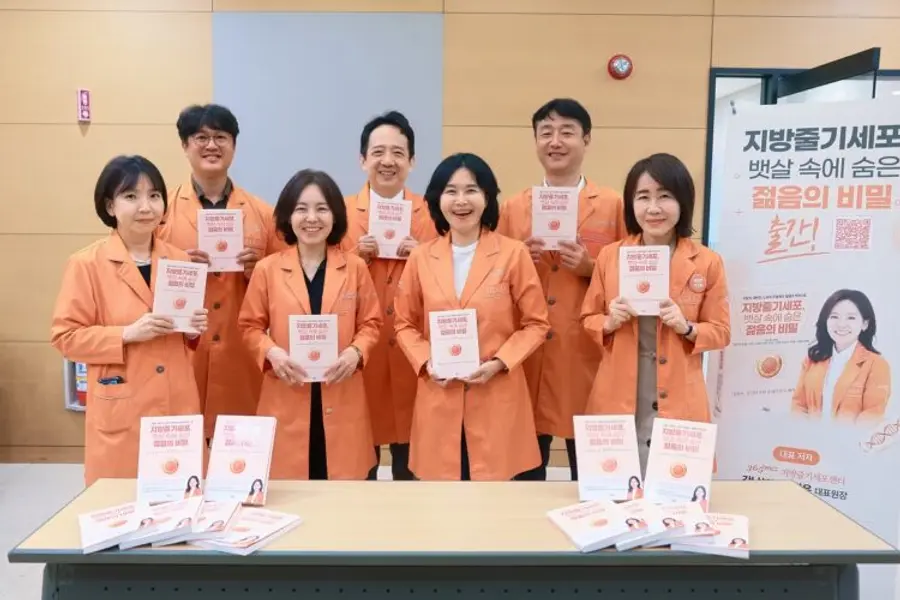
The new release presents 23 years of accumulated fat research at a level accessible to the general public. It covers basic concepts such as stem-cell yield in fat and collection methods. It also includes clinical application cases such as anti-aging using skin boosters and approaches aimed at improving engraftment rates for breast and pelvic fat grafting. The book also introduces cases related to quality of life, including hair-loss or acne improvement and stamina management using intravenous injections.
Still, this content should be read as the hospital’s description of its clinical experience and potential applicability. It is difficult to regard it as a standard treatment established through large-scale research across all areas.

“We will continue building scientific evidence”
Dr. Kim Jung-eun said, “It was a meaningful time to share what’s in the book and hear feedback from the field,” adding, “As a medical institution that studies just one thing—fat—we will continue to publicize the clinical value of adipose-derived stem cells while steadily accumulating scientific evidence.”
Fat is still widely seen as a warning sign for obesity and metabolic disease. But once human-derived fat leaves the body, it faces a different question: Is it waste to be burned and discarded, or a resource that—through a safe management system—can be used as material for research and treatment?
The law has opened the door. The threshold remains. The key going forward is not expectations driven by claims of efficacy, but evidence and safety built meticulously—from collection to processing to clinical application.