
In the field of Japanese orthopedics, specialists use the term "locomotive syndrome" to describe a condition where bones, joints, muscles, and nerves gradually weaken, causing overall mobility to decline. It is widely used as a proactive health indicator to detect frailty and the need for long-term nursing care early on. In a six-part series, Kormedi.com, with the help of South Korean medical experts, will examine the early warning signs of this syndrome that surface in everyday life—from putting on socks to crossing the street.
Sometimes, while waiting at a crosswalk, a sudden sense of urgency hits you. It is a stretch of road you once crossed with time to spare, but now your immediate thought is whether you can make it to the other side before the green light ends. When climbing stairs, your hand instinctively reaches for the railing. When standing on one foot to pull on a sock, you wobble.
Many dismiss these moments as a natural consequence of aging, but that is not necessarily the case. Before physical frailty becomes starkly obvious, the body signals decline through subtle changes in gait. Walking speed slows, stride length shortens, and early shifts often include diminished power when rising from a seat and compromised balance.
When these functional declines converge, clinicians diagnose it as locomotive syndrome—a state where bones, joints, the spine, intervertebral discs, muscles, and nerves weaken collectively, reducing the capacity to walk and move. Depending on its severity, the condition is classified into progressive stages (Stages 1 through 3), serving as a critical warning window to intervene before mobility loss leads to falls, fractures, and a dependence on long-term care.
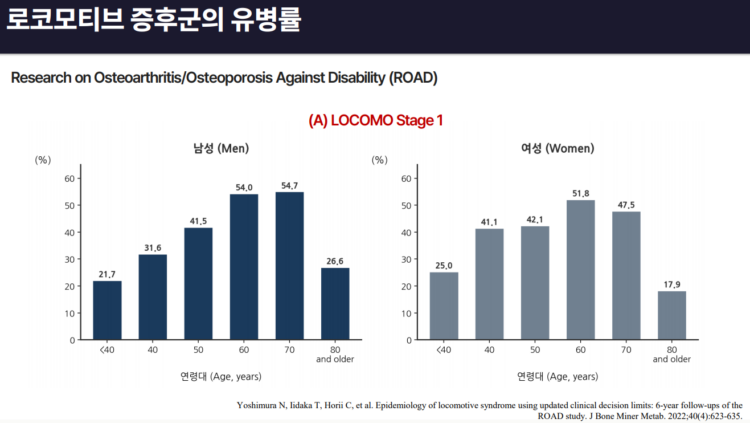
"In many cases, locomotive syndrome is already progressing even during stages when there are no noticeable symptoms," said Kim Mi-ji, a professor in the Department of Medical Science Convergence at Kyung Hee University. "A large-scale cohort study in Japan revealed that more than 80 percent of community-dwelling older adults aged 60 and over were classified as having locomotive syndrome Stage 1 or higher." In short, an absence of overt pain does not mean physical function is being well-maintained.
Red Flags in Everyday Routines
Early signs of locomotive syndrome frequently manifest in daily habits long before they show up on clinical tests. Red flags include struggling to stand on one foot while putting on socks, tripping over door thresholds, slipping indoors, or requiring a handrail for stairs. Carrying groceries home begins to feel burdensome, walking continuously for 15 minutes becomes difficult, and making it across a crosswalk within the signal timing feels uncomfortably tight.
"It used to be a distance I wouldn’t even think about, but halfway through, my legs suddenly felt like lead."
Kim, a 68-year-old resident of Busan, first felt this unease early this year in a supermarket parking lot. After shopping, the 200-meter walk to the parked car felt extraordinarily daunting. While a routine health checkup revealed nothing unusual, the discomfort persisted. When Kim eventually visited an orthopedic clinic, the diagnosis was clear: "Your muscle strength and balance have declined significantly for your age."
People often brush these changes off as simply "lacking energy." In reality, lower-body strength, joint health, balance, and neurological function may all be faltering simultaneously. When these experiences become repetitive after the age of 60, they should not be ignored as mere fatigue or inevitable aging.
Measuring Mobility Before Frailty Strikes
Physicians gauge the risk of locomotive syndrome using a few straightforward physical assessments. Developed by the Japanese Orthopaedic Association (JOA) in 2007 and integrated into clinical practice in the 2010s, the "Locomotive Syndrome Risk Test" relies on three core metrics: the stand-up test, the two-step test, and the 25-item Geriatric Locomotive Function Scale (GLFS-25).
The stand-up test measures the lower-body strength required to rise from chairs or platforms of varying heights using only one or both legs, without utilizing the arms. The two-step test evaluates walking ability by measuring the maximum distance a person can cover in two long strides, relative to their height. The GLFS-25 is a questionnaire assessing a patient's physical challenges over the past month, tracking pain, walking capacity, the frequency of social outings, and the fear of falling.
"The advantage of the stand-up and two-step tests is that they can be performed immediately without any specialized medical equipment," explained Yoo Jun-il, a professor of orthopedic surgery at Inha University. "However, many people assume they are perfectly fine as long as they aren’t experiencing pain, meaning they only seek medical care after significant functional decline has already taken place."
Professor Yoo emphasized that monitoring changes over time is critical. "The trajectory matters more than a single score. If your walking capability feels noticeably different than it did a month ago, that is your cue to consult a specialist."
Frailty does not arrive overnight. It begins with a narrowing stride, a slower walking speed, and weakening leg muscles. This leads to reduced physical activity, which accelerates muscle loss and further degrades balance. Without intervention, this downward trajectory sharply elevates the risk of life-altering falls and fractures.
The objective of managing locomotive syndrome is not to recapture the brisk pace of youth. Rather, it is to preserve the independent mobility required to walk confidently, climb stairs, shop for groceries, and remain safe from falls for as long as possible. Your gait is one of the most reliable barometers of health in later years. If the green crosswalk light suddenly feels like it is ticking down too fast, it is time to take a closer look at your stride.