When North Korea, backed by the Soviet Union and China, invaded the Republic of Korea in 1950, the international response was unprecedented. While 16 nations dispatched combat troops to fight alongside South Korean forces, a vital secondary line of defense arrived in the form of medical support units from six allied nations: Sweden, India, Denmark, Norway, Italy, and West Germany.
On the 76th anniversary of the outbreak of the war, the physical and cultural marks left by these medical units remain visible across the capital city of Seoul and the wartime provisional capital of Busan. These units did far more than treat wounded soldiers on the battlefield; they extended care to thousands of displaced civilians, shared advanced clinical expertise with local physicians, and rebuilt a national healthcare infrastructure that had entirely collapsed.
The Scandinavian Alliance and the Birth of Modern Medicine
Among the medical contingents, the contributions of the three Scandinavian nations—Sweden, Denmark, and Norway—left a profound institutional imprint on South Korea. Operating with a shared cultural and linguistic synergy, these three countries partnered with the United Nations Korean Reconstruction Agency (UNKRA) and the South Korean government to establish a premier medical training ground.
On October 1, 1958, on the former site of the Seoul Municipal Citizens Hospital in Euljiro 6-ga, they opened the Scandinavian Teaching Hospital. Formally commencing patient care on November 28 of that year, this facility laid the foundation for what is known today as the National Medical Center. Having undergone recent modernizing renovations, the center continues to treat patients at its original location, serving as a permanent monument to Nordic humanitarianism.
This partnership also introduced elements of Scandinavian social culture to the peninsula. The medical staff operated a staff restaurant near the hospital known as the Viking Club, which holds historical distinction as Korea's very first buffet-style restaurant. This cross-cultural exchange was deeply rooted in shared history; unlike neutral Sweden, both Denmark and Norway had personally experienced the trauma of foreign occupation under Nazi Germany during World War II, fueling their dedication to South Korea's sovereignty.
Sweden's Deep Roots in Busan
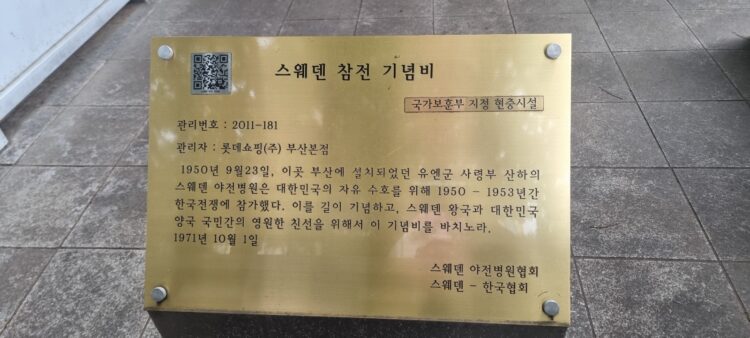
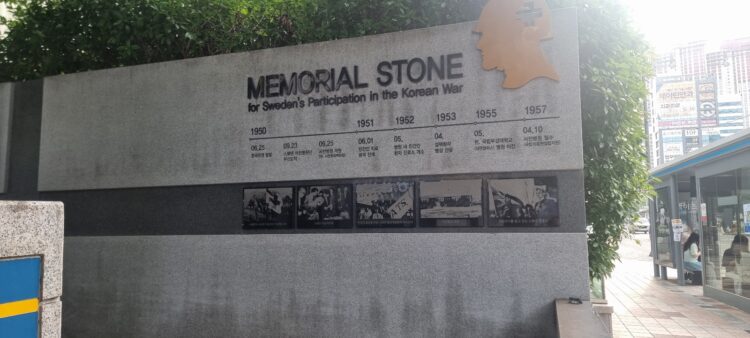
Sweden’s medical mission began early in the conflict, establishing the Swedish Red Cross Field Hospital in September 1950. The unit remained active until April 1957, nearly four years after the signing of the armistice agreement. Following the cessation of hostilities in July 1953, the facility transitioned into the Busan Swedish Hospital, pivoting its focus toward civilian care and the long-term rehabilitation of wounded veterans.
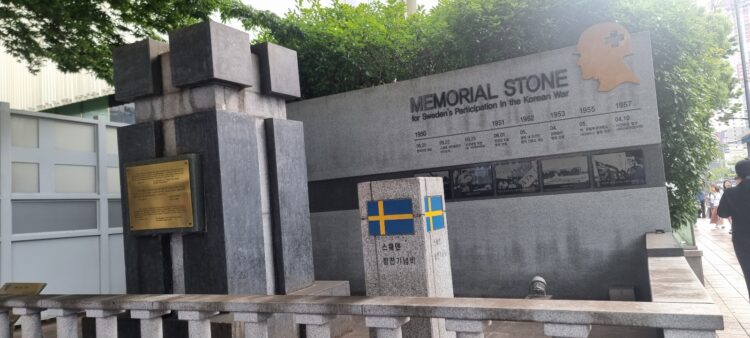
Initially, the hospital set up operations on the campus of Busan Commercial High School in the bustling district of Seomyeon. This prestigious institution counts former President Roh Moo-hyun among its notable alumni. The school has since relocated to Danggam-dong in Busanjin-gu and operates as Gaeseong High School, while the original Seomyeon property was acquired by the Lotte Group to construct a department store and hotel complex. Today, a dedicated Swedish War Memorial stands quietly on a corner of this commercial site.
In May 1955, the hospital transferred its operations to the National Busan Fisheries University campus—now Pukyong National University in Daeyeon-dong, Nam-gu—before its final withdrawal in 1957. Over its years of service, Sweden deployed 1,124 medical personnel across multiple rotations, maintaining a staff of 170 at any given time. The hospital expanded its capacity from 200 beds to a peak of 600, treating a massive influx of local refugees and passing advanced surgical techniques to Korean medical staff.
Locals affectionately referred to the facility as "Seojeon Hospital," utilizing the traditional Chinese-character name for Sweden (Seojeon). The connection between the Swedish Crown and Korea extended back to 1926, when King Gustaf VI Adolf visited the peninsula as Crown Prince to observe archaeological excavations in Gyeongju. A spectacular gold crown adorned with a phoenix ornament was unearthed during his visit; to honor the occasion, the tomb was named Seobong Tomb, combining characters representing Sweden and the phoenix. Decades later, shortly after ascending the throne, King Gustaf VI Adolf authorized the deployment of the medical unit to Korea—a significant geopolitical decision for a nation that maintained strict neutrality until joining NATO in 2024.
Sea-Based Care and Mobile Units: Denmark and Norway
Denmark’s medical support unit took a distinctly maritime approach. Rather than establishing an administrative base on land, the Danish government dispatched the Jutlandia, an 8,500-ton hospital ship converted from a royal yacht. Operating from March 1951 to August 1953, the ship initially anchored at Busan Port before shifting to Incheon Port in November 1952 to be closer to the front lines.
The Jutlandia maintained a rotating staff of 100 personnel at a time, deploying a total of 630 individuals throughout the war. The ship completed two round-trips back to Denmark during the conflict to rotate personnel and replenish medical provisions. During these voyages, the ship performed vital humanitarian service by repatriating wounded soldiers from other allied nations, including Ethiopia, Turkiye, France, Belgium, and the Netherlands.
Norway provided tactical, close-support medical care through the Norwegian Mobile Army Surgical Hospital (NORMASH), which operated from June 1951 to November 1954 across frontline sectors in Uijeongbu and Dongducheon. A cumulative total of 623 Norwegian personnel served in the unit, rotating in cohorts of 109 every six months. Tragically, three Norwegian members lost their lives in the line of duty.
NORMASH primarily delivered immediate surgical care for the U.S. Army’s I Corps, which commanded the South Korean Army’s 1st Division alongside the U.S. 24th Infantry and 1st Cavalry Divisions. Despite the intense operational tempo of treating frontline casualties, the unit dedicated significant energy to treating displaced Korean civilians and restoring fractured local medical networks.
Architecture and Sacrifice: The French Connection
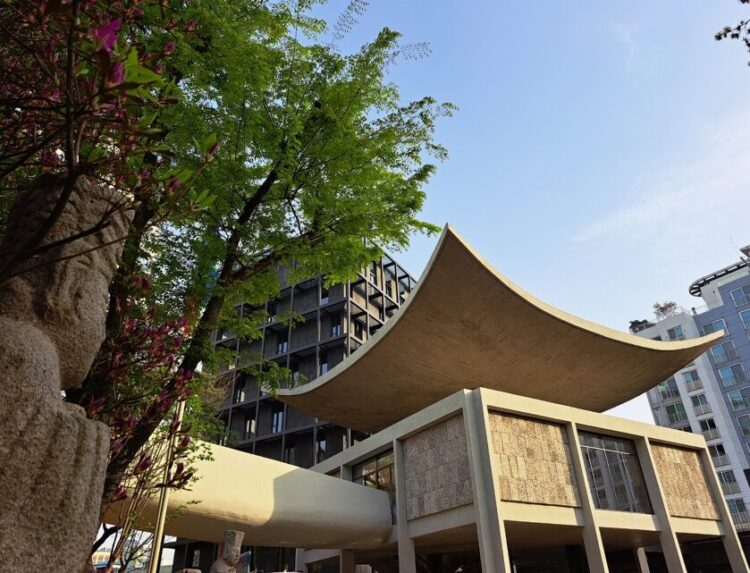
In the heart of Seoul, another striking testament to wartime alliance can be found at the French Embassy in Seodaemun-gu. Completed in 1963, the embassy complex was designed by Kim Jung-up, a pioneering figure in modern South Korean architecture and the sole Korean disciple of the legendary Swiss-French master architect Le Corbusier. The building is celebrated as a masterpiece of structural synthesis, utilizing a sleek, sweeping concrete roofline that evokes the traditional eaves of a Korean hanok. Following a meticulous five-year restoration project to undo decades of ad-hoc modifications, the embassy officially reopened its original architectural profile in April 2023.
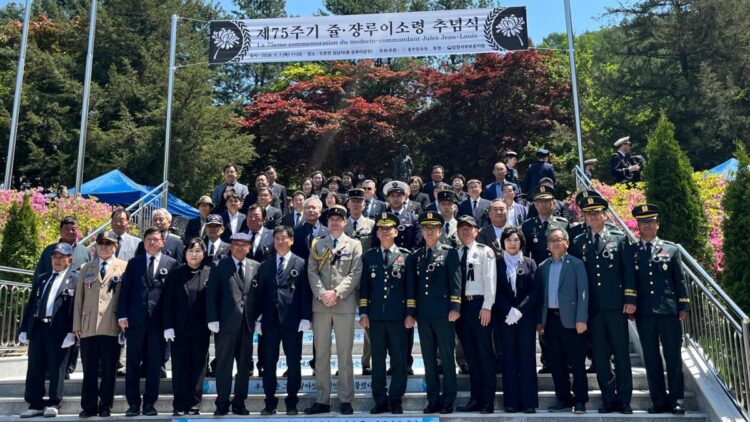
The newly constructed administrative building, Monclar Hall, and the entrance gallery wing, Jean-Louis Hall, were explicitly dedicated to the memory of French veterans. Monclar Hall honors Gen. Ralph Monclar, a celebrated World War II Free French resistance fighter whose real name was Raoul Magrin-Vernerey. In an extraordinary act of devotion, he voluntarily took a temporary demotion from lieutenant general to lieutenant colonel so he could personally command the French Battalion deployed under the UN flag. Concurrently, Jean-Louis Hall honors Maj. Jules Jean-Louis, a military physician who made the ultimate sacrifice for the people of South Korea.
The Ultimate Sacrifice of Major Jules Jean-Louis
Born in Antibes in 1916, Maj. Jules Jean-Louis graduated from the prestigious military medical school at Val-de-Grâce Hospital in Paris. During World War II, he was captured by German forces, receiving the Croix de Guerre for his brave medical care of fellow prisoners within the stalag. Following postwar service in Indochina, he arrived in Korea with the French Battalion on November 26, 1950.
As the chief medical officer of a mobile hospital unit, Maj. Jean-Louis played a critical role in the historic Battle of Jipyeong-ri in Yangpyeong in February 1951. During this engagement, encircled U.S. and French forces successfully repelled a massive Chinese offensive, marking a decisive turning point that halted the communist push south.
On May 8, 1951, while stationed at the French mobile field hospital in Hongcheon, Gangwon Province, Maj. Jean-Louis received word that two South Korean soldiers were trapped and wounded in a nearby minefield. He rushed into the live hazard and successfully extracted both men. However, as he turned to guide them back to safety, an enemy mine detonated, killing him instantly.
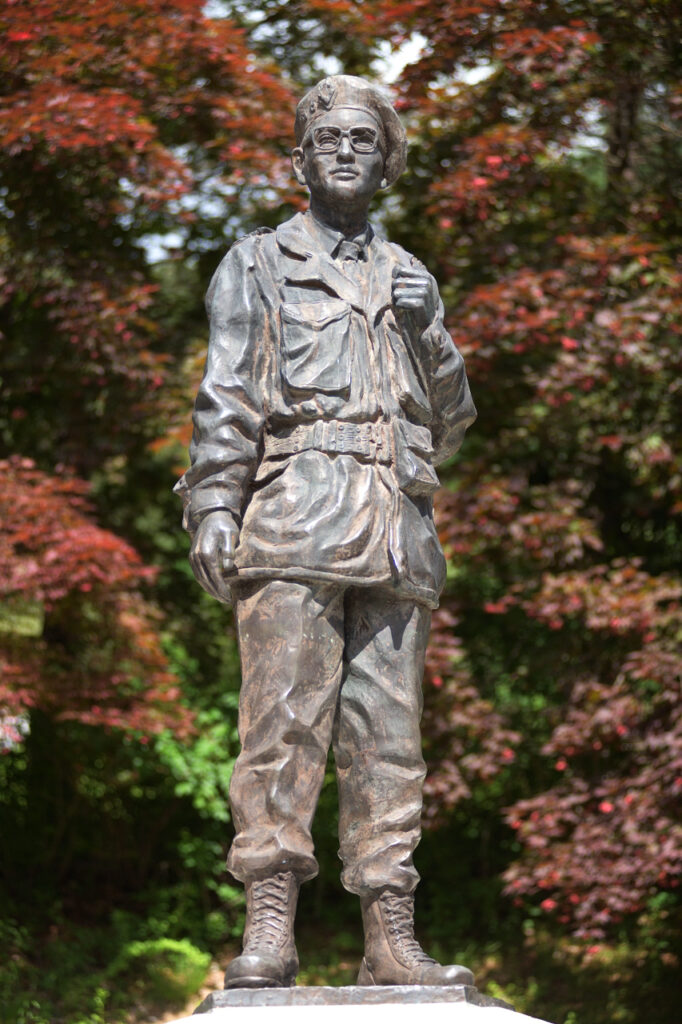
In recognition of his valor, the French government posthumously awarded him the Legion of Honor, France's highest decoration. In South Korea, a memorial statue was erected in 1986 along National Route 44 in Jangnam-ri, Duchon-myeon, Hongcheon-gun, marking the centennial of diplomatic relations between the two countries. Looking out toward the valley where he fell, it is the only statue of a French national in South Korea, and alongside the monument to Gen. Douglas MacArthur in Incheon's Jayu Park, it stands as one of only two statues dedicated to foreign soldiers nationwide.
Forty years after that statue was raised, South Korea and France celebrate the 140th anniversary of their diplomatic ties, tracing back to the 1886 Treaty of Amity and Commerce. To mark this milestone, French President Emmanuel Macron conducted an official visit to Seoul, and President Lee Jae-myung was invited to the G7 Summit held in Evian, France. This high-level diplomacy underscores South Korea's rapid transformation from a war-torn recipient of foreign aid into a global economic and military power, widely positioned to join the group as a permanent member.
The security and prosperity enjoyed by modern South Korea were bought with the immense sacrifices of its own citizens, but they were reinforced by the doctors, nurses, and field hospitals of international allies. June, the national month of remembrance, remains a vital time to honor those who crossed oceans to heal a nation in its darkest hour.