A 190-centimeter-tall man with celebrity-grade looks opened the examination room door and walked in. Patient A was a former user of "Philopon"—a prominent brand name for methamphetamine in South Korea. After accumulating easy money through illicit work, his relentless pursuit of pleasure eventually terminated at narcotics.
His subsequent treatment program spanned more than three years, a grueling process that was less about merely quitting a chemical substance and more about rebuilding his entire life from scratch. He severed ties completely with both the drugs and his former criminal lifestyle. Today, he bakes bread and brews coffee at a cafe in Gyeonggi Province. Where narcotics once single-handedly got him through the day, his daily life is now anchored by the aroma of freshly baked bread and the simple gratitude of customers saying “thank you.”
Patient B, on the other hand, was an absolute headache from the very beginning. Even after voluntarily checking into the hospital to detox, he repeatedly smuggled substances into the ward, betraying the medical staff’s trust. His defensive vows that “this time I’ll really quit” were broken countless times, leaving the clinical team routinely deceived and deeply discouraged.
Yet, a few years after successfully concluding his treatment framework, Patient B unexpectedly returned to the hospital wheeling a bicycle. Beaming with pride, he explained that he had discovered an entirely new, clean source of dopamine. “Back then, I could trigger instant pleasure simply by sticking a needle into my arm," he said. "But these days, after riding hard with my buddies and grinding up a steep hill, the view from the summit is even more thrilling.”
Hearing those words, his attending physician sat in silence for a long moment. Here was a man who had finally learned to discover joy not in a fleeting, drug-induced illusion, but at a hard-won summit reached through his own sweat. There is no clinical outcome more welcome—or more certain—than that.
Behind the successful societal reintegration of Patient A and Patient B lies years of relentless, unheralded labor by a single medical institution. Tucked away in a quiet residential alley in Gajeong-dong, Seo-gu, Incheon, a hospital with a distinctively weathered atmosphere holds its ground. The exterior paint is visibly cracked, and its old sign is far from flashy.
Incheon Chamsarang Hospital is effectively the only psychiatric specialty hospital in South Korea capable of providing dedicated inpatient care specifically for drug addiction patients. It holds the distinction of being the first psychiatric medical institution in the country to receive formal certification from the Ministry of Health and Welfare. Today, desperate patients from every corner of the nation travel here, clinging to it as their absolute last hope.
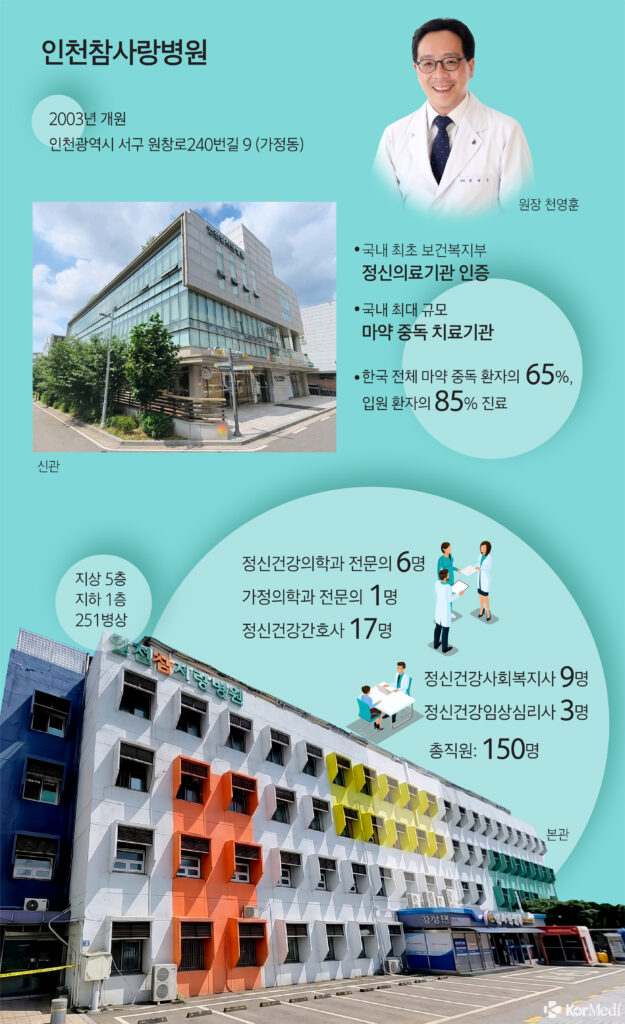
At the epicenter of this operation is Director Cheon Young-hoon, a psychiatrist recognized as one of South Korea’s leading authorities on drug addiction treatment. He single-handedly manages a staggering caseload: more than 4,000 outpatient visits a year and nearly 400 complex inpatient cases, operating largely on his own.
The national data underscores the gravity of his burden. Among all specialized inpatients in South Korea, an astonishing 90% of hospitalized drug addiction patients have Director Cheon as their primary attending physician. This overwhelming concentration exists because, without Incheon Chamsarang Hospital, South Korea possesses virtually no secondary or tertiary specialty infrastructure equipped to handle drug addiction on an inpatient basis.
From Clinical Coincidence to a Life's Mission
Director Cheon Young-hoon did not deliberately set out to become an addiction specialist. After graduating from Wonkwang University College of Medicine, he encountered the field almost entirely by chance at the dawn of his medical career. In the 1990s, Wonkwang University Hospital operated one of the largest psychiatric wards among the nation's university health systems. Because of its massive bed capacity, the facility attracted an immense diversity of psychiatric pathologies.
The most common admissions were individuals suffering from severe alcohol addiction. At the time, the Korean medical community lacked standardized, evidence-based treatment manuals for substance dependence. Even practicing psychiatrists openly doubted whether these patients could ever be truly rehabilitated. As a resident enduring every imaginable hardship on the wards, Cheon initially grew to dread managing addiction cases. Yet, his clinical trajectory remained permanently bound to the discipline.
During his mandatory military service, he traveled extensively across the country as a conscription physician under the Military Manpower Administration. Stationed in regional offices spanning Gwangju, Jeonju, Uijeongbu, and Cheongju, he conducted official draft physicals by day and worked exhausting night shifts at local psychiatric hospitals. What he witnessed firsthand inside those private wards shocked him.
“Back then, I walked away with the distinct impression that private psychiatric hospitals were operating more like a lodging business than a medical service,” Cheon recalls. The institutions were structurally accustomed to warehousing patients indefinitely behind locked doors rather than actively rehabilitating them for a safe return to society. From that point forward, a singular question consumed his thoughts: “Why can't we build a hospital that refuses to lock people away, but instead equips them to go back out into the world?”
That ambition did not immediately translate into narcotics treatment. He continued to build foundational clinical experience while completing a specialized fellowship at Incheon Severance Hospital, the structural predecessor of his current facility. When Incheon Severance ceased operations, a senior colleague established an entirely new entity, and Cheon joined the venture. That institution was Incheon Chamsarang Hospital, which officially opened its doors in 2003.
The definitive turning point of his career arrived in 2007, when he joined a clinical research study investigating risk factors for HIV and hepatitis C transmission among active intravenous drug users. Upon interviewing the participants, he was appalled to discover that South Korea provided virtually no clinical care, preventative education, or structured lectures for narcotics addicts.
Even after the academic study concluded, Cheon found it impossible to turn his back on this discarded demographic. He began systematically entering multiple correctional facilities to meet directly with incarcerated individuals. He lectured them on the neurobiological mechanics of addiction and detailed the exact clinical treatments required for recovery. He focused his intervention not simply on the static act of quitting drugs, but on teaching them how to physically live life again.
The young physician who had once envisioned a conventional career as a university professor had gradually evolved into an uncompromising addiction specialist. In 2013, he fully acquired Incheon Chamsarang Hospital. He chose as his life’s work a marginalized medical field that no one else would willingly assume simply because it "does not make money."
Why True Recovery Demands Community Integration
Within the wider medical community, the true significance of Incheon Chamsarang Hospital extends far beyond its raw volume of patient admissions.
In the architecture of addiction recovery, the environmental conditions waiting outside the clinic doors dictate long-term success. No matter how advanced or successful an inpatient stabilization protocol is, a single moment of unmonitored vulnerability in the outside world can instantly unravel months of clinical progress. "Inpatient treatment is entirely useless unless the hospital and the surrounding community operate as an interconnected ecosystem," Cheon emphasizes.
To bridge this gap, Incheon Chamsarang Hospital has woven itself deeply into the regional civil infrastructure. The Incheon Western Probation Office and the Incheon Mental Health Center serve as dedicated cooperating partner institutions. The hospital has also been formally designated as an official treatment-entrustment facility by the Incheon District Court.
Furthermore, the Incheon District Prosecutors’ Office and the Incheon Metropolitan Office of Education have executed joint institutional covenants with the hospital to aggressively counter adolescent drug abuse. The network extends well beyond municipal borders; this year, the Gangnam-gu Addiction Management Center in Seoul—an area currently experiencing a sharp escalation in high-profile narcotics cases—signed a strategic agreement with Chamsarang to facilitate seamless recovery tracking.
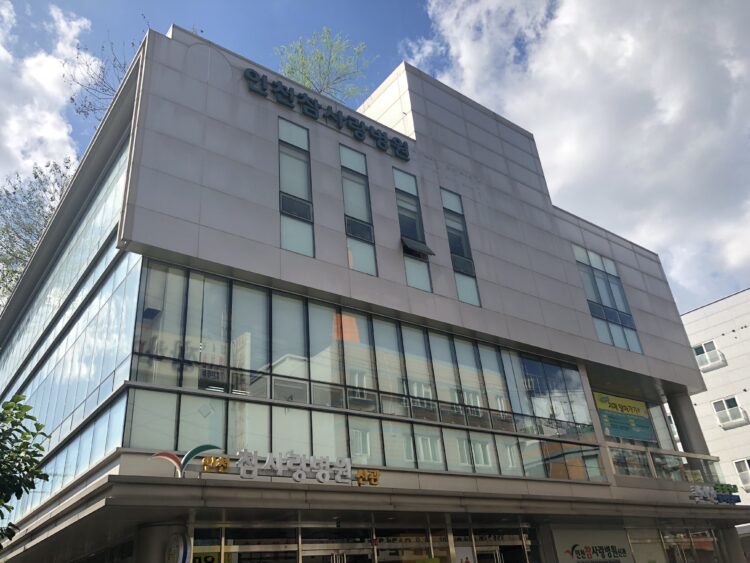
Architecturally, the hospital’s newer facility houses the Haetsal Day Care Center, which provides specialized care for local senior citizens, alongside the Killian Emotional and Behavioral Research Institute, which oversees youth psychological education. The entire second floor of the building is strictly dedicated to managing these community-facing public health programs.
Director Cheon thinks of Patient A and Patient B every single time he evaluates a new admission.
“The exact moment a patient steps outside our doors, the real, unvarnished test of addiction treatment begins," Cheon notes. "Once discharged, they require an overlapping matrix of social support to ensure they cannot easily re-access illicit substances. It is clinically meaningless to simply tell a patient, 'Your inpatient treatment is complete; now go home and never touch drugs again.' We fundamentally require an active, transitional safety net that shelters them between the controlled hospital environment and their eventual return to everyday civilian life."
To address this, the hospital actively leverages a pilot initiative by the Ministry of Health and Welfare titled the “Continuous Treatment Support Project for Acute-Phase Psychiatric Patients.” Under this program, individuals discharged from Incheon Chamsarang Hospital are immediately paired with a dedicated social worker. For up to six months post-discharge, these specialists conduct mandatory, systematic check-ins via phone consultations and direct home visits, organically linking patients to municipal counseling centers and regional government assets.
The Burden of South Korea's "Fourth-Tier" Emergency Room
In 2021, the city of Incheon inaugurated a specialized, 24-hour mental health emergency response room. Incheon Chamsarang Hospital was selected to spearhead the initiative alongside three major regional health systems.
Individuals experiencing severe chemical intoxication who present an imminent risk of self-harm or violence are classified as acute emergency admissions. Methamphetamine users in an acute phase routinely present with severe auditory hallucinations, terrifying visual distortions, and violent paranoid delusions.
The systemic crisis lies in the fact that almost no conventional hospitals are willing to absorb these volatile patients. Even major tertiary general hospitals and premier university psychiatric wards routinely turn them away because they lack the highly specialized containment protocols and security infrastructure required to safely manage chemical psychosis. A few years ago, this systemic failure culminated in a tragedy where an individual suffering from severe Philopon-induced hallucinations died inside a police detention cell because not a single hospital in the region would accept him for admission.
The emergency hub at Incheon Chamsarang Hospital directly steps into this vacuum, taking in these critical patients, administering immediate clinical stabilization, and transitioning them into structured inpatient care. When acute intoxication symptoms are severe enough to threaten vital organ functions, intensive medical detoxification and stabilizing therapies are deployed immediately.
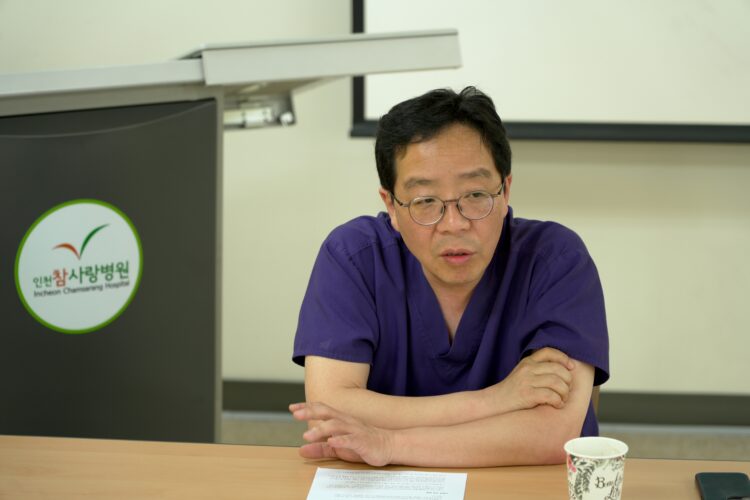
Because it routinely absorbs the high-risk failures of the standard medical system, healthcare professionals colloquially refer to Incheon Chamsarang Hospital as a “fourth-tier hospital.” It operates as the final safety net for patients who cannot be managed within the traditional continuum of primary clinics, secondary general hospitals, and tertiary advanced university medical centers. Chamsarang is where families go when the most prestigious university psychiatry departments in the country throw up their hands.
Yet, this vital public service is mired in an institutional dilemma. While psychiatry is inherently labor-intensive, drug addiction treatment represents the absolute "final boss" of the medical field. It demands intense, round-the-clock clinical management from the moment a patient wakes up until they fall asleep.
Tragically, South Korea's rigid National Health Insurance reimbursement structure fails to adequately compensate the hospital for these exhaustive medical services. Because public insurance payouts are strictly capped by an artificial ceiling, the hospital cannot recoup the true clinical costs and staffing expenses required to execute proper rehabilitation. The structural reality forces the hospital to continuously burn through its own internal resources and personnel, placing an immense, compounding financial burden directly onto the institution.
Even routine physical maintenance poses a distinct logistical challenge; the hospital cannot easily relocate highly sensitive addiction wards to alternative facilities to perform renovations. Aging infrastructure recently mandated massive, high-risk construction to install mandatory fire sprinklers. While the complex engineering was successfully completed without halting active patient care, modernizing the aging, decades-old facilities remains one of Director Cheon’s most persistent anxieties.
“When I calculate our surging labor costs alongside the capital investments desperately required for our facilities, I constantly worry about how much longer we can realistically hold out," Cheon admits candidly. "The institution itself has to remain structurally sustainable for our patients' clinical treatment to survive. It is well past time for the state to engineer systemic alternatives. Ultimately, every single one of these structural anxieties boils down to safeguarding the patients.”
Leaving the facility after the interview, the enduring images are those of Patient A and Patient B—the resilient young man carefully baking bread and the middle-aged cyclist conquering steep hills with his peers. One successfully returned to the embrace of an estranged family; the other triumphantly reclaimed an ordinary, dignifying life.
This human renewal is precisely why Director Cheon has refused to abandon the grueling frontlines of drug addiction treatment for nearly twenty years. He rejects the pervasive societal consensus that narcotics addicts are fundamentally broken, irredeemable people. Instead, he views them strictly as "individuals who possess the absolute capacity to live ordinary lives again." Today, in a worn, unglamorous alley in Incheon, his hospital is quietly preparing those very individuals for their second chance at life.