
Yeonjun, a member of the K-pop group TOMORROW X TOGETHER (TXT), recently ran into an unexpected challenge while trying to prepare breakfast for a baby.
On the 14th, a preview clip from the childcare reality show TXT's Parenting Diary was released on the Wavve YouTube channel. Yeonjun confidently stepped into the kitchen to prepare breakfast for baby Yujun, telling him, “Just trust your uncle.” However, things quickly went awry. Starting the induction cooktop proved difficult, and to make matters worse, an egg burst right in his hand. Because he had not added oil to the pan, the egg white immediately scorched and stuck to the surface.
The struggle reached a peak when Yeonjun went to lift another egg from the carton, only for the shell to crack instantly, spilling its contents. As he continued to fumble with the eggs, fellow member Soobin watched in confusion and asked, "What is that sound when you’re cooking eggs?" A flustered Yeonjun replied, “Can’t I control my strength? It cracked the moment I picked it up from the carton," adding, "They crack way too easily.”
While it is easy to chalk this up to a beginner’s cooking mistake, situations like Yeonjun’s—where an egg shell gives way under the slightest touch—are surprisingly common. Below, we explore why seemingly sturdy eggs break so easily, whether they remain safe to eat, and how to store them properly.

The Hidden Cause: Invisible "Hairline Cracks"
Eggs undergo a lengthy distribution process before reaching kitchen tables, making them highly susceptible to damage. While being transported or stacked on display shelves, eggs frequently jostle against one another. This pressure can create micro-fractures, often referred to as hairline cracks, which are virtually invisible to the naked eye.
An egg with an existing micro-fracture can split open under minimal pressure. Structurally, eggshells are highly resilient against vertical pressure applied to the top and bottom, but they are significantly weaker against forces applied to the sides. When removing an egg from a carton, gripping it firmly by the sides concentrates pressure onto a single, vulnerable point. If the shell is already compromised, even standard handling can cause it to burst. To minimize this risk, it is best to support eggs gently from the top and bottom rather than pinching the sides.
Temperature fluctuations also play a role. When a cold egg is removed from the refrigerator and left at room temperature, condensation forms on the shell. While moisture alone does not weaken the structure, it can seep into existing hairline cracks, making the shell more fragile. Furthermore, inherent shell thickness varies based on the laying hen’s age, health, and calcium intake, meaning some eggs are naturally more delicate than others.

Avoid the Refrigerator Door: Optimal Storage Tips
To preserve structural integrity and freshness, experts recommend storing eggs on an inner shelf of the refrigerator rather than in the door bins. The refrigerator door is subjected to constant movement and frequent exposure to warm room air, creating continuous temperature swings. An interior shelf provides a stable, consistently cold climate.
When arranging eggs in a storage container, always place the pointed end facing down and the rounded end facing up. The rounded end contains an air cell (air pocket) that is more fragile and prone to cracking under impact. Keeping the rounded end upright also centers the yolk, preventing it from drifting and pressing against the shell.
Additionally, avoid moving eggs back and forth between cold and warm environments. Leaving eggs at room temperature long enough to develop condensation creates a breeding ground for bacteria. Once refrigerated, eggs should remain chilled until the exact moment of use.
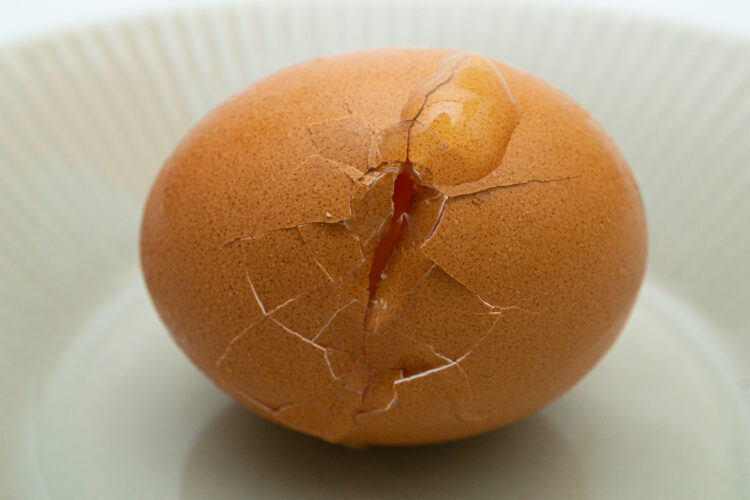
Are Cracked Eggs Safe to Consume?
According to food safety guidelines, cracked eggs present a notable risk of bacterial contamination, including Salmonella, and should be approached with caution. Once a shell is breached, environmental bacteria can easily penetrate the protective inner membrane.
Consumers can often identify compromised eggs by inspecting the shell for hairline fractures, localized wet spots, or sticky, dried residue. If you accidentally crack a fresh egg yourself during food preparation, it is generally safe to consume, provided it is cooked thoroughly immediately afterward.
However, if you discover an egg that was previously cracked in the refrigerator, or if the exact time of the fracture is unknown, it should be discarded. Any egg that exhibits an unusual odor, a discolored yolk, or watery, runny whites upon opening should never be consumed.
Finally, resist the temptation to wash eggs before storing them. Eggshells are naturally lined with a thin protective layer called the cuticle, which blocks microbes from entering the pores. Washing eggs with water strips away this barrier, leaving them highly vulnerable to infection. If an egg has dirt or debris on the surface, gently wipe it clean with a dry paper towel, and only wash it with water immediately prior to cooking.