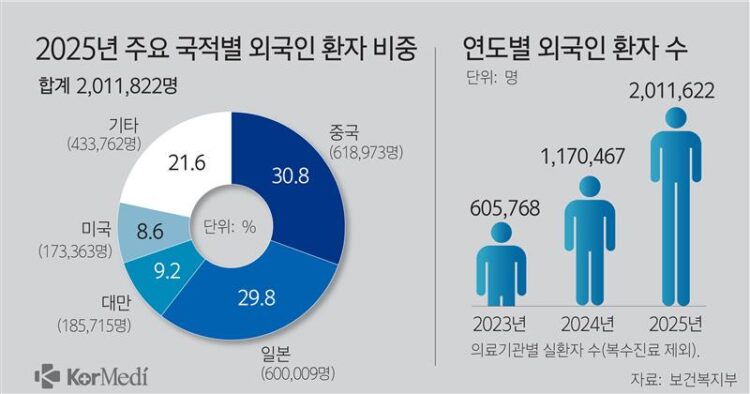
For the first time since records began in 2009, the number of international patients visiting South Korea has surpassed 2 million in a single year. After a significant downturn during the COVID-19 pandemic, the sector has seen a rapid recovery, with patient numbers doubling annually over the last three years to reach an all-time high.
The Ministry of Health and Welfare released these findings on April 24, detailing the 2025 statistical results for international patient attraction.
China and Japan Lead Global Influx
According to the report, a total of 2,011,822 international patients from 201 countries sought medical care in South Korea last year. China contributed the largest share at 30.8% (618,973 patients), followed closely by Japan at 29.8% (600,009). Taiwan, the United States, and Thailand rounded out the top five.
The growth from the Greater China region was particularly notable, with patient visits from China increasing by 137.5% and Taiwan by 122.5% year-over-year. Ministry officials attributed this surge to several converging factors: a high demand for non-surgical aesthetic services, China’s visa-free policy, expanded flight routes, and a broader recovery in regional tourism.
Dermatology Remains the Top Draw
By specialty, dermatology remained the primary driver of medical tourism, accounting for 1,313,000 patients, or 62.9% of the total. Other major departments included:
Plastic Surgery: 233,000 (11.2%)
General Internal Medicine: 192,000 (9.2%)
Health Screening Centers: 65,000 (3.1%)
Dermatology also recorded the highest annual growth rate among all specialties at 86.2%. In terms of healthcare facilities, clinic-level institutions saw the vast majority of visits at 87.7%, while general hospitals and tertiary general hospitals accounted for 3.6% and 3.0%, respectively. Geographically, Seoul remains the hub of the industry, attracting 87.2% of all international patients due to its concentrated medical and tourism infrastructure.
Economic Impact and Future Outlook
The economic contributions of the sector have reached significant levels. According to the Korea Institute for Industrial Economics & Trade, total medical tourism spending by these patients and their companions reached KRW 12.5 trillion. Direct medical spending accounted for KRW 3.3 trillion of that total, generating an estimated KRW 10.5 trillion in added value for the national economy.
Jung Eun-young, Director General of the Health Industry Policy Bureau, noted that South Korea has firmly established itself as an Asian leader in the field. “We will continue to pursue qualitative growth in the international patient sector and strengthen the global competitiveness of our healthcare industries,” Jung said.