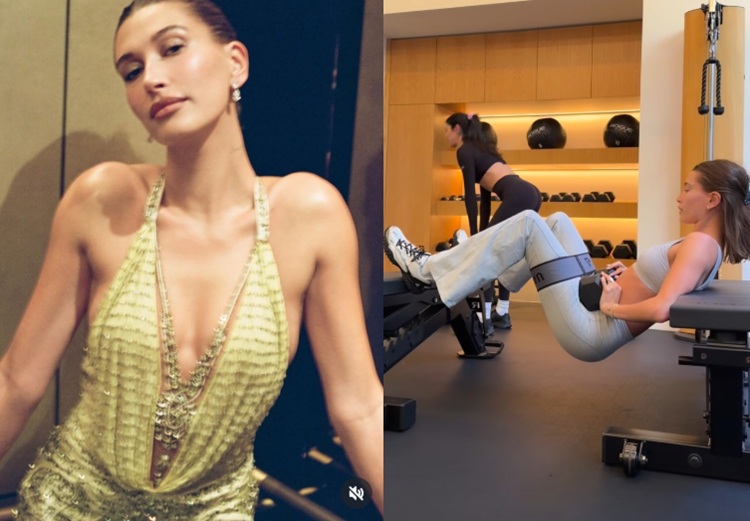
Hailey Bieber, the fashion model and wife of global pop icon Justin Bieber, recently gave her followers a glimpse into the rigorous training routine behind her toned physique. In a video shared on her social media, Bieber was seen performing a variation of the "dumbbell hip thrust," a powerhouse move for lower-body strength. "Thanks to my trainer, I got in a properly intense workout on Saturday," she noted in the caption.
Known for a slim frame defined by lean muscle tone, Bieber’s choice of exercise is a favorite among fitness professionals for its targeted impact. Here is a breakdown of the movement and why it is so effective for glute development.
The Dumbbell Hip Thrust and the Benefit of Thigh Bands
The dumbbell hip thrust is a specialized lower-body exercise designed to maximize glute activation. To perform it, the athlete leans their upper back against a bench, places a weighted dumbbell across the pelvis, and drives the hips upward.
In her version, Bieber incorporates a resistance band looped around her thighs. This addition forces the legs to resist inward pressure, effectively targeting the "outer glutes" (the gluteus medius and minimus) alongside the main gluteus maximus. To execute this correctly:
Set Up: Lean your upper back over the edge of a bench and place your feet on a stable surface in front of you with knees bent.
Position: Rest a dumbbell securely on your pelvis.
Drive: Brace your torso to keep your rib cage from flaring and press through your feet to drive your pelvis toward the ceiling.
Finish: At the top of the movement, your shoulders, hips, and knees should form a straight line. Lower the weight slowly to maintain muscle tension.
This exercise is key to building "upper glute" volume, which creates a firmer, more lifted appearance and improves the side-profile silhouette.
Avoiding Common Mistakes: Back Pain and Foot Placement
While highly effective, the hip thrust requires strict form to avoid injury. A common error is excessively arching the lower back to lift the weight. Doing so shifts the load away from the glutes and places dangerous pressure on the lumbar spine. To prevent this, you must keep your abdomen drawn in and your ribs "tucked" throughout the movement.
Foot placement is also critical. If the feet are placed too far away from the body, the hamstrings take over the majority of the work. Conversely, placing them too close can increase stress on the knee joints. Ideally, your shins should be nearly vertical at the top of the thrust to ensure the glutes are doing the heavy lifting.
Suggestions for Beginners
For those new to strength training, starting with a "glute bridge" is a safer alternative. This involves lying flat on the floor and lifting the hips without the added elevation of a bench. This allows beginners to focus on the mind-muscle connection and ensure they are actually engaging their glutes.
Individuals with chronic lower back pain, hip joint discomfort, or frequent hamstring cramps should approach the dumbbell hip thrust with caution. It is advisable to start with little to no weight and a lower intensity to build foundational strength before progressing to more advanced variations.