“I thought there was a separate species of jasmine tea tree!”
This is a common reaction when people learn that jasmine tea is actually green tea infused with the fragrance of jasmine petals. In reality, there is only one species of tea tree; the vast variety of teas we enjoy is determined by the manufacturing process. Jasmine tea is a "scented tea," a tradition that flourished in China across the Song, Ming, and Qing dynasties, eventually becoming a symbol of elegance among the Beijing literati and European salons alike.
The journey of jasmine tea is one of preservation. Because it is harder to maintain a tea’s delicate aroma the further it travels from its source, the art of "scenting" became a vital technology. But how exactly does a flower's ephemeral scent become part of a solid leaf?
How Fragrance Infuses the Leaf
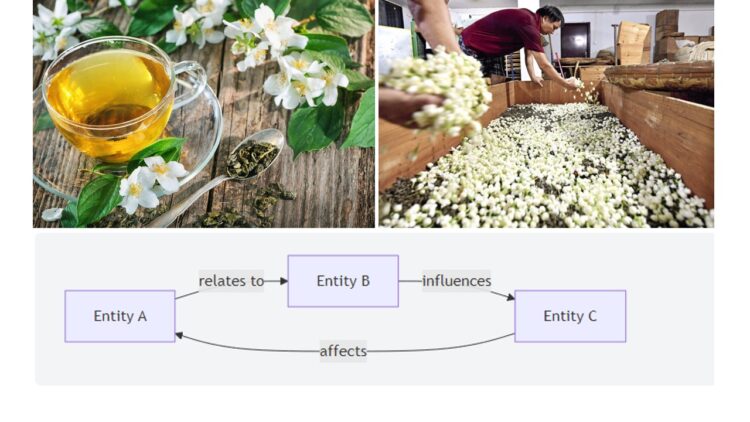
Jasmine flowers (Jasminum sambac) bloom at night, releasing their strongest scent after dusk. To capture this, buds are harvested in the late afternoon and layered with tea leaves for six to eight hours. In high-quality batches, this "scenting" process is repeated up to seven times.
The tea leaf is a porous structure composed of polyphenols, proteins, and sugars—an ideal vessel for fragrance. When volatile molecules from the blooming flowers diffuse into the air, they form weak hydrogen bonds with the surface of the tea leaves. This fragrance is only truly "unlocked" when warm water moistens the leaves, causing the cell walls to swell and push the stored molecules back to the surface.
The Critical Role of Temperature
Temperature is the catalyst that defines the tea. Unlike other varieties, jasmine green tea should be brewed at 60–70°C. At this specific temperature, catechins and caffeine are extracted gently, preventing excessive bitterness.
Coincidentally, this is also the ideal range for extracting the jasmine fragrance. While higher temperatures would cause fragrance molecules like benzyl acetate and linalool to volatilize too rapidly, the 60–70°C range allows them to emerge gradually. In a sense, jasmine tea only truly "exists" as jasmine tea within this specific thermal window.
Medicine: An Entity Defined by its Environment
Similarly, medicines possess different efficacies depending on their thermal environment. Most drugs are designed to activate at human body temperature, but they are incredibly sensitive to storage conditions.
Protein-based drugs, such as insulin, growth hormones, and certain vaccines, must be maintained between 2–8°C. If the temperature rises, their complex tertiary structures collapse, rendering them ineffective. mRNA vaccines are even more demanding, requiring ultra-cold storage at -70°C. In the cold, they are life-saving treatments; once overheated, they are merely inert masses of protein. Their ontological status—what they are—changes with the temperature.
Conversely, some drugs require heat to function. Inhalation anesthetics like sevoflurane are liquids at room temperature but must be heated in a vaporizer to become the gas that induces unconsciousness. Similarly, traditional herbal medicines often require boiling water to break down tough plant fibers and release active components like ginsenosides.
Existence Revealed through Conditions
We often assume that "efficacy" is an intrinsic, fixed property of a drug—that an antibiotic is always an antibiotic. However, modern philosophy invites us to look closer. If the fragrance of tea and the healing power of medicine are only revealed when specific conditions of temperature and environment are met, can we say those qualities are truly "fixed"?
This brings us to Relational Ontology, the perspective that individual entities do not exist in isolation but form their essence through interactions with their environment. A medicine relates to the refrigerator, the patient’s 37-degree body, or perhaps a feverish 40-degree system. In each scenario, the medicine becomes a different entity—sometimes effective, sometimes toxic, sometimes inert.
The identity of the medicine, much like the fragrance of the tea, is not found within the object itself. Instead, it is formed anew each time in relation to its surroundings. Happiness and healing are not merely the products of chemicals or aromas; they are the results of a perfectly met relationship between an object and its conditions.
Yoo Young-hyun, Director of Tick Clinic (Audio Column 1+1 Story: https://www.youtube.com/@yhyoo0906)