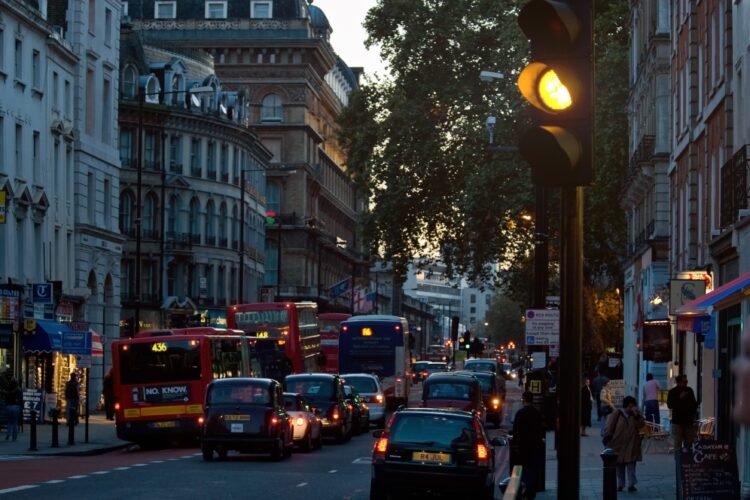
When a green light suddenly shifts to yellow, most drivers experience a momentary flash of indecision. This split-second hesitation—the choice between slamming on the brakes or accelerating to clear the intersection—is not merely a matter of personality. In traffic engineering, this high-pressure area is known as the "dilemma zone."
The Anatomy of Intersection Hesitation
The dilemma zone is a product of intersection design combined with human biology. No driver can respond to a signal change instantly; there is a mandatory delay between seeing a light and physical action.
According to the Federal Highway Administration (FHWA), the average driver’s perception-reaction time ranges from 0.75 to 1.5 seconds. When engineers design roads, they often use a safety standard of 2.5 seconds to account for the majority of the population. This cumulative delay is why a line of cars at a green light moves sequentially rather than simultaneously; as each driver’s reaction time adds up, the flow of traffic at an intersection can be delayed by several seconds.
The "3-Second Distance" Criterion
Traffic engineers often use a "3-second distance" as the benchmark for a safe response to a yellow light.
If you are more than three seconds away from the stop line when the light turns yellow, it is generally considered safe to come to a controlled stop. However, if you are already within that three-second window, attempting to brake suddenly can be more dangerous than maintaining your speed. In these cases, it is often safer to proceed through the intersection. If another vehicle is following closely behind, this decision must be made even more rapidly to avoid a rear-end collision.
The Psychology of "Red Means Stop"
Our reactions to traffic lights are a result of deep-seated conditioning. Research led by Takayuki Horinouchi at Hiroshima University, published in the 2022 journal Heliyon, confirms that our reaction times are heavily influenced by prior knowledge.
The study found that simply seeing a color does not inherently trigger a faster reaction. Instead, the behavioral inhibition—the "stop" response—is activated only when the brain engages the learned meaning of "red light equals stop." This suggests that our intersection behavior is a sophisticated cognitive response shaped by repeated learning rather than a purely instinctive reflex.
The Evolution of the Yellow Light
The three-color traffic signal was not always the standard. Early railway systems relied solely on red and green, but the lack of a transition period led to frequent accidents as trains could not stop in time. Yellow was introduced as a cautionary intermediate signal to solve this problem.
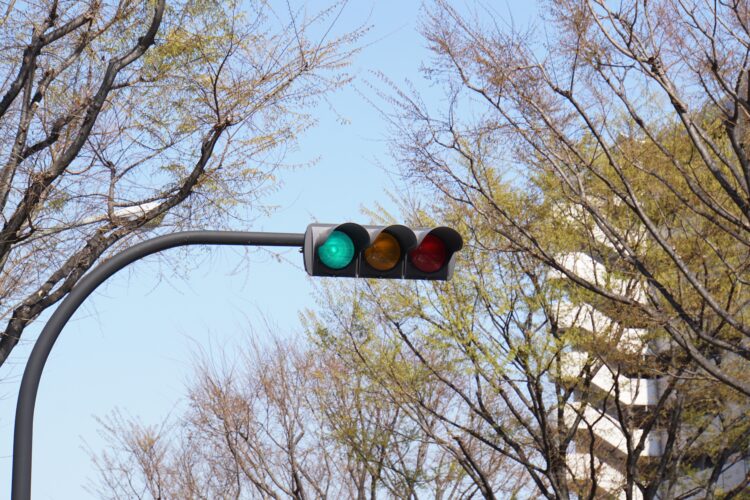
Red was chosen as the universal stop signal because it has the longest wavelength in the visible spectrum, allowing it to be seen from the greatest distance. Modern signals are further refined by position and brightness to ensure they are distinguishable even to drivers with color vision deficiencies.
[Traffic Safety Q&A]
Q: Does the yellow light duration actually feel shorter than it used to? A: It’s not an illusion. Yellow light timing is calculated based on the road’s speed limit and intersection size. If you are traveling faster than the limit, the perceived time to react decreases significantly, effectively widening the "dilemma zone."
Q: Why is it harder to judge signals on rainy days? A: On wet pavement, braking distances can increase by 1.5 to 2 times. A "3-second distance" that feels safe in dry conditions may be insufficient on a slick road, making it vital to reduce your entry speed during poor weather.
Q: If I hit the car in front because they stopped at a yellow light, who is at fault? A: Generally, the following vehicle is held responsible. Courts and insurance providers typically view the failure to maintain a safe following distance as the primary cause of such accidents, regardless of the lead car's decision to stop.
Q: Is it illegal to accelerate when the light turns yellow? A: A yellow light is a caution signal, not a stop signal. If you have already entered the intersection or cannot stop safely, you are permitted to pass. However, accelerating specifically to "beat the light" increases the risk of a high-speed collision and can be cited as a traffic violation depending on the jurisdiction.