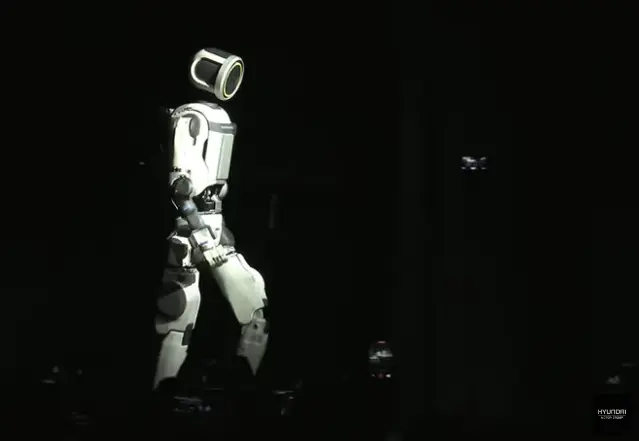
Hyundai Motor Group's humanoid Atlas is lying face down on the floor. Its calves are bent at a right angle to the floor. It moves its feet towards its back as if doing yoga. Oh my, it turns its feet 90 degrees, steps on the floor near its waist, and stands up immediately.
On the 5th (local time), Atlas was showcased at the Mandalay Bay Convention Center in Las Vegas, USA. Its appearance was almost identical to that of a human, but several parts were different. The range of motion in its joints was particularly eye-catching. Its hip joint could rotate 360 degrees. Unlike humans, it can stand upright without using its hands or bending its knees forward.
Although it is rarely mentioned, there is a feature of Atlas that caught my attention. It has no buttocks. There is an area corresponding to the pelvis that connects to the thigh, but there are no buttocks attached behind the pelvis. Unlike Atlas, humans have buttocks. Moreover, among other mammals and even primates, humans have the largest buttocks. The fact that humanoids, including Atlas, have evolved without buttocks has significant implications for existing theories explaining the evolution of human buttocks.
Existing Theory: “The Gluteus Maximus Acts as a Counterbalance When Walking and Running”
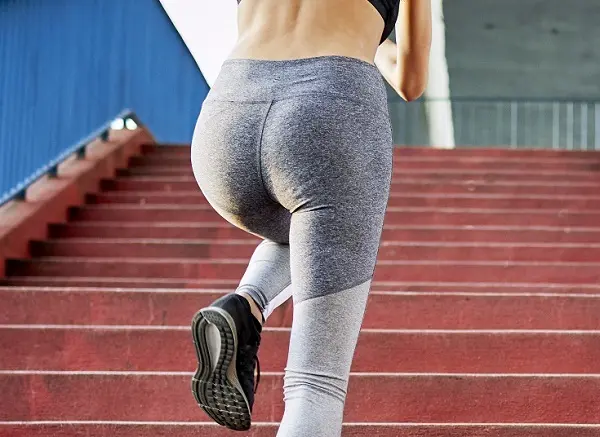
The human buttocks consist of a layer of subcutaneous fat and the gluteus maximus (the large gluteal muscle) beneath it. The gluteus maximus of other animals is not as large as that of humans. The same goes for primates. Gorillas have broad shoulders and thick upper bodies, but their buttocks are smaller compared to humans. Various theories have emerged regarding how and why the gluteal muscles grew larger as humanity evolved.
Professor Daniel Lieberman, an evolutionary biologist at Harvard University, believes that the buttocks played a role in keeping the first hominins from swaying side to side while walking. Hominins is a term that encompasses all species closer to modern humans than chimpanzees and other apes. In his book 《The Story of Our Bodies》, Professor Lieberman speculates about one of the hominin fossils, 'Orrorin', stating, "When walking, it could effectively stabilize the torso using its gluteal muscles and resist the forces that cause the body to sway side to side." He further explains, "These characteristics of the buttocks indicate that the first hominins did not sway side to side while walking."
Japanese anatomist Professor Tatsu Sakai of Juntendo University also states that the human buttocks function in aiding upright walking. However, Professor Sakai explains that rather than balancing side to side, "the gluteus maximus pulls the upper body, which tends to lean forward during upright walking, backward to keep the waist upright" in his book 《Anatomy Stories That Are Fun to Read All Night》. This explanation focuses more on structure than movement, as the gluteus maximus originates from the back of the pelvis and attaches to the upper part of the back of the femur, pulling the femur backward.
The Reason Bipedal Robots Walk Like Birds is Also 'Balance'
I speculated that the human gluteus maximus helps maintain front-to-back balance when walking or running. There have been several instances supporting this during the development of humanoids. Here are two cases that caught my eye.
First, humanoids that walk on two legs like humans and move their arms easily tend to lose front-to-back balance easily. They would often fall forward while reaching out one hand. At that time, the approach of attaching a balance weight like buttocks behind the humanoid's 'pelvis' was not attempted. The added weight would reduce battery efficiency, shortening operating time. This is still the case today.
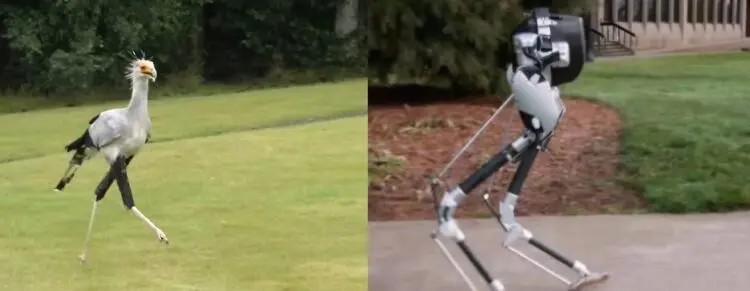
A more peculiar appearance in terms of balance was observed in later developed bipedal robots. These bipedal robots, which move without falling, walk like birds, albeit slowly. Humans bend their knees and extend their feet forward when walking. Early bipedal robots extended their feet first, with the part corresponding to the knee following from behind. I speculated that this movement was a compromise devised due to the constraint of not being able to attach a balance weight like buttocks to the robot.
If They Walk Well Without Buttocks…Is That Function 'Sexual Selection'?
Surprisingly, Atlas walks briskly even without buttocks. Previously, the Chinese humanoid Tiangong (天工) completed a half marathon, albeit not quickly. Tesla's Optimus walks better than its older brother Bumble C. However, Optimus has a narrower stride than Atlas. It seems that the balance issue has not been completely resolved yet. Instead, Optimus is more adept at delicate hand movements than humans.
Atlas has raised questions about existing theories explaining buttocks in human evolution. While buttocks may have contributed to balance, it has become unclear whether they were a decisive factor.
A hypothesis that could provide a greater explanatory power is sexual selection. The argument is that the firmer or more voluptuous the buttocks, the higher the probability of being chosen by the opposite sex. There have been studies attempting to interpret whether physical characteristics, including buttocks, are related to sexual selection. Brazil is the country that most strongly supports this hypothesis globally. In Brazil, surgeries to enhance buttocks are a thriving business.
Among the unique human body features, there are several areas that cannot be analyzed precisely. No other mammal has a jaw as long as humans. Among primates, humans have the largest noses. When looking at chimpanzees, their nostrils are visible from the front. There is even a joke that says, "The purpose of the nose is to support glasses." It remains unclear what evolutionary advantages human jaws and noses provided.
The mystery of human evolution seems to be adding buttocks to its list. After all, if every body part is explained for its unique purpose, that would be a humanoid. Buttocks also make us human. This is a reason to take a renewed interest in the gluteus maximus and maintain or develop it.