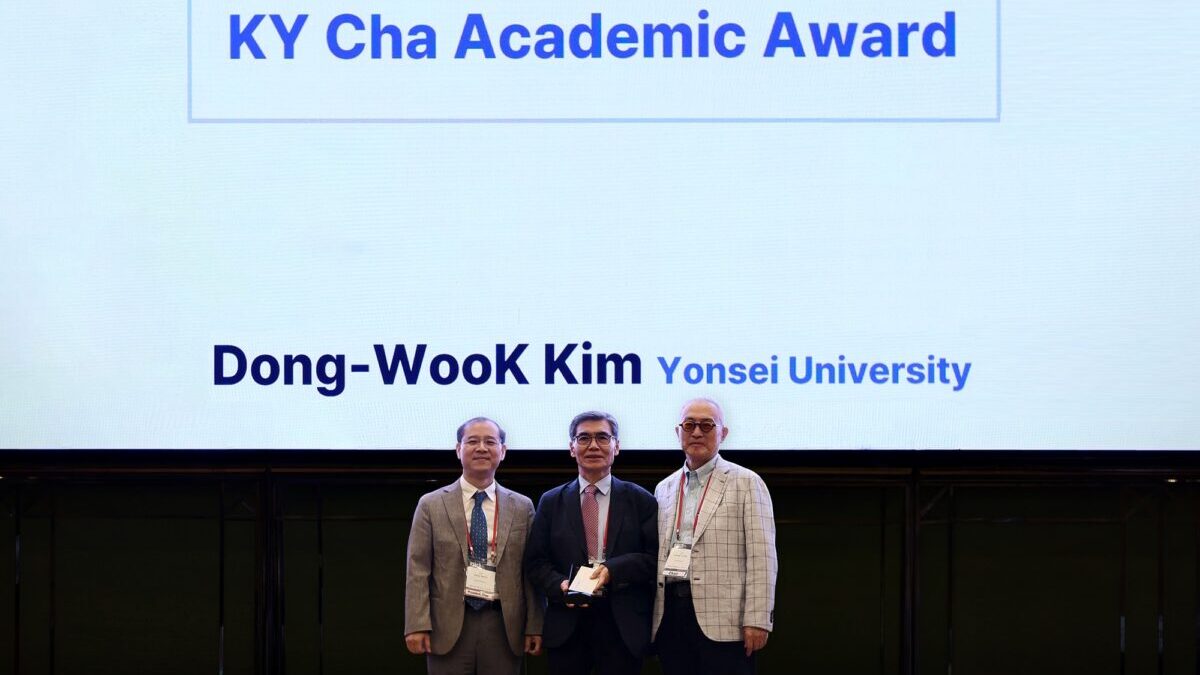
Professor Kim Dong-wook of Yonsei University College of Medicine, a pioneer in human embryonic stem cell-based therapies for Parkinson’s disease, has been awarded the prestigious KY Cha Academic Award by the Korean Society for Stem Cell Research.
The society presented the award to Kim at its 2026 Annual Meeting, held Aug. 20–21 at the Swiss Grand Hotel in Seoul. Following the presentation, Kim delivered an award lecture titled “From Stem Cells to Medicine: A Journey from Disease Modeling to Clinical Translation.”
The KY Cha Academic Award was established to recognize and support distinguished researchers who have achieved outstanding results in stem cell biology and regenerative medicine.
Tackling Parkinson’s Disease with Embryonic Stem Cells
Kim has devoted his career to investigating intractable diseases using human embryonic stem cells (hESCs) and induced pluripotent stem cells (iPSCs), expanding his research into gene editing and advanced cell therapies.
Embryonic stem cells possess pluripotency—the ability to differentiate into virtually any cell type in the human body. Induced pluripotent stem cells are engineered by reprogramming adult somatic cells, such as skin or blood cells, back into an embryonic-like state capable of developing into various tissue types.
Kim’s signature achievement lies in developing a cell replacement therapy for Parkinson’s disease—a progressive neurodegenerative disorder characterized by the gradual loss of dopamine-producing neurons, which leads to motor symptoms such as tremors, rigidity, and slowed movement.
Kim’s research team developed a technique to differentiate human embryonic stem cells into dopamine progenitor cells—precursor cells on the cusp of maturing into functional dopamine neurons—and transplant them directly into patients' brains.
According to Yonsei University, this breakthrough marked Asia’s first and the world’s second embryonic stem cell-derived Parkinson’s cell therapy to enter human clinical trials.
Early Clinical Trials Demonstrate Safety and Therapeutic Potential
The team's clinical findings were published last year in the scientific journal Cell.
The Phase 1/2a trial evaluated 12 patients with moderate-to-severe Parkinson’s disease, split into low-dose and high-dose cohorts. Researchers transplanted embryonic stem cell-derived dopamine progenitor cells into the bilateral putamen of six patients per group and monitored their progress for 12 months. Over the one-year follow-up, no dose-limiting toxicity or cell-related adverse events were observed.
Motor function assessments conducted while patients were off anti-Parkinsonian medication showed measurable improvements, with the high-dose group exhibiting greater therapeutic gains. Positron emission tomography (PET) scans targeting dopamine transporters further confirmed that the transplanted cells had successfully survived and engrafted in the brain.
However, researchers noted that these early results do not constitute definitive proof of clinical efficacy. Designed primarily to evaluate safety in a small, 12-patient cohort without a control group, the Phase 1/2a trial represents an initial stepping stone. Further follow-up trials involving larger patient cohorts are needed to establish definitive efficacy and safety profiles.
In addition to his Parkinson's research, Kim has utilized patient-derived iPSCs to elucidate the mechanisms of rare, intractable disorders and develop gene-correction technologies.
Recognizing Decades of Translational Stem Cell Research
The KY Cha Academic Award was established in 2025 in honor of Dr. Cha Kwang-ryul, director of the Global Comprehensive Research Institute at CHA Hospital and CHA Bio Group, recognizing his contributions to stem cell research and medical talent development.
Professor Cha Hyuk-jin of the Seoul National University College of Pharmacy received the inaugural award in 2025. Professor Kim Dong-wook becomes its second laureate this year.
This year’s annual meeting of the Korean Society for Stem Cell Research showcased cutting-edge breakthroughs across pluripotent stem cell biology, tissue regeneration, organoid modeling, and cell therapy.
Awards honoring Dr. Cha Kwang-ryul are also administered by international academic organizations, including the American Society for Reproductive Medicine (ASRM)’s KY Cha Stem Cell Award, as well as awards conferred by the Asian Society for Cell Therapy and the Korean Society for Reproductive Medicine.
The award highlights Kim's distinguished track record in bridging basic stem cell research with clinical applications in real-world patients.