A woman in her 60s living on the remote island of Baengnyeongdo is making a full recovery after a sudden, life-threatening aortic tear was nearly dismissed as simple indigestion. Thanks to a swift diagnosis and a midnight airlift across land and sea, she underwent life-saving emergency surgery at Gachon University Gil Medical Center.
Gachon University Gil Medical Center announced on June 30 that its medical team successfully coordinated with Baengnyeong Hospital and the Incheon Fire Service to transport and operate on the patient, who was suffering from an acute aortic dissection.
The patient, a 67-year-old resident identified as Oh, experienced sudden, excruciating chest pain and shortness of breath during a dinner with acquaintances on the evening of June 7. While she initially thought the discomfort was just indigestion, the relentless pain eventually drove her to seek help at Baengnyeong Hospital.
Recognizing the severity of her symptoms, the hospital staff immediately performed a computed tomography (CT) scan and diagnosed Oh with an acute aortic dissection. This condition occurs when the inner layer of the aorta—the body's largest blood vessel—tears, causing the vessel walls to split. It is a critical, race-against-the-clock emergency where the risk of mortality increases exponentially with every hour treatment is delayed.
With the patient in critical condition, Baengnyeong Hospital requested an emergency fire helicopter. Following a high-stakes transport involving both sea and land, Oh arrived at Gachon University Gil Medical Center at approximately 12:10 a.m. on June 8.
By the time she reached the mainland, the dissection had spread dangerously beyond the aorta, reaching the blood vessels leading to her brain and extending down to her abdominal aorta. Clinicians also discovered aortic valve regurgitation and bleeding into the pericardium—the sac surrounding the heart—putting her at immediate risk of stroke, irreversible brain damage, or fatal cardiac failure.
Upon her arrival, an emergency medicine team led by Professor Chu Seung-hwa immediately alerted Professor Park Cheol-hyeon of the Department of Cardiovascular and Thoracic Surgery. Professor Park Cheol-hyeon and the surgical team, which included Professor Lee Ji-yeon of the Department of Anesthesiology and Pain Medicine, mobilized instantly to perform an emergency aortic graft replacement, replacing the torn section of the aorta with a synthetic blood vessel.
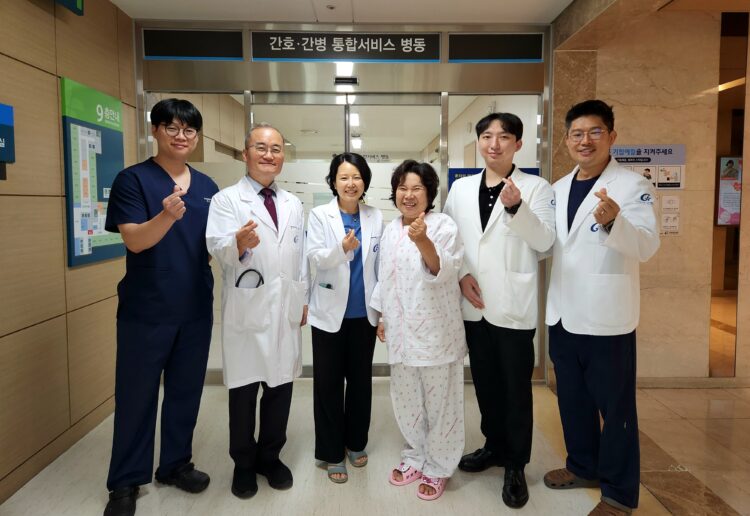
Despite the grueling, early Saturday morning hours, the cross-departmental teams integrated seamlessly to complete the complex operation. Oh went on to make a smooth recovery and was officially discharged on June 22.
"At first, I truly thought it was just bad indigestion, but it turned into a life-or-death crisis requiring a midnight flight to the mainland," Oh said. "I am deeply grateful to Baengnyeong Hospital for the precise diagnosis, the firefighters who flew me so quickly, and the medical staff at Gachon University Gil Medical Center who worked through the night to save my life."
Professor Park Cheol-hyeon emphasized the critical nature of time in such cases. "An aortic dissection is a textbook medical emergency where survival is entirely dictated by the clock," Professor Park Cheol-hyeon said. "This successful outcome demonstrates the strength of our emergency care network—from Baengnyeong Hospital’s rapid diagnosis and transfer decision to the Incheon Fire Service's helicopter transport and our hospital's immediate surgical intervention."
Professor Park Cheol-hyeon added that because Oh's condition involved cerebral vessel dissection, valve regurgitation, and internal bleeding, even a minor delay could have proven fatal.
Medical experts are pointing to this case as a model for how severe-emergency healthcare infrastructure should operate for remote island populations. The life-saving chain relies heavily on local island clinics recognizing early warning signs and coordinating fluidly with major mainland trauma centers.
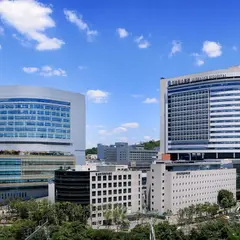
As the primary designated regional medical center for Incheon, Gachon University Gil Medical Center has been actively partnering with island medical facilities to close geographical healthcare gaps. Under a 2026 public health initiative, the hospital is expanding its clinical cooperation and emergency transport frameworks. Hospital officials previously visited Baengnyeong Hospital on May 13 to solidify these emergency response protocols with local staff.
Additionally, Gachon University Gil Medical Center operates the "Doctor Helicopter"—South Korea’s first dedicated public-private medical air ambulance—and manages a real-time telemedicine consultation system with Baengnyeong Hospital, allowing mainland specialists to guide island doctors through critical care scenarios.
"We are continuously refining our emergency transport and clinical networks so that geographical isolation never costs a patient their life," said Director Kim Woo-kyung of Gachon University Gil Medical Center. "Moving forward, we will also coordinate with local health and welfare agencies on the island to monitor her continued rehabilitation."
Health professionals remind the public that sudden, crushing pain in the chest or back should never be ignored. While some chest pain can stem from benign causes like muscle strain, it can also signal catastrophic cardiovascular events like an aortic dissection or a myocardial infarction (heart attack). If severe pain strikes suddenly, especially when accompanied by shortness of breath, cold sweats, or dizziness, individuals should bypass local clinics and call 119 immediately.